
Dr Azmain Muhtasim Mir
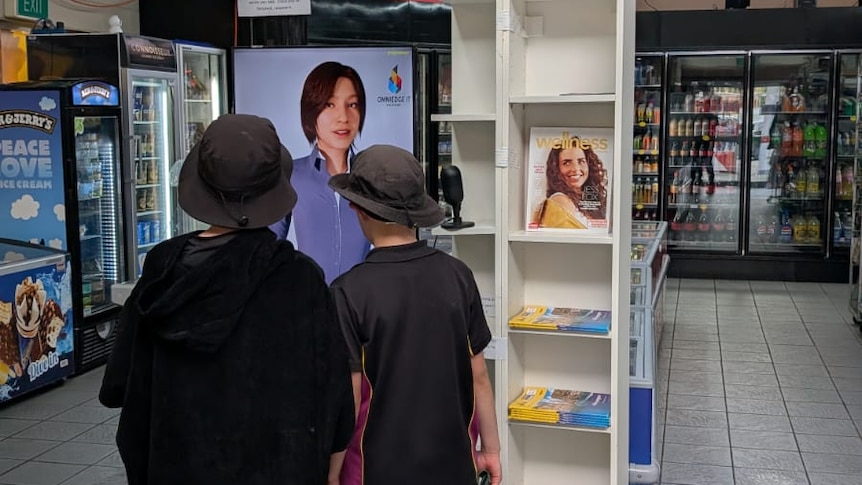
She is learning every day. Every day from every interaction. So, this is a very interactive and communicative model we are using, and it is also going to be multilingual.
Ryk Goddard
So, we’re at the store, and she’s there, and Mustaneer, there’s, I mean, the store’s got takeaway, you do food service there, there’s a bunch of stuff for sale.
Dr Mustaneer Rahman
You have a grocery salesman. Yeah.
Ryk Goddard
So, what’s gone wrong so far? How’s she going with people’s orders?
Dr Mustaneer Rahman
Actually let me tell you the background first. So, during the last winter, it was very difficult for me as a business owner to, because we need at least two employees at a time. But during the winter, it’s very less sales, so it’s very difficult to keep two employees at a time. It’s not possible for me. So, what I experienced, then I realised, okay, if I have a receptionist there, like Matilda, and the other people can work in the kitchen. So, that actually gives them the idea, okay, for the next winter, before the next winter, if we could have something that can take order, and that can print also the order in the kitchen, and then the person who is working in the kitchen, they can easily deliver the things. So, this is what happened. So, it’s also welcoming. So, whenever there is a tourist guide, whenever there is a tourist nearby, they can go and ask where is the bathroom, where I can travel in Tasmania. It knows everything, the Matilda. The most interesting part is she is learning. Yesterday, another one of the elderly lady came, and she told me, okay, Matilda, this is my order, remember this one. And today morning, she came again, and she just ordered it. This is my name, and I’m not telling her name, so this is my name. And can you please place the order? She can remember. She can remember, hi, this is the order for you.
Ryk Goddard
And that’s such an important part of the corner shop, isn’t it? That you feel known, and you feel part of that community. I mean, Azmain, you’re an anthropologist in terms of your PhD, so part of your interest is in community and culture.
Dr Azmain Muhtasim Mir
Yeah. So, it’s all about connecting with the community. So, in many cases, we see that the technological advances excludes community. So, digital technology is not about excluding, but we feel like that it should be inclusive. It means that community people are part of this, and that should be a kind of approach which requires low literacy. So, this is a very interesting model. As you see that older people, you know, young people and children are coming to the shop and places. They’re coming and interacting. They’re enjoying this conversation. It’s easier for them to develop this connection. And obviously, it is omnipresent that in the future, this will happen in many cases. And that’s why people are taking this learning in the Tasmanian context. So, this is a Tasmanian model. It’s, you know, the nuances, the cultural nuances are present here. We are kind of like approaching in a way that respects the culture and values here. So, that’s why this is more like Tasmanian, we’re calling it, Tassie style.
Dr Mustaneer Rahman
She’s also a data analyst, Matilda, in the admin room. So, whenever, because it’s connected with our POS systems. So, let’s say we can ask a worker.
Ryk Goddard
So, she can see what you’re selling, what’s selling well, what’s not. So, at the end of the day, you’re like, Matilda, help me with my business. What am I getting wrong? And she’s like, mate.
Dr Mustaneer Rahman
She’s also recommending what I need to purchase for the next summer, next month. It can also tell the trends, how the sale is going. So, this is another aspect, because for a small business, it’s not possible to employ an analyst. It’s not possible, completely impossible. So, I’m trying to work on a framework that a small business can afford with cost-effective technology. This is my aim for now.