
Financials stocks also advanced, with ANZ Bank adding 0.4 per cent, Westpac rising 1.3 per cent, National Australia Bank gaining 1 and investment bank Macquarie Group jumping 1.4 per cent. However, the Commonwealth Bank lost 0.7 per cent.
Westpac held its annual meeting, at which director Peter Nash survived a protest vote of 39.8 per cent against his re-election. A shareholder resolution over the bank’s approach to fossil fuel lending, which had been backed by some major overseas funds, only attracted 13.8 per cent of proxy votes.
Myer shares rallied 9.8 per cent after the department store announced billionaire retailer Solomon Lew would join its board in April. In a trading update, it also reported a “very encouraging start” to the financial year as sales in the first 19 weeks of the financial year were up by 3 per cent, boosted by record Black Friday sales.
Energy stocks bounced back from recent losses as oil prices rose, with Woodside Energy (up 0.2 per cent) and refiner Ampol (up 1.7 per cent) both closing in the green. Santos was unchanged.
In the insurance sector, the consumer regulator said it would oppose IAG’s plan to buy RAC Insurance from the Royal Automotive Club of Western Australia, the biggest home and car insurer in the state. IAG shares closed 1.2 per cent weaker.
But it was the tech sector that got the biggest bruising in the afternoon, after shares of US tech giant Oracle – whose fate is deeply tied to the artificial intelligence boom – plunged more than 10 per cent in extended trading after second-quarter cloud sales fell short of analysts’ estimates.
Local software makers WiseTech Global, Xero and Technology One fell 2.2 per cent, 1.3 per cent and 1.4 per cent, respectively, while AI data centre operator NextDC shed 0.4 per cent. Property giant Goodman Group, which owns data centres, slipped 0.3 per cent.
”While most of the focus was on the [Fed], a key risk for markets overnight was Oracle,” said Billy Leung, investment strategist at Global X Management. He said the result was a key test for the AI infrastructure trade, given Oracle’s role as a bellwether for hyperscale data centre spending.
Overnight, during Wednesday’s trading session in New York, the S&P 500 climbed 0.7 per cent and finished just shy of its all-time high, which was set in October. The Dow Jones jumped 497 points, or 1 per cent, and the Nasdaq composite rose 0.3 per cent.
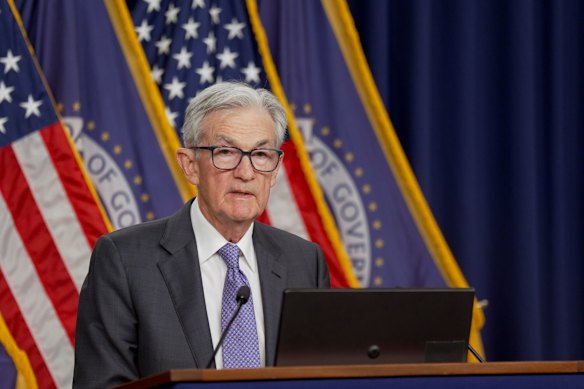
Jerome Powell’s press conference boosted markets.Credit: Bloomberg
Wall Street loves rate cuts because they can boost the economy and send prices for investments higher, even if they potentially make inflation worse.
The latest cut was widely expected, but some investors found encouragement from comments by Powell, which they said were less forceful about shutting down the possibility of future cuts than they had been anticipating.
Loading
Powell said again on Wednesday the central bank is in a difficult spot because the US job market is facing downward pressure when inflation is simultaneously facing upward pressure. By trying to fix one of those problems with interest rates, the Fed usually worsens the other in the short term.
Powell also said for the first time in this rate-cutting campaign that rates are back in a place where they’re pushing neither inflation nor the job market higher or lower. That gives the Fed time to hold and reassess what to do next as more data comes in on the job market and on inflation.
“We are well positioned to wait and see how the economy evolves,” Powell said.
With Bloomberg, AP, AAP
The Market Recap newsletter is a wrap of the day’s trading. Get it each weekday afternoon.