
“For that, it only achieved 70.6 per cent accuracy, which is somewhat high, but definitely not ready for clinical deployment.”
Michaela’s model also yielded a finding that was supported by recently emerging research.
“My AI model detected the gene transferrin [essential for moving iron through the body] as having quite a potentially significant impact when it comes to breast cancer development and gene dysregulation involved in breast cancer. I found all this secondary research that validated the results yielded by my model.
“I couldn’t believe it. I was like, ‘Oh my god, oh my god.’ I woke my Mum up!”
The project took nine months. “I call it my little baby,” Michaela said.
Michaela has a lifelong passion for STEM. When she was eight, she moved a boys’ periodic table T-shirt to the girls’ section of a clothing store because, as she said, “Why are we entrenching these gender biases?”
In primary school she joined a lunchtime coding club, organised by a female teacher.
“I kind of saw myself in her … It really inspired me,” she said.
In high school, she realised she could combine her software skills with her love of science, particularly biology. She was partly inspired by her father, who has had four different cancers over his life.
“I was just confused because we’ve got all this science and theory behind cancers … but why are we so stagnant with our treatment options?” she said.
Michaela’s father is doing well now, but he teases her about her focus on breast cancer.
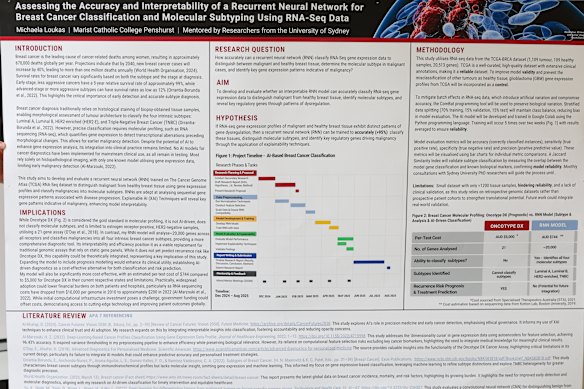
Michaela’s award-winning research project. Credit: Edwina Pickles
“My Dad says to me, Michaela, out of all the cancers I have had, of course you choose the one I don’t have.”
She shrugs. “It was the data set that was most easily accessible,” but she was also motivated after watching her friend’s mother wait months to find out what type of breast cancer she had, and what treatment would be best.
Loading
“By the time you actually receive the information as to whether or not radiation or chemo will be best for her, the cancer’s already progressed, and it’s so costly,” she said.
“Unless we can find a way to deliver these treatments in a way that can ensure equitable access globally, we are not going to see the advances in healthcare and in our human health as a society that we strive for.”
Michaela will find out her HSC results next week and hopes to study a bachelor of engineering in bioinformatics at UNSW.
Start the day with a summary of the day’s most important and interesting stories, analysis and insights. Sign up for our Morning Edition newsletter.