
The West Indies, who scored 167 in their first bat, made it to 457 for six in their second dig after being set 530 to win. Justin Greaves, 31, scored 202 in his 24th test innings. He’d scored only one previous test century (against Bangladesh). Heroic though he was, you can’t tell me that is an accurate portrayal of the strength of the two sides.
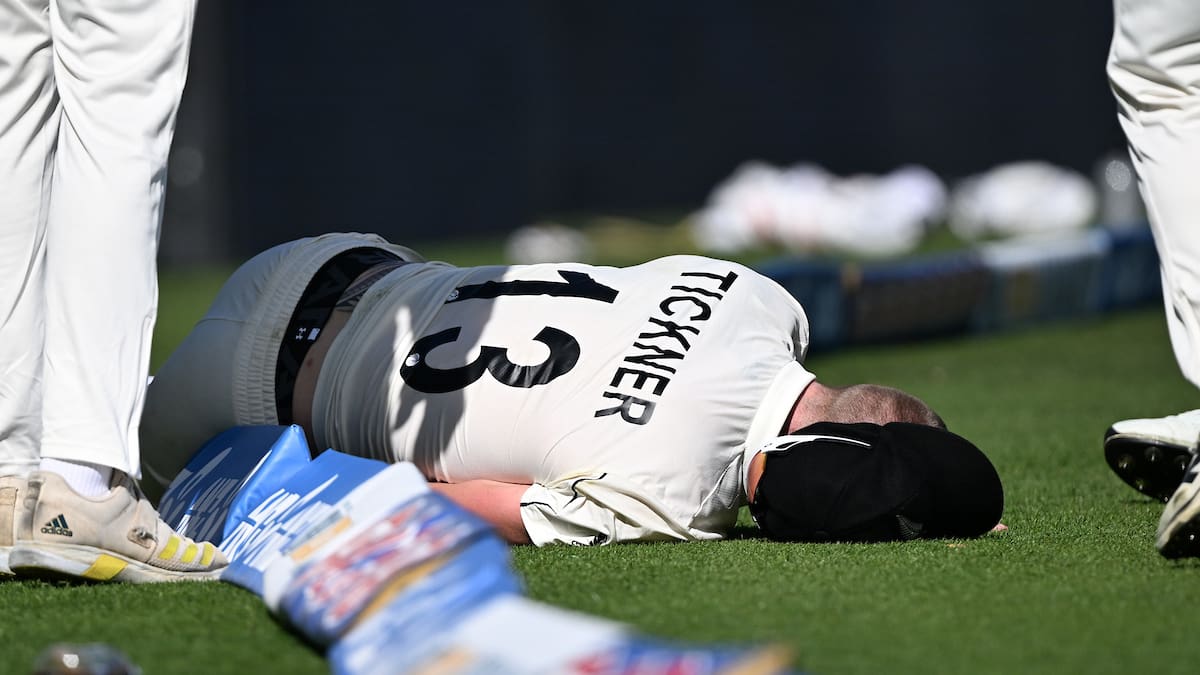
Then, in the second test, Blair Tickner’s headlong dive to save a boundary popped his shoulder in the West Indies’ first innings – and he exited on a stretcher, not to be seen again. The New Zealand attack looked exceedingly thin again – although, led by Jacob Duffy, they quickly had the West Indians six down cheaply before lunch in their second innings.
There are moves to allow substitutes in the game – but only at first-class domestic level. New Zealand Cricket decided not to join Australia, India and England in trialling subs in domestic cricket. Why? Cost – understandable as toting extra cricketers all over the country would stretch budgets already under assault.
The Black Caps lost bowler Matt Henry to injury in the first test against the West Indies in Christchurch. Photo / Photosport
Test cricket is the premier version of the game but is even worse off than rugby, where tests are often affected by a red card, which sucks all the life and interest out of the match in question. Rugby can at least replace injured players. Cricket can’t (except in the case of concussion), but is other genuine injury any less influential when it comes to keeping the entertainment alive?
It’s daft. Why not name 13 players, with one bowling sub and one batting sub for each test. Yes, there is the facility for teams to pull swifties, throwing Premier League-style “Hollywoods” everywhere, especially during the third and fourth innings of a match.
So what about this? Allow teams to replace players like-for-like (so they can bat, bowl and field) in the first innings of both teams if a player is injured then. A doctor must be in attendance and has the final word, meaning the ability of teams to sucker the system will be much reduced. Some players and commentators fear fakery so much that they don’t want to allow replacements if a player is injured during the second innings of a test.
Surely the game is capable of policing substitutes. The other extreme of this argument is that, if you permit replacements, allow them to be made for tactical reasons, too. Obviously, there would have to be limits. Cricket can’t do “Bomb Squads”, a la rugby, but it doesn’t take much imagination to see how tactical replacements could add to the drama and colour of a test.
What kind of player do you select for the bench? When do you introduce them to a match? Have you judged the conditions right (like pitch, humidity, proximity to the new ball) to play your substitute card or cards? Players coming off the bench commonly win games in football, rugby, basketball and league. Why not cricket?
Some of the game’s most courageous stands have been made by injured players, like the one everyone remembers – South Africa’s Graeme Smith, coming out to bat last man against Australia in 2009 with a broken left hand and a right elbow strain. He was hugely saluted for the courage of batting with one hand, in pain, and lasted 17 balls, scoring 3 runs, before Mitchell Johnson cleaned him out.
South Africa lost the test – and that’s rather the point. They had 103 runs to go, and potentially a fit Smith or a fit batting replacement could have made the difference. Why expose an already injured player to the menace of Johnson, and why stifle what could otherwise have been a close finish?
In one famous instance, though, the damaged player triumphed. West Indian great Malcolm Marshall broke his thumb fielding against England in Leeds in 1984, later batting with one hand with the other in a cast. He returned to the bowling crease, along with cast, and one of the greatest fast bowlers took seven for 53, including a caught and bowled, to win the test.
Yes, a singular achievement. However, the thing about singular achievements is that they are, well, singular. The great majority of injured players in such situations will end up on the losing side. Time to fix that by allowing replacements.
Paul Lewis writes about rugby, cricket, league, football, yachting, golf, the Olympics and Commonwealth Games.