
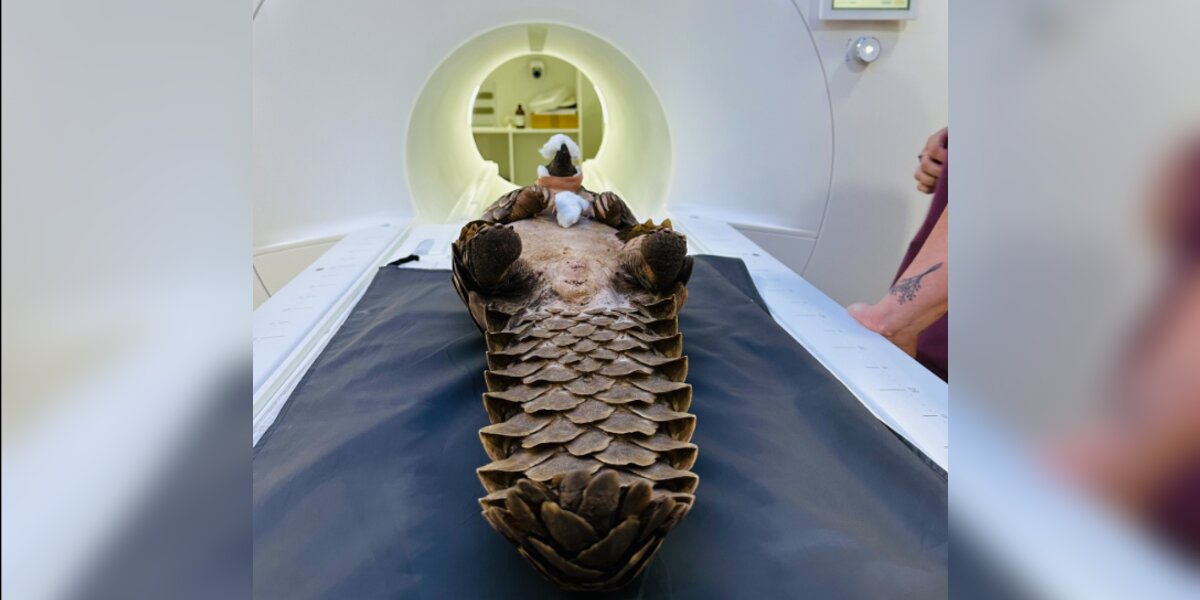
Emma De Jager and Dr. Debbie English held their breath as the MRI machine clicked around their patient. For almost an hour, they watched the machine produce images of the endangered animal’s organs, tissues and spine.
Finally, the ordeal ended. De Jager and Dr. English were overjoyed to see their patient, a pangolin named Heritage, wake up.
 Umoya Khulula Wildlife Centre
“We don’t like doing MRIs on pangolins,” De Jager, co-owner and director of Umoya Khulula Wildlife Centre, told The Dodo. “The anatomy does not allow us to intubate them for breathing. So, it is a risky test.”
In fact, this was the first MRI on a pangolin at ProVet Animal Hospital in Limpopo, South Africa, ever. But they’d had no other choice.
 Umoya Khulula Wildlife Centre
Heritage had recently been rescued from wildlife traffickers during an organized sting operation. Her captors, arrested for illegally poaching a pangolin, held Heritage without food or water for roughly two weeks before trying to deliver her to a buyer inside a flimsy bag.
 Umoya Khulula Wildlife Centre
The Umoya Khulula Wildlife Centre participated in the sting and took Heritage to the hospital, where Dr. English, a licensed veterinarian, examined her.
“She was emaciated and dehydrated and dragging her tail and limping badly,” De Jager said.
Dr. English ran a series of X-rays and a CT scan, but nothing explained Heritage’s limp. This is when the vet decided an MRI was their only option if they wanted to save the pangolin’s life.
 Umoya Khulula Wildlife Centre
The risk paid off: Scans revealed a rare infection in Heritage’s spine.
“We have never seen this before in a pangolin,” De Jager said. “We cannot be 100% sure of the reason it happened, but we can be sure that her poaching added to it.”
 Umoya Khulula Wildlife Centre
Since the case was so unusual, De Jager said treating Heritage became like “working in the dark.” But they refused to give up on this brave girl.
They moved Heritage from the hospital to Umoya Khulula Wildlife Centre, a less stressful environment, where she received antibiotics, pain relievers and steroids through an IV. She also needed oral medicine.
“We have worked with over [100] pangolins with all different personalities,” De Jager said. “Most are very scared, as you can imagine, and don’t allow you to treat them easily. But Heritage is a gentle soul.”
 Umoya Khulula Wildlife Centre
After two months of treatment, De Jager and Dr. English once again prepped Heritage for an MRI. She’d improved, but they had to scan for any sign of lingering infection.
“We have the best news ever!!!!” Umoya Khulula Wildlife Centre posted to Facebook on December 7. “After a very intensive treatment program for nearly 60 days, we finally have got the all clear and Heritage is free of her infection!”
“Seeing the infection was gone was the most amazing feeling,” De Jager said. With a clean bill of health, Heritage is set to be released by Christmas.
 Umoya Khulula Wildlife Centre
De Jager is in awe of the strength this traumatized animal showed during treatment.
“Pangolins are shy, solitary creatures and really do not do well in captivity,” she said. “The amount of trauma that she has gone through from humans, and the fact that she still allows me to help her, is incredible.”
Pangolins are the most trafficked mammals in the world. Poachers go after them for their scales, which are made of keratin and falsely said to have healing properties, or their meat, which is sold as a delicacy in some areas. The International Fund for Animal Welfare says there are eight unique pangolin species; all are at risk of extinction.
 Getty Images/Neil Aldridge
Despite this bleak outlook, De Jager is optimistic about Heritage’s future.
“She is a confident pangolin,” De Jager said. “We have found an amazing release site for her, which is close to where she originated from. We will be monitoring her carefully on release, making sure that she is adapting well and doing everything a pangolin should do.”
Umoya Khulula Wildlife Centre does not disclose the locations of their pangolin release sites or pangolin housing to ensure the safety of the animals. If you would like to support their work, you can donate through their website. Rescuers Rush To Revive Comatose Wild Animal Lying In A LandfillHe was overheating and running out of time 🥵