

Adobe has released new versions of Photoshop, Adobe Express and Adobe Acrobat that run directly inside ChatGPT, offering free access to the tools for the chatbot’s global user base.
The integration places three of Adobe’s best-known creative and document products inside one of the world’s most widely used conversational AI platforms. ChatGPT has more than 800 million weekly users, according to the announcement.
The move extends Adobe’s recent focus on conversational interfaces and AI assistants. It also widens the reach of its software to people who may not use the company’s standalone applications.
Users can access the tools by naming an app and giving a plain-language instruction in the chat. ChatGPT then loads the relevant Adobe experience and guides the user through the requested task.
People can edit images, create visual designs or work with PDFs inside the chat window. They do not need to open separate desktop or mobile applications.
Adobe said the apps are now available for ChatGPT users on desktop, web and iOS. Adobe Express for ChatGPT is also available on Android. Support for Photoshop and Acrobat on Android is planned.
“We’re thrilled to bring Photoshop, Adobe Express and Acrobat directly into ChatGPT, combining our creative innovations with the ease of ChatGPT to make creativity accessible for everyone,” said David Wadhwani, president, digital media, Adobe. “Now hundreds of millions of people can edit with Photoshop simply by using their own words, right inside a platform that’s already part of their day-to-day.”
Conversational editing
The new apps place familiar Adobe features inside a conversational workflow. Users can describe the edit they want and then refine the result through follow-up prompts.
They can also switch from text-based instructions to on-screen controls. The Photoshop experience inside ChatGPT includes interface elements such as sliders for brightness or contrast.
An example prompt for Photoshop is: “Adobe Photoshop, help me blur the background of this image.” The system then identifies the image, applies background blur and offers options for further changes.
Adobe said the approach allows step-by-step refinement. Users can ask for adjustments until the output matches their intent.
Photoshop in chat
Photoshop for ChatGPT focuses on core image editing functions. Users can alter specific regions of a picture, such as a background or a subject.
They can adjust brightness, contrast and exposure from within the chat. They can also apply effects such as Glitch and Glow.
Adobe stated that the image tools are designed to preserve visual quality while changes are applied. The chat-based interface sits on top of Adobe’s existing imaging technology.

Express for design
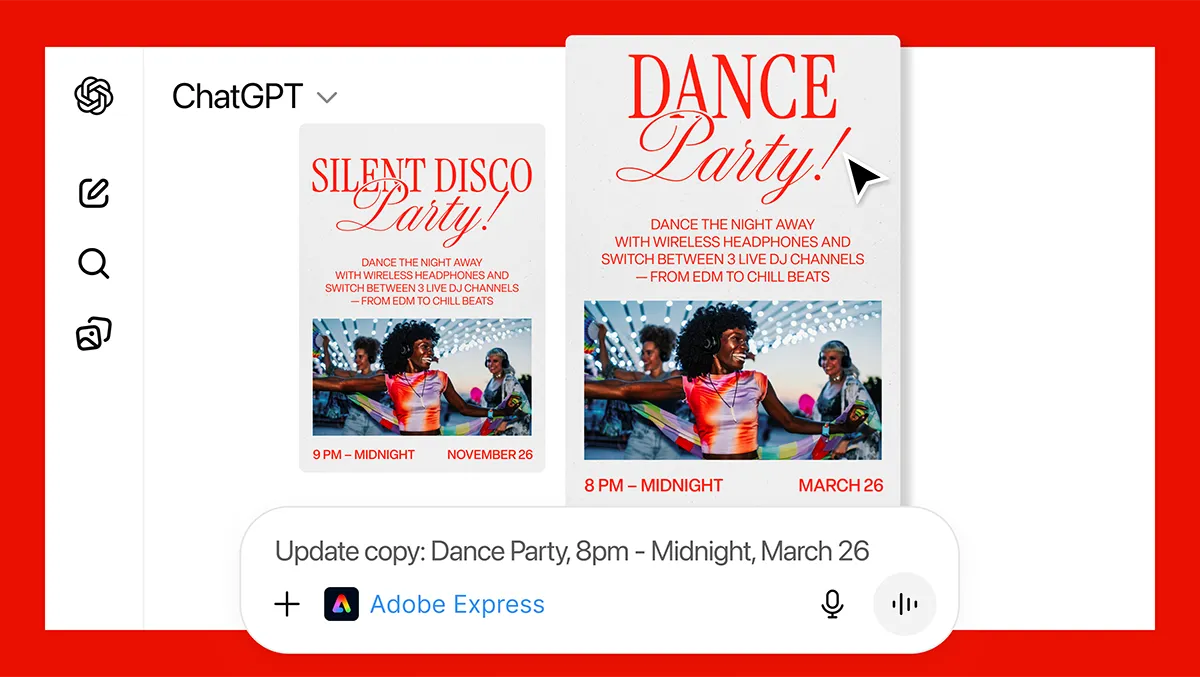
Adobe Express for ChatGPT brings template-driven design into the chatbot. Users can browse the Express library of layouts and graphics from within the conversation.
They can select a template for occasions such as events, social posts or marketing materials. They then fill in text, swap images and add simple animations.
All of these steps occur inside the ChatGPT environment. Users do not need to move between different design tools while they iterate on a piece of content.
Adobe said the Express integration targets people who want quick, branded or polished assets without spending time learning complex design software.
Acrobat for PDFs
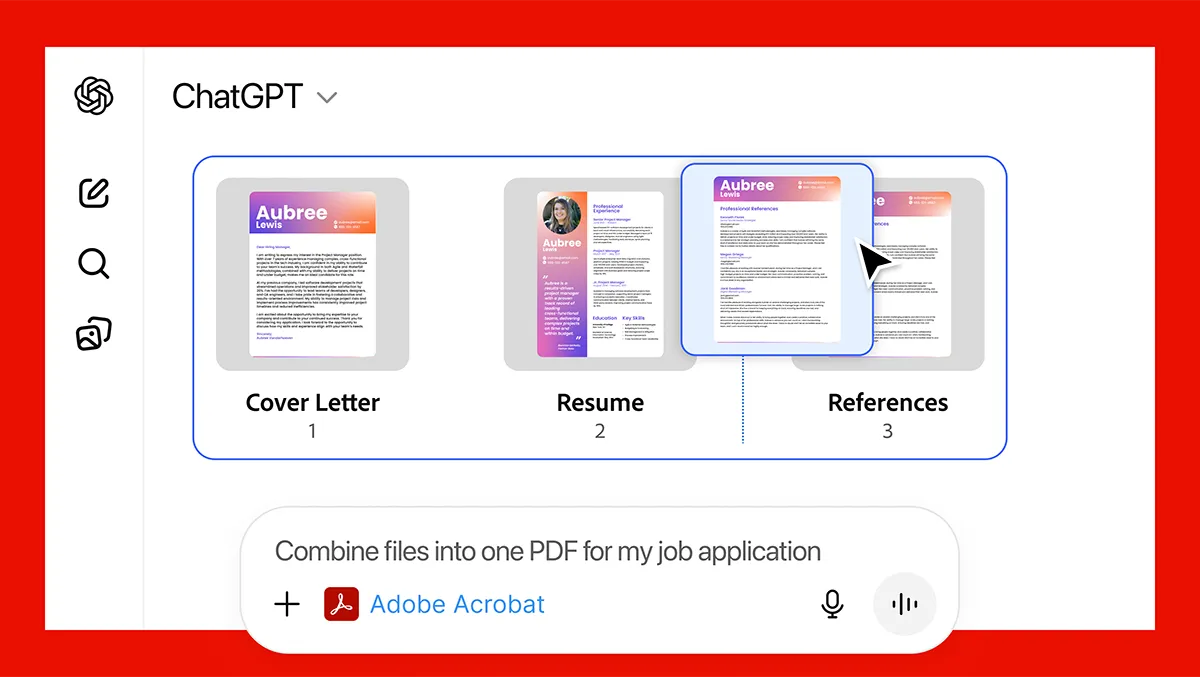
Acrobat for ChatGPT focuses on PDF management and text handling. Users can edit PDFs inside the chat, extract passages of text or pull out tables.
The app can merge several files, organise page order and compress large documents. It can also convert other file types into PDFs.
Adobe said the conversion process maintains layout and formatting. Acrobat for ChatGPT also includes tools for redacting sensitive details.
That means users can remove confidential information from documents before they share or export them.
AI and MCP context
The launch follows a series of AI-related updates across Adobe’s portfolio this year. Earlier, the company introduced Acrobat Studio, which creates interactive workspaces on top of static documents.
Acrobat Studio allows users to ask questions of their PDFs and generate new content from them. It uses conversational prompts and AI models to summarise and reformat information.
At its MAX conference, Adobe also unveiled AI Assistants in Photoshop and Adobe Express. These tools turn text instructions into creative outputs and then allow detailed manual edits using Adobe’s toolsets.
Adobe is also working on an AI Assistant for its Firefly generative service. The company said this assistant will support workflows that run across multiple Adobe apps and external environments.
The ChatGPT integrations use Adobe’s work on agentic AI and the Model Context Protocol, or MCP. This protocol manages how tools interact with AI models and user data across different systems.
Route into full apps
Adobe said the ChatGPT experiences form an entry point into its broader product range. People can start a project inside ChatGPT and then move into the full desktop or mobile apps when they need more detailed control.
The transition preserves the state of the work so users can continue editing without repeating earlier steps. This approach links low-friction, text-based creation with deeper professional workflows.
Photoshop, Adobe Express and Acrobat for ChatGPT are free for ChatGPT users around the world. They are available immediately across supported platforms.