
designboom’s top 10 private spaces of 2025
In 2025, architects around the world continue to expand the possibilities of domestic design, presenting a diverse collection of private houses that reconsider how we inhabit landscape, community, and climate. This year’s selection ranges from net-positive, off-grid experimentation in rural Japan to rammed-earth dwellings carved into the terrain of Crete, revealing a field increasingly attuned to resourcefulness, site specificity, and the choreography of indoor–outdoor living.
Shared themes emerge across these works — some occupying their natural context gently, others defined by a bold sculptural form. Florian Busch Architects pioneers an energy-generating modular residence amid agricultural fields in Hokkaido, while Wallmakers suspends a thatched, occupiable bridge over a gorge in India. Social frameworks also come to the fore, with TEN’s collaborative housing for women in Bosnia-Herzegovina proposing new models of care-based living. Explore designboom’s top 10 private houses of 2025 below!
Hidden within the dense greenery of Brazil’s Atlantic forest, the Iporanga House stands as architect Arthur Casas’s own retreat. Conceived as a place to ‘recharge his energies,’ the home sits lightly in a protected natural reserve along the São Paulo coast. Its design is guided by a desire for harmony with the surrounding vegetation, a goal demonstrated by wood cladding that blends with the forest’s shifting tones and textures.
The plan takes the form of two symmetrical cubes framing a lofty central volume. Inside, lofty ceilings rise 11 meters (36 feet), and continuous glass panels draw in light and views, creating a breezy and fluid connection to the trees beyond. ‘The shape is simple, symmetrical, easy,’ Casas notes. He contrasts the home’s subdued form with with the ‘entropic, messy profile’ of the forest that surrounds it.
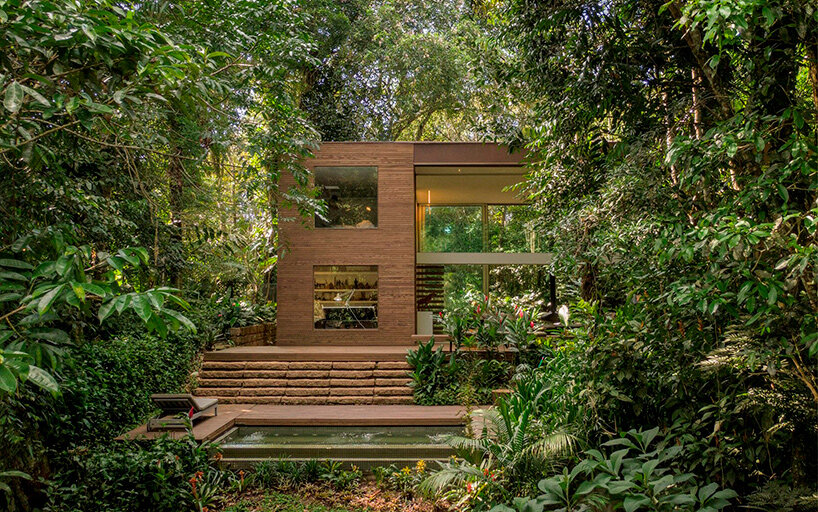
image © Fernando Guerra
Florian Busch Architects’ (FBA) newly completed House W in Nakafurano, Hokkaido, marks the firm’s first project that generates more energy than it consumes. Rather than achieving this carbon neutrality through compact design, the solution lies in breaking up the structure. The team’s goal was ambitious: to create a building entirely independent from the local power grid, achieving net-zero energy consumption.
In reality, House W surpasses this objective, producing nearly twice the energy it consumes over the course of a year. The family selected a site in the middle of active agricultural land, prioritizing functional farmland use over picturesque countryside aesthetics. The plot was previously home to a farmer’s barn, and the surrounding landscape consists of rice paddies, asparagus fields, irrigation channels, and roads. This setting offers an open, largely man-made natural environment.
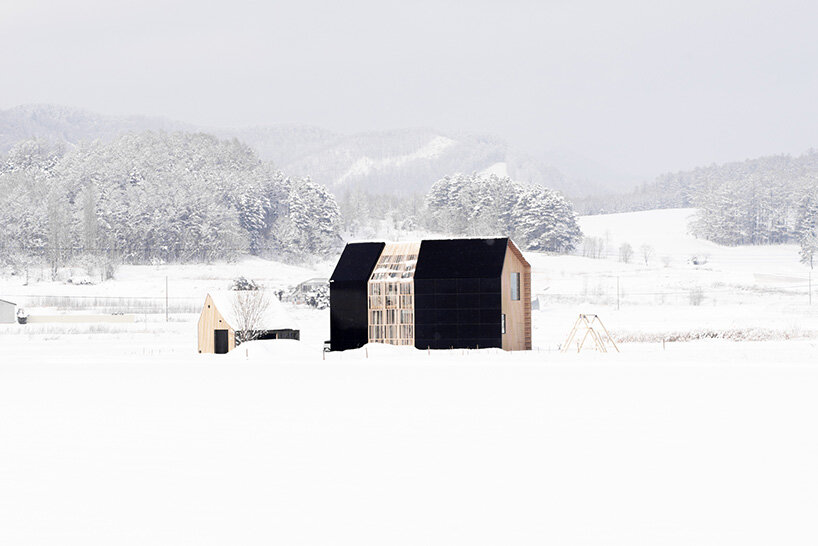
image © Florian Busch Architects
Set to be carved into the olive-dotted hills of Crete, Mykonos Architects designs a home titled N’Arrow to respond directly to the steep topography and slender dimensions of its site. The underground, rammed-earth project is designed to avoid imposition, and instead works with the natural contours of the land, inviting the surrounding environment to shape its form. Olive groves and rolling terrain are not backdrops but rooftops, and but co-authors in the architectural narrative, pushing the residential space toward harmony rather than dominance.
A fifteen-meter setback regulation, typically a limiting factor, sparked the defining concept behind N’Arrow. Mykonos Architects saw not a constraint but a creative opportunity, transforming the elongated form of the plot into a narrow, wedge-like structure that nestles into the hillside. This bold, linear geometry sets the tone for the home’s identity, drawing attention to the power of architectural adaptation when guided by site-specific conditions.
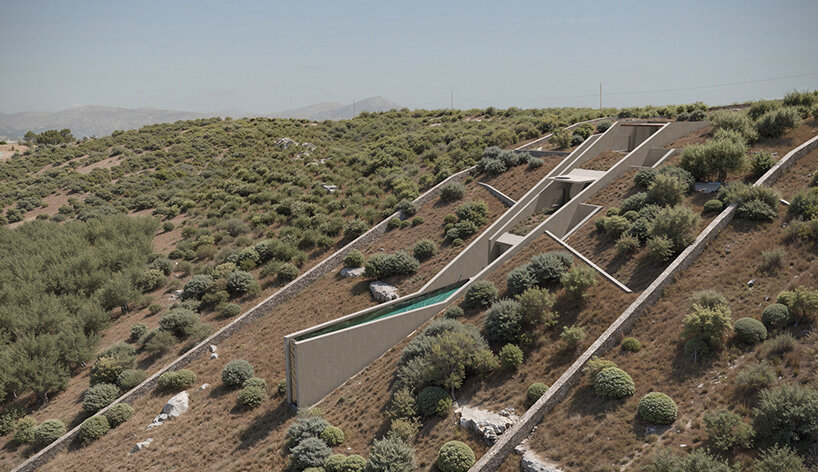
image © Marinkovic Marco
The Bridge House by Wallmakers, led by architect Vinu Daniel, stands in Karjat, India, where a natural gorge divides the land. A natural stream has carved a seven-meter-deep channel through the site, creating both a challenge and an opportunity. The two parcels of land required a connection, yet no foundations could be placed within the 100-foot width of the spillway. As a result, the dwelling is suspended across this divide as an occupiable bridge.
The structure’s form emerged from constraint. Designed as a 100-foot suspension bridge composed of four hyperbolic parabolas, it uses minimal steel pipes and tendons for tensile strength, while a thatch-mud composite provides compressive resistance. The dialogue between these materials lends a structure that is both taut and flexible.
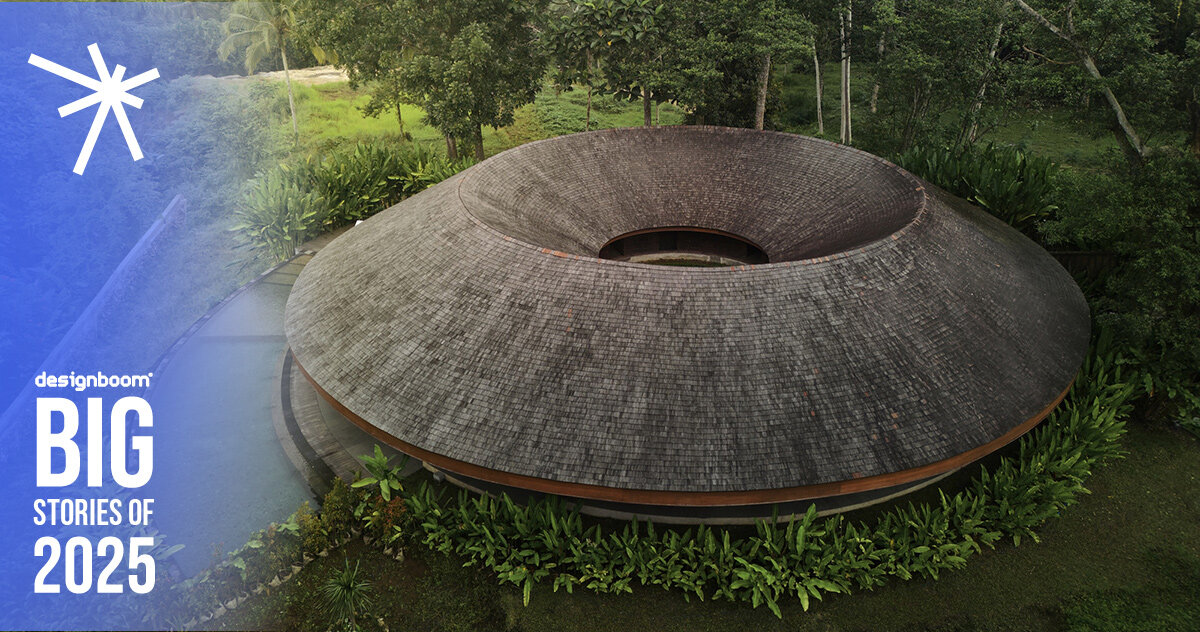
Villa Omah Prana by Alexis Dornier unfolds as a circular retreat that feels absorbed into the landscape of Payangan’s forested slopes, just north of Ubud, Bali. The 475-square-meter residence adopts a compound-like arrangement organized around a lush internal courtyard. Its low, continuous timber roofline and radial plan echo local vernacular geometries.
The project sits like a ring placed over the terrain, with the broad, funnel-like roof forming a shaded perimeter walkway and an introverted core. The shingle texture and earthy tonality of the roof make the building blend with its tropical context, while the inner void admits daylight and natural ventilation.
Fran Silvestre Arquitectos designs Villa 95 as part of the real estate developer Cork Oak Mansion project in Sotogrande, crafting a residence that appears to glide across the southern Spanish landscape. Defined by a continuous architectural gesture, the three-story villa unfurls along a sharp diagonal, its elongated form maximizing the buildable area of the 2,317 square meter plot while framing views of Altos de Valderrama area. Developed by DUS Desarrollos Inmobiliarios, the house is part of an exclusive collection of six high-end villas.