
healthcare space design by ZAHA HADID architects
A consortium led by Zaha Hadid Architects has been selected to design the new Malpensa Hospital in Lombardy, Italy. The project will unite the existing hospitals of Gallarate and Busto Arsizio into a single medical campus serving the area between Milan and Varese. Commissioned by the Lombardy Regional Health Authority, the project is conceived as a contemporary healthcare environment for a population approaching one million residents.
The winning team led by Zaha Hadid Architects with RINA, Studio Plicchi, WSP, STI Engineering, and BC Building Consulting brings together architectural design with engineering and healthcare planning. The proposal responds to the evolving demands of the Olona Valley, with an emphasis on adaptability, operational efficiency, and long-term public service.
visualizations © X Universe
navigating the malpensa hospital
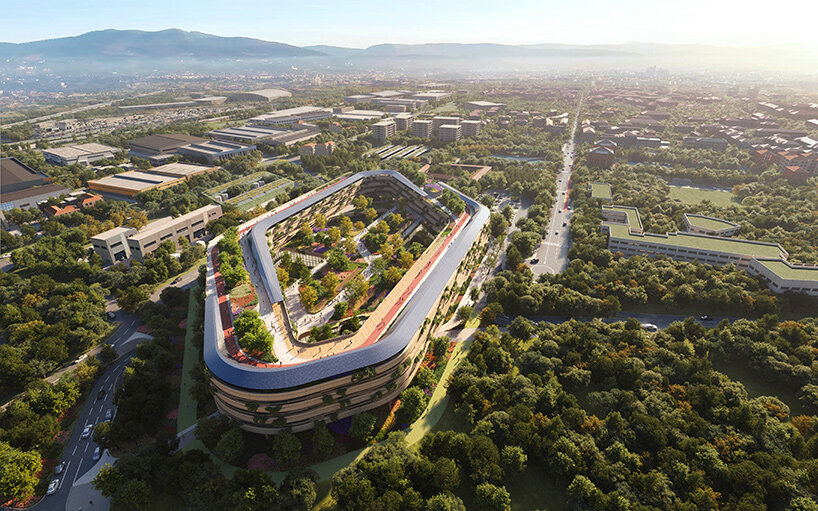
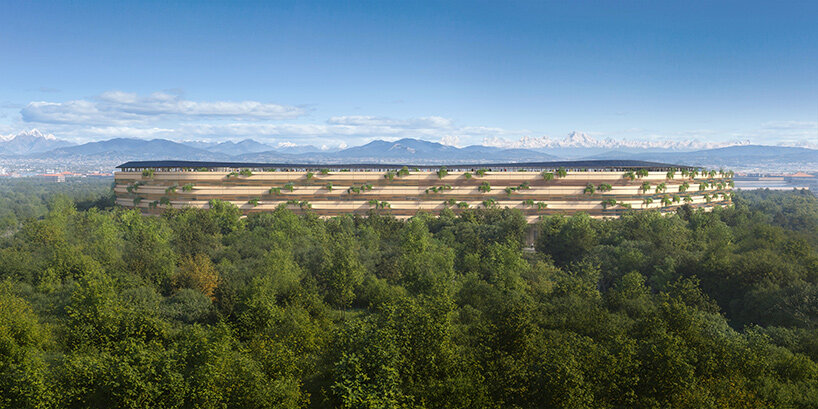
Malpensa Hospital is planned by Zaha Hadid Architects and its partners as a compact structure with five levels above ground and a single basement, encompassing around 90,000 square meters. Its organization follows a clear gradient of care intensity, which allows critical functions to operate with precision while maintaining legible movement for patients and staff. Clinical spaces are arranged to support change over time, with layouts capable of adjustment as medical practices and technologies advance.
Circulation plays a defining role in the project’s spatial logic. Distinct routes for visitors and healthcare professionals reduce overlap and support hygiene protocols, while dedicated logistical paths handle materials, goods, and waste. An automated delivery system further streamlines daily operations for a more efficient campus.
Zaha Hadid Architects will design the new Malpensa Hospital in Lombardy
sunlit timber interiors
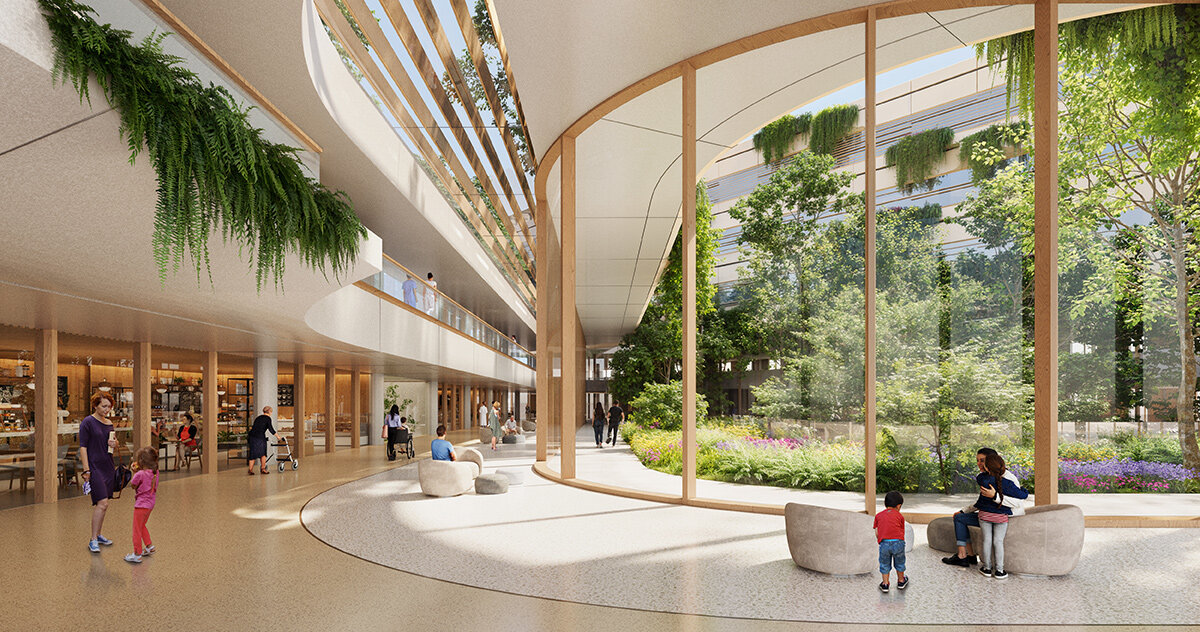
At ground level, a central internal street links the entrance plaza with landscaped outdoor areas, establishing a civic threshold between the hospital and its surrounding communities. This public axis supports wayfinding and introduces daylight deep into the plan, shaping an environment that feels open and measured rather than institutional.
Interior spaces prioritize comfort through proportion, light control, and acoustic consideration. Privacy is addressed through spatial sequencing and the placement of quieter zones for rest and recovery. Materials such as wood surfaces and textile elements contribute to a calm atmosphere suited to long hospital stays and demanding working conditions.
the new hospital is organized as a compact five story structure
a landscape of forests
The Malpensa Hospital site sits within a landscape of forests and agricultural land connected to the Regional Ecological Network and the Parco Regionale della Valle del Ticino. The design preserves existing woodland while introducing new wetlands and water-management features that support biodiversity and responsible stormwater use.
An important cultural dimension emerges through the integration of Cascina dei Poveri, a rural complex dating from the medieval period. Incorporated into the campus, this historic structure becomes a shared place for community activity, reinforcing continuity between the region’s past and its contemporary healthcare infrastructure.
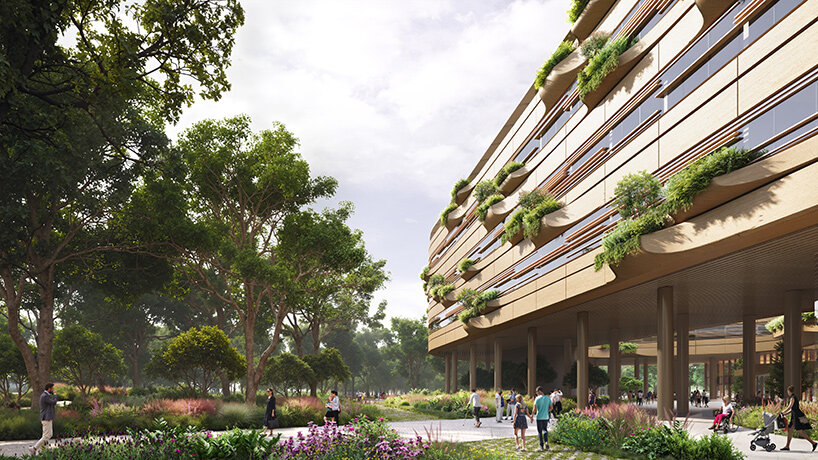
a central internal street connects the entrance plaza with landscaped public areas
a sustainable design, ready for the future
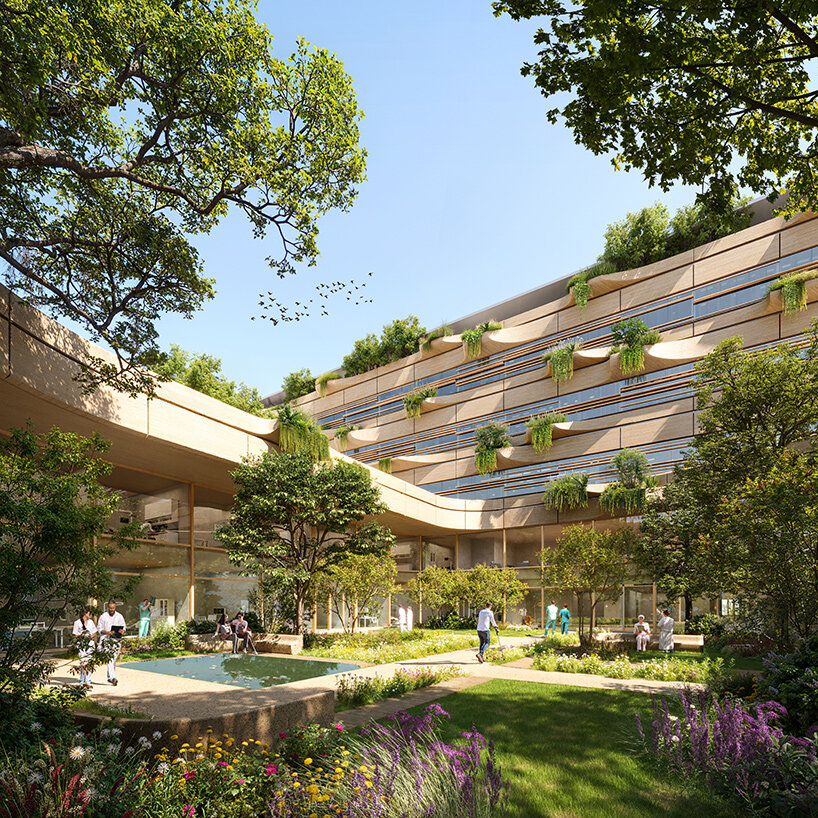
The building envelope comprises modular aluminum rainscreen panels with integrated planting and solar control, chosen for durability and reduced embodied carbon. Prefabricated construction methods shorten build time and limit material waste, while a high-performance facade lowers cooling demand and improves energy efficiency.
Renewable energy systems form a central part of the strategy, including a photovoltaic installation exceeding one megawatt and a hybrid heating system prepared for future hydrogen use. Digital building management tools and virtual modeling support predictive maintenance and long-term performance optimization, positioning Malpensa Hospital as a flexible and climate-responsive medical campus designed for decades of use.
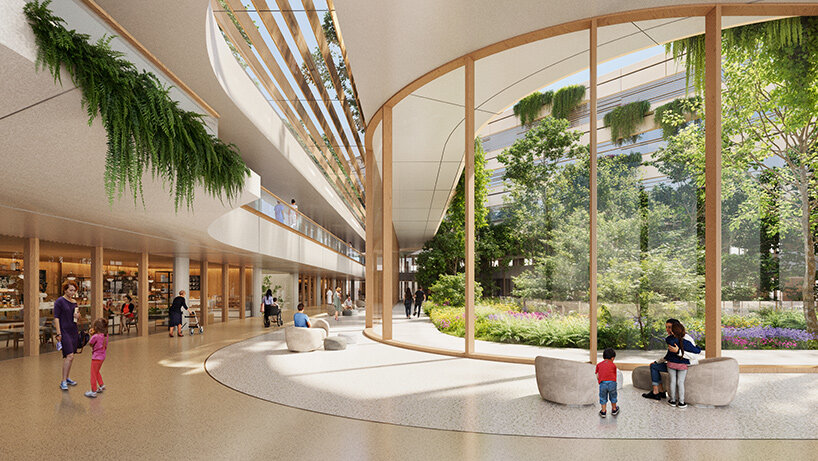
interiors emphasize daylight, acoustic comfort, and material warmth