
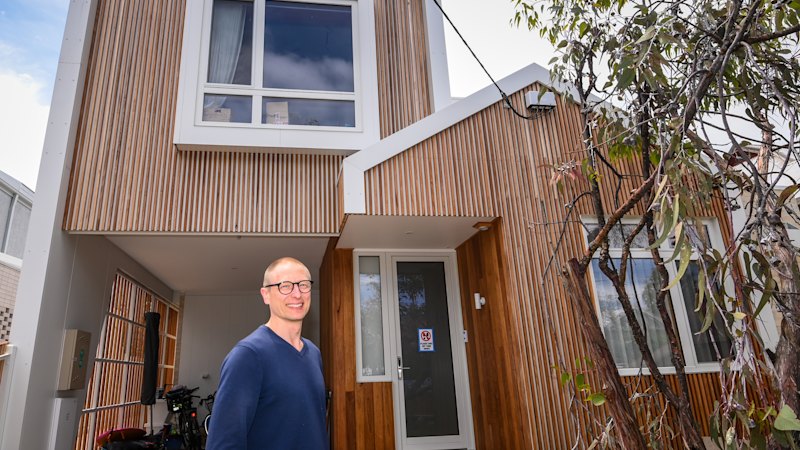
Most of the house was built off-site in a factory, avoiding weather delays, typical for prefab homes which then have modules or components assembled on site.
“Because prefab homes are done in a factory, they have to be really precise. Everything is exact and square. The quality has been awesome,” Schrever said.
Prefab appealed not only for speed, but also sustainability. Schrever said his wife, who is French, was “astounded by the Australian housing stock and how poor it is”.
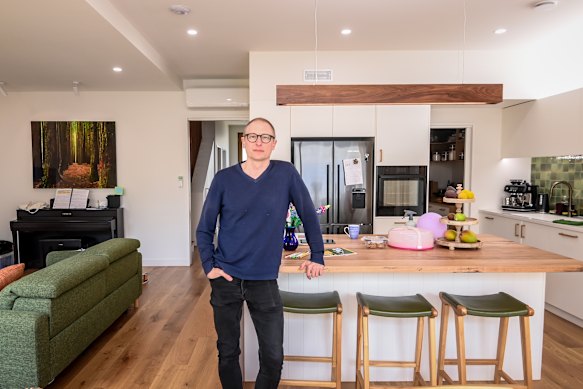
Ben Schrever in his prefab home. He says prefab homes are built faster and can save owners money in rent.Credit: Justin McManus
Their home meets energy-efficient German Passive House (Passivhaus) standards. It’s airtight, all-electric, and in winter can sustain itself from the solar energy in the battery.
The home was not much cheaper than a standard build, costing about $7000 per square metre because it was architect-designed rather than a catalogue model.
“Was prefab the cheapest option? Probably not, but we did want an architecturally designed home, and so that was always going to cost more,” Schrever said.
Loading
“But the speed can save a lot of money … If you’re renting while you build, that could save $40,000 over a year.”
AMPLIFY found 122,000 extra homes could be built in the next 20 years if Housing Australia set aside funding for prefab projects of 10 per cent of the Housing Australia Future Fund, and 5 per cent of the government’s 100,000 new first home buyer homes.
This scenario would also require a government action plan, regulatory fixes, two major banks lending for such projects, states and territories using prefab for part of their social housing programs and six companies offering custom designed prefab homes.
This could be increased to 192,000 homes if the HAFF funding rose to 20 per cent, and 10 per cent of the new first home buyer homes, plus loans from four banks and 10 companies offering the product.
“If you build a [traditional] house, you pay a builder when they’ve completed each stage. Prefab stages are completed in a factory, and you don’t get ownership of that product until it’s delivered to site,” AMPLIFY chief executive Georgina Harrisson said. “So, there needs to be a different financial model. Only one bank has released a product in Australia at the moment, and that’s CBA.”
She said funding would provide certainty for a new industry in Australia.
Overseas, prefabricated construction is mainstream, accounting for a large share of new builds in Scandinavia, Japan and Singapore.
“We absolutely know from the international landscape that this is a way of building that both saves time, saves money, and can significantly contribute to housing stock,” Harrisson said.
Loading
Dr Ehsan Noroozinejad, senior expert on smart and resilient housing at Western Sydney University, said modern prefabricated homes were often indistinguishable from traditional builds and frequently outperformed them on energy efficiency.
“We need to build some demonstration plants, which is currently being done by the federal and state governments, so the people can go and see the quality of the final product. And the perception will change.”
But there are capacity constraints, he said.
“One solution is to bring international investors and manufacturers into the market. The other solution is for the government to allocate maybe 50 per cent of their future social or affordable housing to be done by this type of construction.”
At scale, prefabricated housing could also reduce costs.
“Prefab could be up to 20 to 25 per cent cheaper than traditional construction on average. But if we use advanced manufacturing technology, we can automate everything in the factory and construction site that could be up to 35 per cent cheaper.”
In need of some good news? Sign up for our Greater Good newsletter for stories to brighten your outlook, delivered every Wednesday.