
Coming to a cinema near you soon is Giant, produced by Sylvester Stallone and starring Pierce Brosnan, a biopic of the incredible career of one of boxing’s supreme showmen, Naseem Hamed. But I am in Scarborough, standing outside the front door of one of the 36 fighters Hamed defeated and wondering if cinema audiences could ever deal with the story that lies behind it.
Paul Ingle called himself “The Yorkshire Hunter”; the reason, he explains, is that he spent much of the 1990s hunting down Hamed. Same county, but the other side of Yorkshire; same weight division — featherweight — but vastly contrasting styles and personalities. Hamed, the supremely gifted showman from Sheffield who thrived on swagger and state-of-the-art knockouts; Ingle, modest, brave, preposterously hard-working and so fiercely loyal that he never considered boxing as an exit from his working-class roots.
When they met, in Manchester’s MEN Arena, Ingle pushed Hamed for 11 rounds until he lost by technical knock-out. He then went away, won two fights and regained two world titles. He believed he had earned what he thought would be a £4million rematch. It is almost exactly 25 years to the day since those hopes were destroyed.
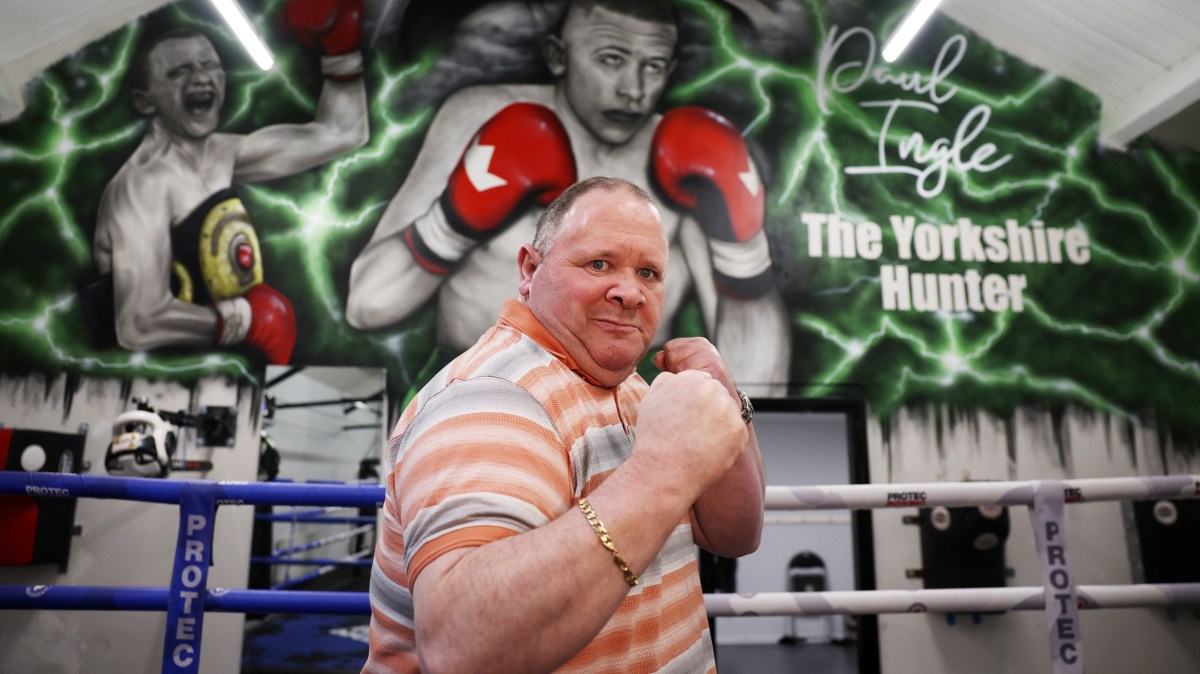
The Paul Ingle who answers the door still has a speech impediment, he is still blind out of the left side of his left eye. What you first notice is his size: not far off twice his nine-stone fighting weight. Quickly you also locate the reason: still visible, the massive scar in the shape of a question mark on the side of the 53-year-old’s head.
Soon, too, you understand the limitations in his memory though everything before December 16, 2000 is in sharp focus and that’s good, at least, because those were the glory days and they were great.
“The fight that really went to plan was Junior Jones in Madison Square Garden,” Ingle says. He relishes being invited to share these recollections. Jones was the IBO world featherweight champion at the time. “He could really whack. When he hit you, you knew.” Ingle stopped him in the 11th.
On the back cover of Ingle’s book is a quote from Tris Dixon, the former editor of Boxing News, which gets straight to the heart of how Ingle went about his work. “What an understated warrior,” he says of Ingle. “Paul was a throwback, he would hunt you down, chase you all night and thrill those who’d paid to watch the brutal little man at work.”
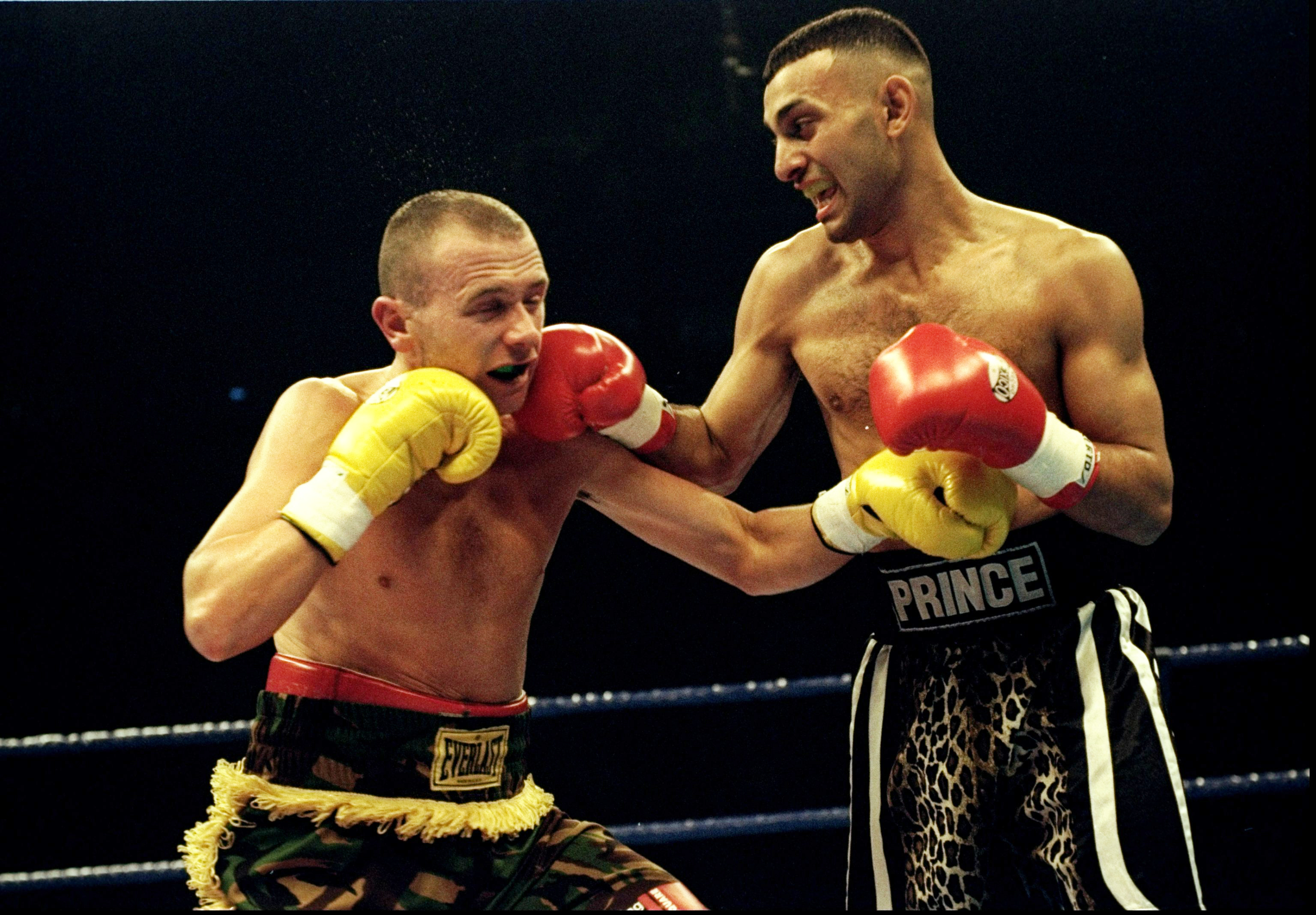
Ingle pushed Hamed for 11 rounds in 1999 before losing to a technical knockout. A year later Hamed was visiting his fellow Yorkshireman in hospital rather than preparing for a £4million rematch
JOHN GICHIGI/ALLSPORT
The one person who refused to watch was Carol, his mother. She went only once and was so frozen in fear that, for every fight thereafter, she would wait by the phone to hear the result. She remembers the call 25 years ago; it wasn’t her son on the line, it was her sister-in-law.
Ingle had gone 12 rounds with Mbulelo Botile, a South African widely considered the last stepping-stone before the Hamed rematch. But Botile had put Ingle down in the 12th round in Sheffield and, as Carol’s sister-in-law reported, he hadn’t got up and there were doctors in the ring.
By the time Carol got to the Royal Hallamshire hospital, Paul was already in surgery. By all accounts, the speed and expertise with which the surgeon worked to remove a blood clot on his brain saved his life. “When they brought him out of surgery,” Carol says, “they took us to his room to see him. I nearly collapsed.”
Over the coming days, the flood of support she would receive from the boxing community included a message from Jones. One day, with Paul still in a coma, Hamed arrived to pray by his bedside.
‘All I wanted was his title, not this’
Two months after the fight, I was in East London in the Eastern Cape of South Africa, discovering that Ingle was not the only victim of that fight.
Mbulelo was training in the same gym from which a small pocket of local boxers had risen to the world stage and lifted themselves and their families out of poverty. Welcome Ncita was the first, a world champion at the start of the decade. Botile reached prominence at the same time as Vuyani Bungu, another world champion and another one of Hamed’s 36 victories.
But Botile told me about his uncle, a celebrated local bantamweight who had died in the ring fighting for the national title and, thus, how his mother had never wanted him to box, and how this was now all impacting on him.

The scars from the operation performed to save the life of the now 53-year-old Ingle are still clearly visible
TIMES PHOTOGRAPHER MARC ASPLAND
For two weeks after the Ingle fight, he said, he had barely slept. He wanted to return to the UK to visit him. He wanted to dedicate the first defence of his new world titles to Ingle but he was concerned about how Ingle would play with his mind.
“I am just so sorry,” he said. “I have been so worried. I pray for him every day; every day I think about him. Paul Ingle seemed a nice man. All I wanted was his title. I didn’t want this.”
This is what would happen next: Botile would lose his first title defence. He then fought for another world title a year later and was beaten again. Two-and-a-half years later, he staged a comeback fight but was in nothing like the mint condition of his better days. He lost that too and that was his career done.
‘It’s been hard, but it’s your son’
From this bleak story, though, there are two clear heroes.
One is Carol. Two years after the fight, Ingle’s girlfriend left him. She said to Carol: I feel like a carer. So Carol moved in instead.
“He had to have someone with him all the time,” she says. “He can’t live on his own.”
For instance, she has to put his socks and shoes on. Or, as she says: “If he goes into town, he can’t go on his own because he doesn’t know where anything is.”
“Believe me,” Ingle says, “she’s been through 12 rounds with me.”
“It’s been hard,” Carol says. “But at the end of the day, it’s your son. You’re there for him, aren’t you? I love him.”
The other is Sonny Pollard whose father, Steve, had been Ingle’s trainer. Pollard is three years Ingle’s junior, but in their fighting days, spent many rounds sparring with him.
In Ingle’s heyday, he had been the toast of the town. There had been open-top parades; he had switched on the Christmas lights. Post-Botile, he became increasingly reclusive, furious that his meaning in life had been stripped away, embarrassed by his weight gain which, it seemed, no kind of diet could control.

Carol moved in with Paul and has cared for her son since the brain injury he suffered in a world title bout
TIMES PHOTOGRAPHER MARC ASPLAND
In January 2013, Pollard knocked on Ingle’s door. His friend was now 21 stone, and that shocked him, but he was on a mission to help.
He started by organising a benefit dinner; he then got a deal for Ingle’s book. He found a diet that did finally make an impact. When he opened a boxing gym in Hull, he called it the Paul Ingle Boxing Academy and he persuaded Ingle to come down and help.
“Just his presence in the gym,” he says, “all the kids, they’ve seen him on YouTube, they are in awe.”
If anything remotely positive came from the fight, though, it is this. In the months that followed and as analysis focused on why Ingle had been so uncharacteristically flat that night in the ring, it became widely recognised that he had mistimed his preparation and then crash-dieted too fast to make the weight. Directly as a result, the British Boxing Board of Control brought in new protocols to prevent this happening again. Good for future fighters; too late for Ingle.
And now here we are, exactly 25 years on, in Ingle’s living room with Carol and Pollard still by his side. What is clear is that there is no lack of warmth or love in the room. Carol says that Paul keeps her going because he still jokes a lot. “That’s what he’s always been like,” she says.
Yet there remains an aching frustration with how the cards have fallen. With Pollard’s help, Ingle lost eight stone. But a lot of that can quickly come back on, especially when you are battling with mood swings, depression, lack of confidence. The brain that would lock into religious self-discipline in his fighting days is very different now.
Ingle did get back to the Scarborough gym where his boxing life had started and worked with his nephew Harry, but that was fleeting.
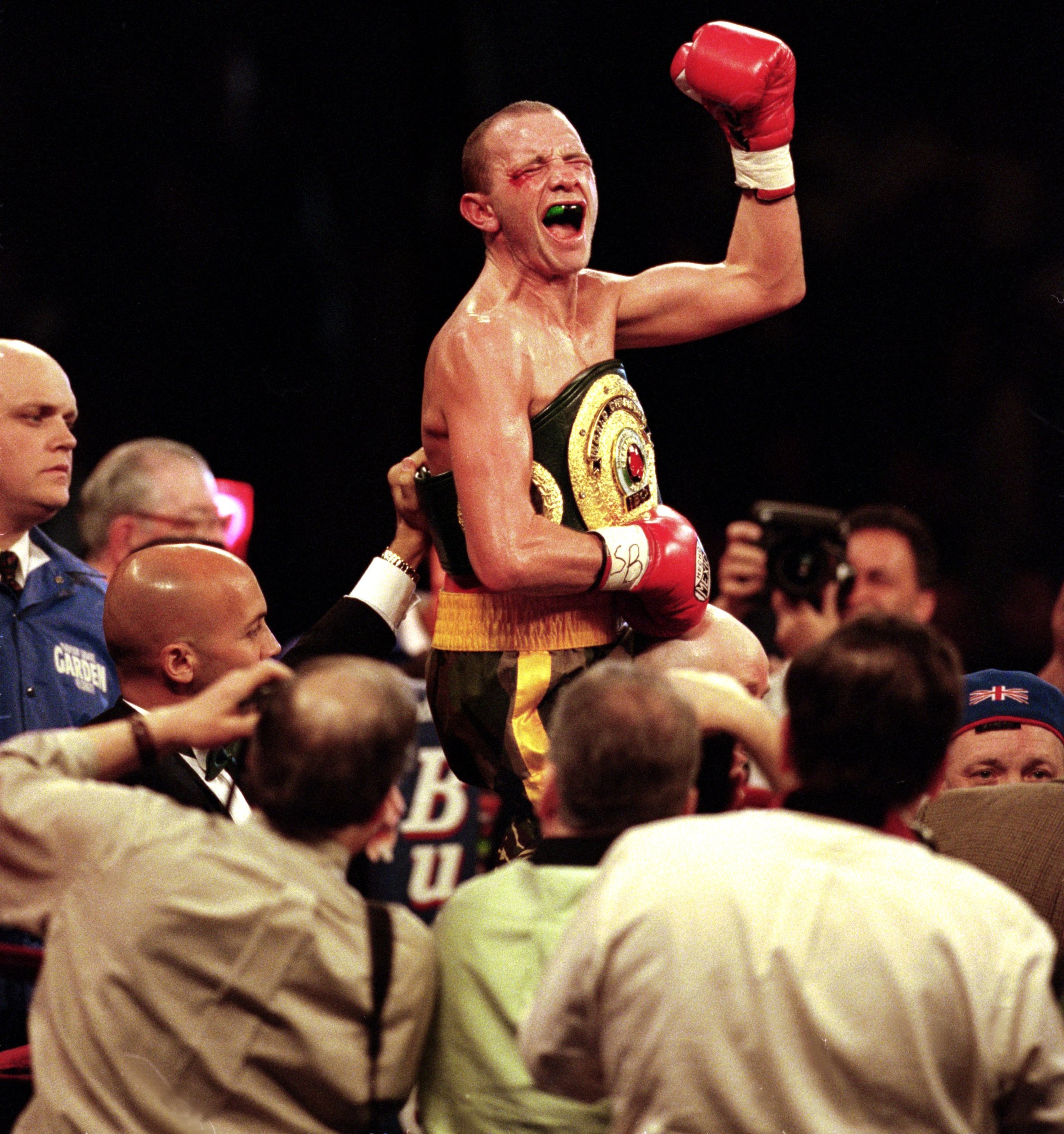
Ingle celebrates the pinnacle of his career at Madison Square Gardens in 1999 having defeated Jones to add the IBO world featherweight title to the IBF version that he retained
EZRA O. SHAW /ALLSPORT
“Maybe we’ll get him back in again, working with some of the kids,” Pollard says encouragingly. “That’s the plan.”
“My head doesn’t let me do a lot,” Ingle says. “I’m making excuses to get out of it — which I shouldn’t do really because I love being in there. My head just doesn’t want to do it. I want to get a bit more weight off.”
He was disappointed that he couldn’t get any work with Sky Sports on their boxing shows. “It was because of your long-term memory,” Carol, says, who then explains: “He doesn’t remember who half the boxers are. He couldn’t do it.”
It is not as if he is forgotten — at least not here in Scarborough. There is a new mural in his old gym, dominated by two images of his world champion days. The greatest pictorial record is the artwork tattooed onto the back of Dean, his younger brother, Harry’s father, who is a coach at the gym.
Yet the brutal truth is that, 25 years on, Ingle has not been able to work. “If I was allowed to fight now, I would,” he says. This is the fantasy but also a remnant of his old identity. “If you said to me: do you want a return, I’d say yeah. I’d fight Botile again in ten weeks’ time.”
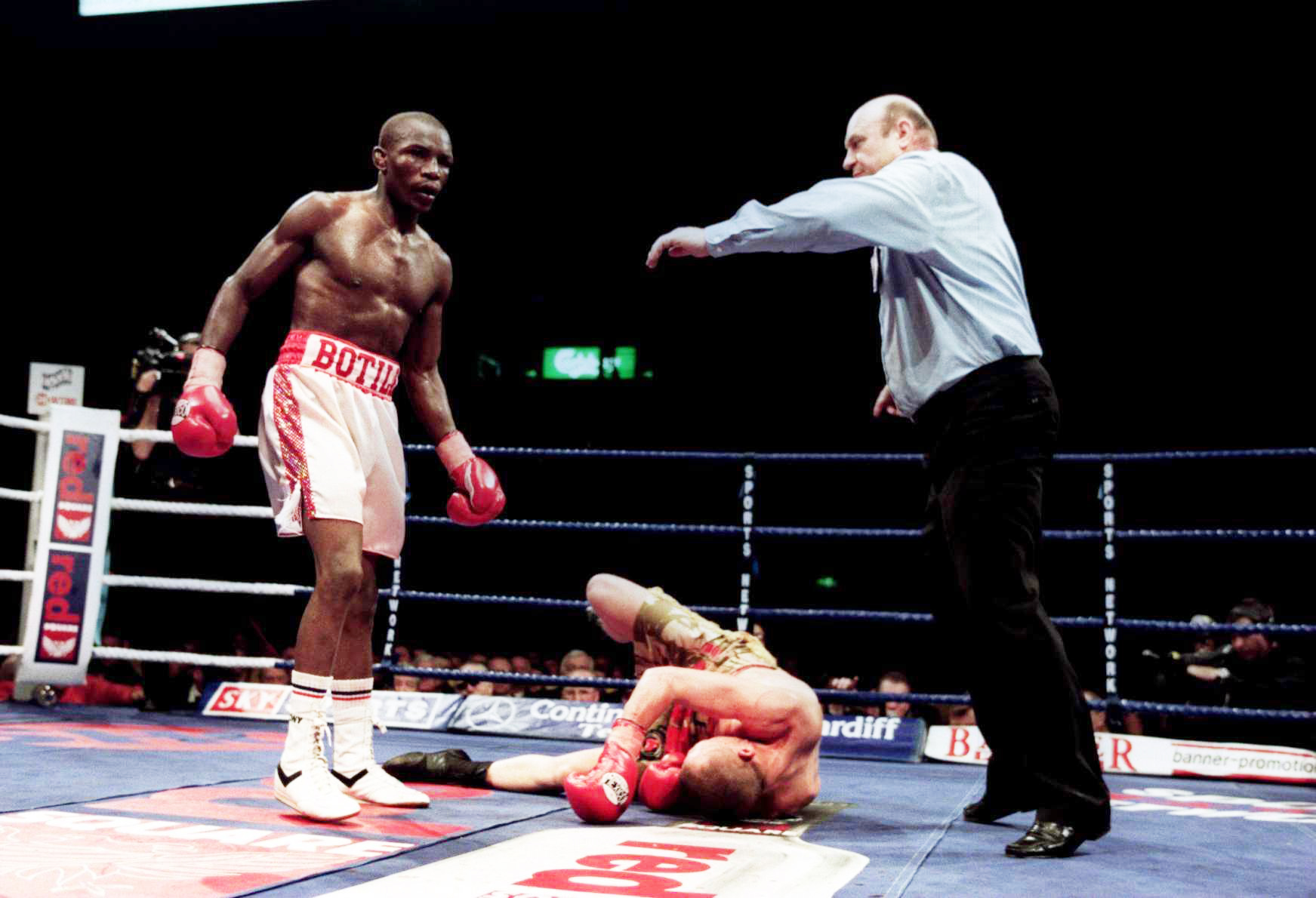
After a series of defeats that followed his victory over Ingle, Botile’s business venture failed and he turned to drink and became isolated
NICK POTTS/EMPICS SPORT
Yet it is not Ingle alone for whom that 12th round 25 years ago has been a life-defining moment. After Botile’s three defeats, he soon became known in East London as much for his boozing as his boxing. He bought a taxi company which failed. He talked about becoming a boxing trainer but started selling liquor from his home instead.
Over the phone, 8,000 miles away, he brings his side of the story up to date: “After Paul Ingle, I wanted to quit boxing because I was not right,” he says. “How could I fight when he was still in a hospital?”
It took him years before he could sleep properly again. He wanted to come to Scarborough to visit Ingle, he says, “but I didn’t go because I was afraid.”
I speak to Ncita who is busy with Bungu, the third man of that East London trio, putting in a programme to take boxing into local schools. They are hoping that they can persuade Botile to join them.
“He’s just staying at home, not doing anything,” Ncita says. He says that Botile struggled with the responsibility that came with success to be the financial bedrock of the broader family. “You carry that load, and you are not exposed to financial planning.
“When the days are dark,” he adds, “it comes back and haunts some people.”
“I don’t have a job,” Botile says. “Once I was a trainer but after that: nothing.”
He has six children. They have not been allowed into the ring.
In Scarborough, we leave Ingle’s house and take him to the gym that he hardly ever visits. It is when he stands in the ring, fists up in the boxer’s stance, posing for pictures, that a spark returns to his eye. After 25 years, he still has this extraordinary love for boxing, a love so cruelly unrequited.