
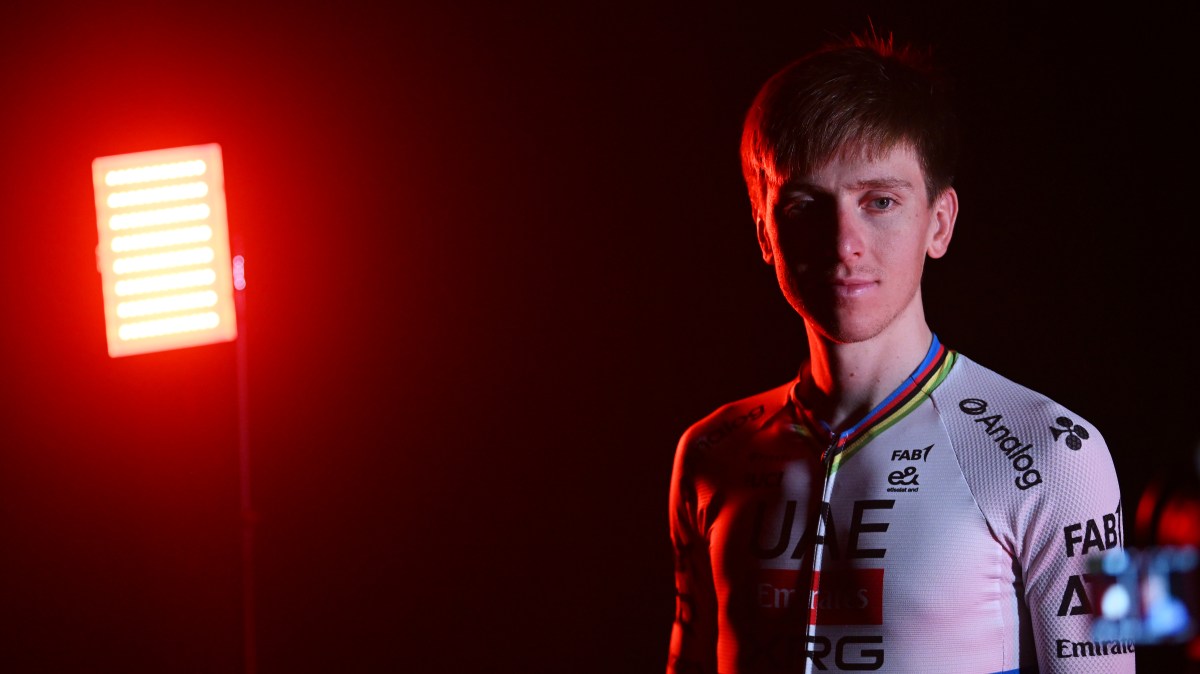
Tadej Pogacar comes to a table in a now deserted room of a hotel in Gran Canaria. Loose denim jeans, trainers and a casual top, I half-joke that without the Yellow Jersey he is barely recognisable. Not funny, he thinks, but lets it pass. He has no wish to be seen as separate from his team-mates. No throne, thank you, a seat on the team bus is fine. His greatest achievement is not the Tour de France but to keep soaring while keeping his feet on the ground.
Pogacar is 27 now. Seven seasons have passed; 380 race days in his legs, 107 wins on his palmarés. Only Eddy Merckx, now a long-retired octogenarian, has a comparable record. Who knows how far the Slovenian can go. Merckx had ten good years but after seven, he’d raced 478 days, 22 per cent more than today’s champion at the same point. Unsure whether he wants longevity, Pogacar still plans it.
That’s a journey into the unknown and he pushes on, one season at a time. What makes it hard is what he’s already done. The bar that he has set can feel like a noose around his neck. To avoid anxiety, he looks to the future matter-of-factly. He is contracted to UAE Team Emirates until 2030 and says he will honour that. Earning €8million (about £7million) per annum before bonuses makes it a straightforward option. And, by the way, Tadej gets a lot of bonuses.
By 2030 he will have completed 11 years in the pro peloton. That’s a long time for a rider who won the Tour in his second season.
One of the reasons he’s reluctant to do interviews is that he gets taken to places he’d prefer not to go. An example: I mention that the sports science people in his team speak in awe about the 2 to 2.5 per cent improvement in his numbers every year. But I don’t leave it at that, instead wondering aloud if he worries about the moment the music stops.
“I’m still waiting for the moment when my numbers don’t improve,” he says, “or my durability decreases, or just anything. It’s not all about the numbers but, yeah, I’m waiting for that year when everything stops. I will be, like, a little bit shocked, but I will also be ready for it. I hope it doesn’t go downwards too fast, so I can still enjoy some fast riding on the climbs.”
His hair is a little longer now than it will be in July; the natural spikiness at odds with the least spiky character on the sporting planet. Five and a half years have passed since he turned up at the Tour de France believing he had a chance of competing for the White Jersey that goes to the best young rider in the race. The years haven’t changed his appearance. About him there is the aura of the eternal boy.
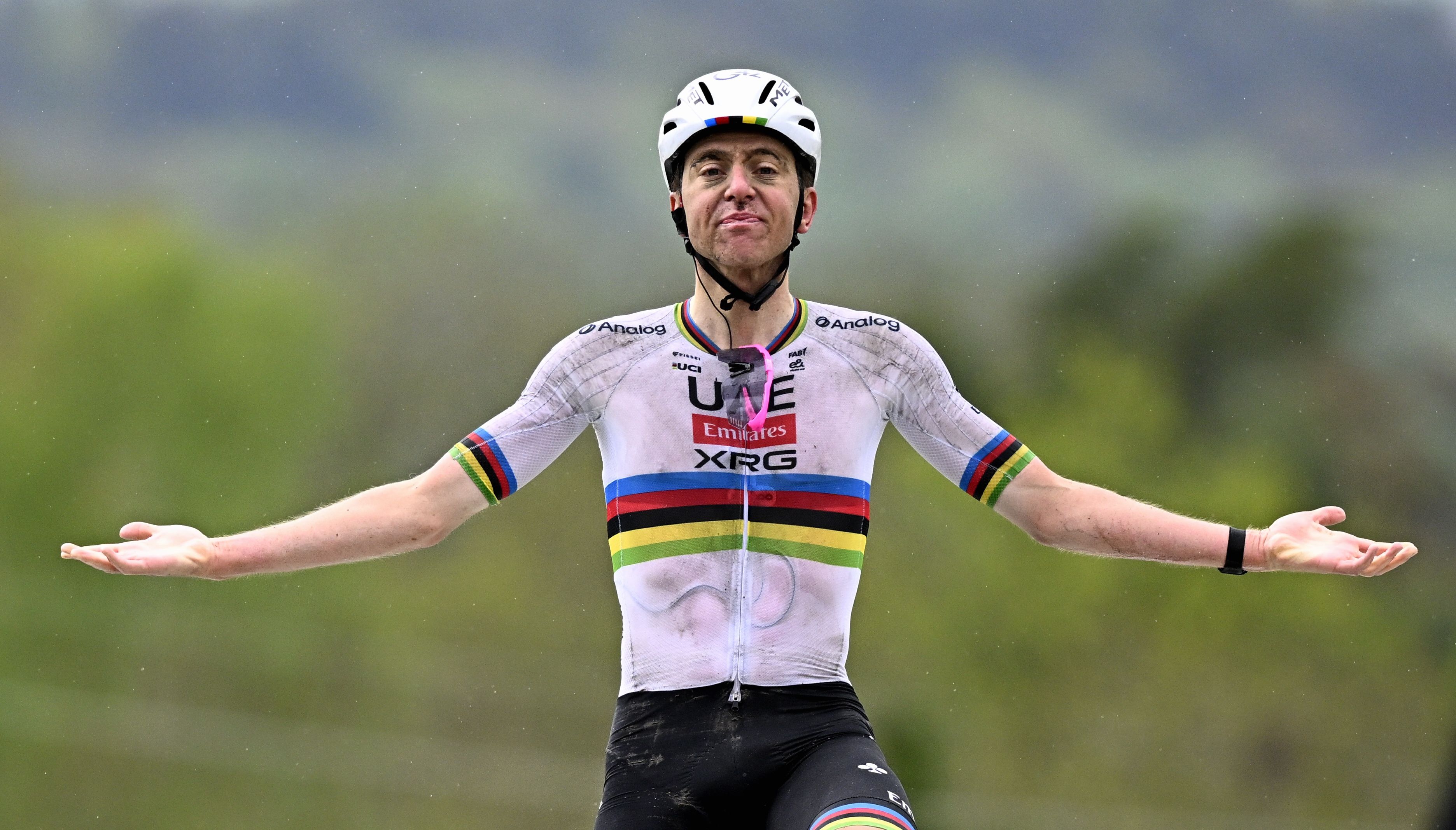
Another victory for Pogacar came at this year’s Fleche Wallonne — he is running out of peaks to conquer
WAALSE PIJL/REX
I bring him back to the penultimate stage of his first Tour. This was 2020, the Covid Tour moved from its July home to an August/September rental. That second to last stage was a 36.2-kilometre time-trial that ended at the summit of La Planche des Belles Filles in the Vosges. His Slovenian compatriot Primoz Roglic had a 57-second lead that everyone felt sure was enough. At the time Roglic, nine years older, was considered the better time-triallist.
Pogacar was 21 but already understood that defeat was fine provided you did your best. Setting out in that time-trial, that was his only thought. Give this everything you’ve got. It was the more experienced Roglic who wilted while Pogacar delivered one of the greatest ever Tour performances. As announcing-your-arrival moments go, this was Becker at Wimbledon in 1985. What does he see when he looks back?
“It was super-unexpected,” he says. “I remember, at the start [of the Tour] we were like, ‘OK, we fight for the White Jersey.’ Then, after a week, ‘We fight, fight for top five.’ Then in the middle of the tour, ‘We fight for top three.’ When I got up to second, everybody was happy with that. Second and the White Jersey. And then, after the time-trial, the White Jersey came also with the Polka Dot and Yellow Jersey.
“Just yesterday, somebody reminded me the deficit was 57 seconds, almost a minute, before the time-trial, but on the tough climb like La Planche des Belles Filles, it’s possible. Still it was really unexpected.”

Pogacar’s searing time-trial on the 2020 Tour de France catapulted him into the lead — and his first victory in the race
AP
Against all the victories that followed, does he still consider it special? “Not in terms of numbers or how fast we were going. There’s been better performances, but, yeah, that was one day that I will always remember, especially how good I felt on the bike. Everything went perfect, and there was zero stress, just the feeling of flying on the bike. Our bike change at the foot of the climb was so smooth. The climb itself was really nice, and the atmosphere was wild. Yeah, it was one of the nicest in my career.”
In a Dutch TV documentary Code Yellow, broadcast six months later, Roglic and his then Jumbo Visma team-mate Tom Dumoulin questioned that performance. They didn’t directly accuse Pogacar of doping but the implication was clear. That hurt him and fuelled his motivation. The Jumbo team would learn that his first Tour victory was neither fluke nor fake. He didn’t so much beat as pulverise them in the 2021 Tour. People speak of a smiling assassin. Fairer to say the exterior man should not be mistaken for his interior self.
He won the Tour in 2020 and 2021 and then finished second to Jumbo’s Jonas Vingegaard in 2022 and 2023. Within the team there was the fear that Vingegaard was simply stronger than Pogacar in the high mountains and would continue to beat him. I mention this and can immediately sense the thought slightly offends him.
“No, I always knew that I could I could come back and win the Tour again. After losing in 2022 we had a lot of days thinking about what went wrong and what we can do better. If I improved all the things I needed to, I could close the gap to Jonas. And then in 2023 I broke my wrist in April and it was tough to be strong in the three-week Tour after that. I failed again but I learnt so many things in these two years.”
Of the four Tours he has won, the performance in 2024 was the most dominant. Six stage victories and a final winning margin of 6min 17sec. The 2024 Pogacar was the best we’d seen at that point. What did he and the team do to reach that level?
“We changed quite a bit of our equipment, as well as the nutrition protocols. We also created a stronger group. Everybody around me was more focused and understood that we had to go to another level because we could not stay in 2021. Everybody else had moved forward.”
So, why has nutrition become so important?
“For now, we are in the off-season, just restarting proper training. I’m not a big fan of eating gels and drinks with so much sugar. So in the off-season, when you’re not so concerned about the numbers and all that stuff, I stop at a bakery on a training ride. Then, after 3½ hours, I bonk [have a sudden energy crash]. I get home, and eat everything that’s in the fridge. It’s what happens when you’re not paying attention to nutrition.
“I know that’s wrong, but I still do it sometimes. We’re here in Gran Canaria now, a mini-training camp and we’re getting back to proper nutrition and it will get more serious. What you eat makes a big difference. Six, seven years ago, when I joined the team, our nutrition was all over the place. That’s completely changed and we’re still not close to perfection.”
Into this conversation he brings technology, clothing, rest because it is never one thing. Forced to identify the single most important factor in team performance, he says it’s the way the riders are with each other. Are the team training camps fun, do they like to be in each other’s company and, when the tough moments come in the biggest races, are they ready to suffer for each other?

Pogacar’s team-mates know they are riding for the supreme cyclist of this generation, a point proved by his Tour victory this year
MARCO BERTORELLO/AFP
What his team-mates speak about is his calmness. On tough days he reminds them it’s only a race. Whatever anxieties he may be feeling are not visible to them and are never transferred. All that matters, he says, is they try their best and second is OK if you’ve given everything. It helps too that they know they are riding for the supreme rider of this generation and every time he wins, they feel part of it and, of course, they earn a little more. It is clear to them that he enjoys their company. He likes nothing better than to sit on the bus and shoot the breeze about the race they’ve just ridden.
Which is why the post-race protocols are the bane of his life, that part of the race that makes it more difficult to actually win the race. He tells what happens when you’re wearing the Yellow Jersey at the Tour de France. “The stage ends, you go to cool down near the podium which is not the same as the cool-down area in front of your bus. Everybody’s nervous. Everybody’s rushing you. I get a little bit anxious always. You’ve got a change of clothes for the podium. Basically, you take a wet wipe, wipe your balls and put on another skinny jersey over your sweaty body.
“You haven’t showered and it’s really uncomfortable. Your team does everything it can, brings you a recovery meal and recovery shake. But then, yeah, once you finish with the podium and signing all the jerseys, you have to go to the mixed zone and that always takes quite a bit. And TV. TV is always a priority. There’s normally two interviews. And then the press conference, which is in another place sometimes.
“And yeah, it takes up from one hour to one hour and a half until you’re back on the bus, if they can wait for you because they will be ready much earlier. Naturally they want to go to the hotel. I rush to get to the bus because I don’t want my team-mates to have to wait. I could go to the hotel in the car but I always want to have that debrief with the other riders, make some little jokes about the day and just relax.”
If he’s in yellow, there is also the post-race doping control. He has become a master of pee-delivery. “We often time how long it takes me. In last year’s Giro, we achieved our best time, 5min and 20sec. The DCO [doping control officer] was ready, had everything up on his iPad, the doctor was filling in the forms and I’d drunk plenty of water towards the end of the stage, so I was ready.
“Normally it takes about ten minutes. Some days you walk in there and three guys are ahead of you. Two of them are sprinters because it has been a flat stage. This can be difficult because they’ve got to have everything perfect for the sprint, and so take a pee at the last possible moment, 20k from the finish. They do this so they can feel totally empty. And then they’re there, in the doping control room, looking at each other, unable to do anything, and you have wait 30 or 40 minutes.”
Now Tadej Pogacar is the tennis player expected to win every grand-slam title, the golfer who must triumph every time he tees up at a major championship, the footballer who must always be the leading goalscorer. This has been his life for six years. He is too smart not to know the toll that it takes, so he searches for ways to freshen the challenge.
In Gran Canaria he was asked which races he would ride in 2026. He said that while they had yet to finalise the programme, he expected to ride the one-day classics, Milan-San Remo and Paris-Roubaix. He mentioned those two because they are two of the very few important races he has yet to win. New frontiers excite him, the ones he’s already conquered less so. The problem he’s got is that new frontiers are now hard to find: those who quickly travel far soon find there is nowhere left to go.
“Yeah, it does [get harder]. I mean winning now feels a bit like a routine, almost. I remember when we won [the Tour of] Flanders the first time, it was really sad, because we just packed up our things and went home. Everybody went home that evening, and I didn’t even see all of my team-mates after the finish line because, again, from the podium and the post-race interviews, it was a long time. Like three hours. And some of the guys have had to go. We just accept it. It is our job. We go to a race that we have to win, and then we go home to prepare for another race. We never got to celebrate that Flanders.”
Over the past five years Vingegaard has been his greatest rival. In the five Tours they have raced together, the score is 3-2 in Pogacar’s favour. The Dane has recently taken to describing Pogacar as “the greatest-ever cyclist”. It’s hard to imagine the Slovenian rider being as deferential about a superior rival.

Vingegaard has recently taken to describing Pogacar as “the greatest-ever cyclist”
MARCO BERTORELLO/AFP
“I understand this from Jonas’s position. If one guy is better than me, I would probably say he’s the greatest of all time because that means I’m second to the greatest of all time. So, to be fair, it’s nice to say this but I don’t want to get into the greatest-of-all-time debate. People are the greatest of their era. You can’t compare riders from different eras. It’s impossible. I will not say now that if I go back to 1975 that I could drop Eddy Merckx from the wheel or that, if he’s racing now, it would be easy for me to win, because we don’t know. We will never know.”
In his excellent book Tadej Pogacar: Unstoppable, Andy McGrath speaks to countless riders who competed alongside and against the young Slovenian as he made his way through the junior ranks. They tell what he was like as a team-mate, and as a rival. What is remarkable is the uniformity of opinion: pretty much everyone liked and respected him. A story told by fellow Slovenian Blaz Debevec reflects a universal view.
McGrath writes: “At the Grand Prix of Vir Island, an early season stage race off the Croatian mainland in April 2016, the Radenska juniors turned up with the strongest team. On the opening day, team-mates Debevec and Pogacar escaped up the road together. ‘In the last kilometre, we knew we could come to the finish. I was very happy — Tadej was the captain, for sure he will win and I will be second, a great result for me,’ Debevec says.
“ ‘Then he said, “No, Blaz, this one is yours.” He let me win there, the first victory in my career. It really meant a lot to me.’ Not that being in the lead for two hours with Pogacar was easy. With one part of the course uphill, the stronger rider did far longer pulls than Debevec, who helped on the way down. He was glad to see the finish line and end the suffering. ‘That was probably my favourite moment with him,’ Debevec says. ‘And he did the same the next day with one other rider, I think he was second twice. That’s when I saw he’s more than just a rider and a captain, he’s a really nice person. He’s not just thinking about himself and his results, he cares a lot about his team.’ ”
A bit like his record on the road, the man himself stands up to scrutiny.