
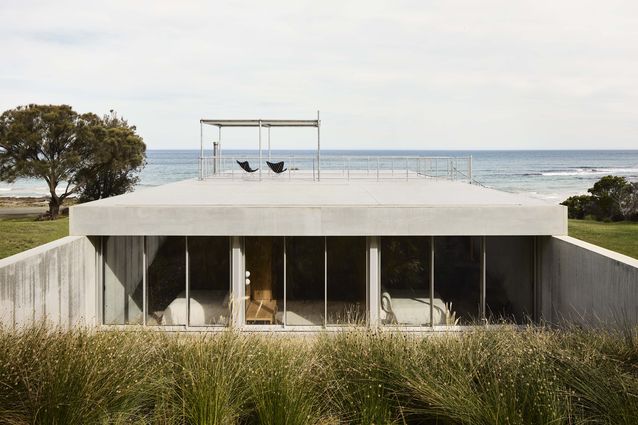
Located on the unceded lands of the Gadubanud people of the Eastern Maar, Otway Beach House by Kerstin Thompson Architects (KTA) is anchored into a section of coastline along the Great Ocean Road approximately two hours’ drive from Naarm/Melbourne. Designed as a weekend home that could continue to support a family’s longstanding connection to the area, the project is also a sustained exploration of what it means to live and build within a sensitive and fire-prone area.
Construction on the project was completed in 2024, but the clients first approached KTA in early 2016, in the aftermath of catastrophic bushfires in the region that came within a few hundred metres of the existing house on the site. As such, the broader ethical considerations associated with constructing a home on a site where bushfire risk is high and coastal vegetation is vulnerable were apparent to both clients and architect from the very start. Perhaps less clear at this point, however, was the extent to which layers of planning and regulatory frameworks would ultimately challenge and shape the direction of the project. A bushfire management overlay mandated non- combustible materials and construction systems, while the site’s location within a rural conservation zone placed further restrictions on the building’s visibility from the Great Ocean Road. As the home’s owners explained it to me, the process of realising Otway Beach House was one that “took everyone out of their comfort zone.”
View gallery
To build and live within a flame zone at the edge of a national park is to confront some of the ways in which native ecologies and their relationship with fire have been damaged and changed by colonial oppression of First Nations cultural burning practices, by extractive industries and by catastrophic climate change. While Otway Beach House doesn’t claim to be able to resolve the tensions and challenges of its location, the project does offer a thoughtful and thought-provoking response that goes beyond a concern for compliance.
Dubbed “Sawmills,” the house’s name serves as a reminder of the site’s recent past. Properties along this stretch of coastline were part of provisions for worker accommodation associated with the local sawmill during the mid-twentieth century. The impacts of the logging industry, the clients note, are still felt beyond the edges of the property: remains of tools and machinery left behind to be reclaimed by the forest and scrub; the spread of invasive flora; and weathered piles of remnant sawdust along the shoreline.
View gallery
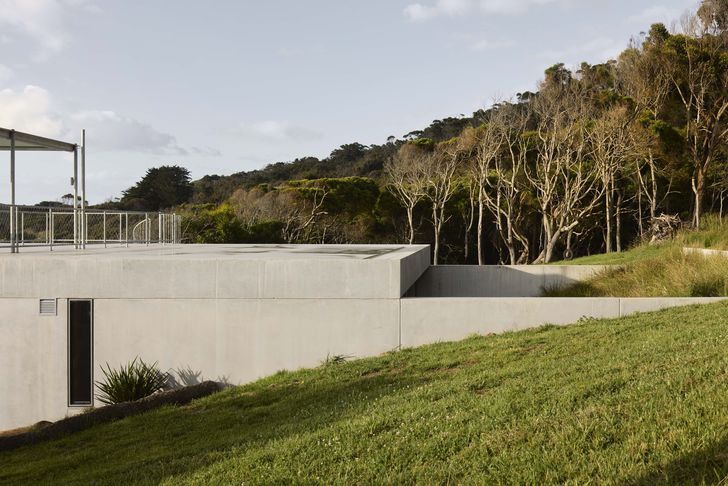
The house was initially conceived as a place for large family gatherings, and an early concept design proposed a sizable two-storey dwelling with just under 500-square-metres of internal floor area. The complexity of the approval process and the clients’ changing needs saw the design contract over time, ultimately becoming a much smaller retreat with a highly distilled plan and connection to site. In contrast to the high-set timber house that it has replaced, Otway Beach House is thoroughly grounded. The home’s long concrete blade walls dig into the hillside to the north-west, gradually emerging from the falling terrain towards sweeping ocean views to the south-east.
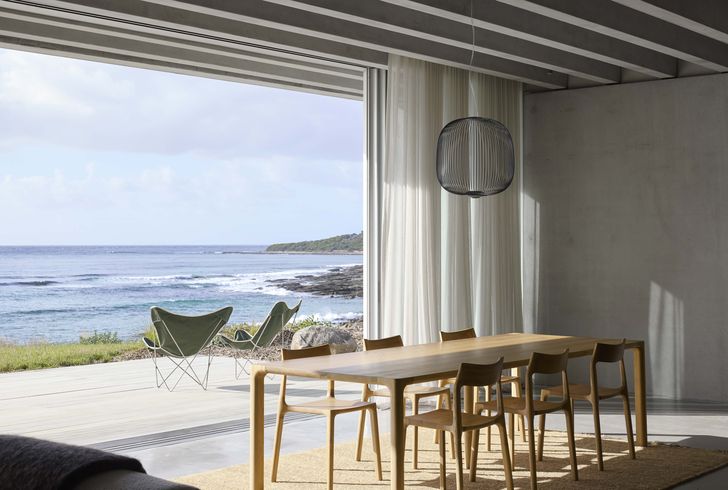
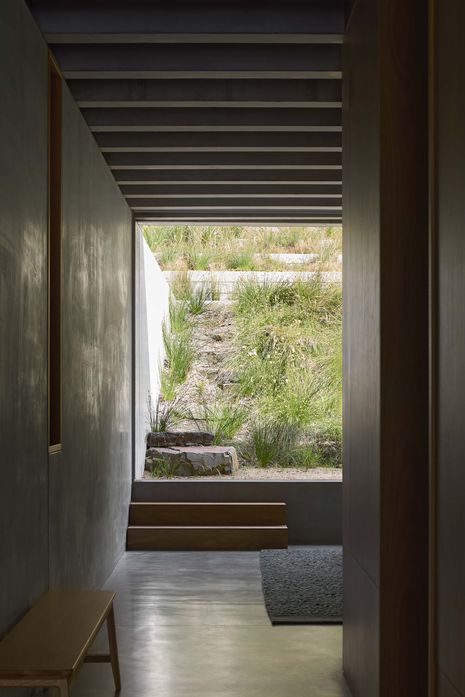
On approach, the house presents as a deep concrete shell, a gesture that emphasises material mass and resilience. The depth of the building’s visual and physical connections to context only become further apparent from the interior, where its more permeable edges are revealed. Two bedrooms and a study are tucked back into the hillside, where the floor level drops below ground and the surrounding landscape spills over into the courtyard-like space created by the concrete walls as they disappear into the earth. On the southern side of the plan, the impressive span of the concrete roof – facilitated by deep T-beams – is used to full effect, creating a living, dining and kitchen area that opens out to a patio space and the water beyond.
View gallery
An early KTA sketch section captures the two distinct site orientations – “bush” and “ocean” – with a remarkable clarity that is just as legible in the constructed home. In this sense, the dwelling’s reduced footprint serves to bring the site into sharper focus, pulling the density and depth of the structure into a series of conversations with the surrounding environment. On climbing the spiral stair to Otway Beach House’s roof terrace, one finds subtle hints of the hidden layers of infrastructural intensity across the site: rainwater collection and water treatment processes are contained in a series of subterranean structures.
While maintaining clarity in terms of its overall form and material finish, Otway Beach House nevertheless develops a set of rich and complex relationships with context that will no doubt continue to contribute to larger conversations about where and how we create liveable spaces in tune with an increasingly fragile environment.