
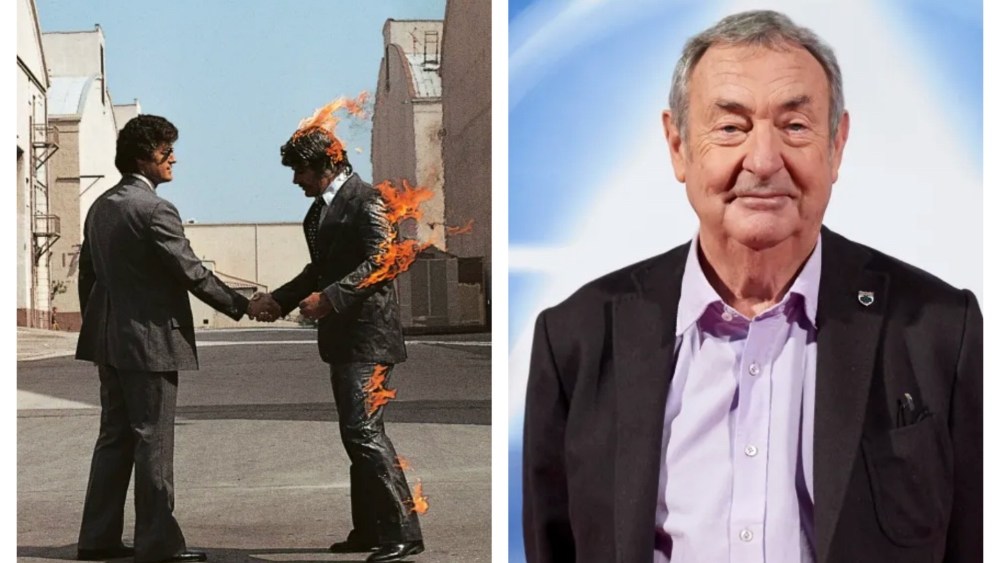
How we wish we were there … back in 1975, that is, and able to again listen to Pink Floyd‘s magnum opus “Wish You Were Hear” as a fresh work for the very first time, as opposed to hearing it through 50 years of hindsight. [Insert “mind blown” hand gesture here.] But the hindsight’s not bad, either, especially if it means we’re alive and kicking a half-century later, and most especially when it can result in an experience as enhanced as the 50th anniversary boxed set commemorating the classic, with everything from previously unreleased demos and live tracks to Dolby Atmos mixes sweetening the deal.
Nick Mason can claim bragging rights as the only member of Pink Floyd to appear on every one of the band’s albums, from 1967’s “Piper at the Gates of Dawn” — when Syd Barrett was the ostensible band leader, before he soon exited and David Gilmour entered the picture — on through to the group’s protracted final act, after Roger Waters‘ departure, with Gilmour as sole frontman. So the drummer had a full measure of the shock when Barrett showed up at the studio during the “WYWH” sessions after years of being MIA with mental illness. Barrett was in no shape and probably had no desire to participate in those sessions, even as a cameo player, but in a way, he is a star of the album nonetheless, as the record came a little bit closer to having a throughline once parts of it started being written about him.
Mason spoke with Variety about his memories of Barrett showing up at those sessions, and of the album’s tortured beginnings as a “Dark Side of the Moon” follow-up that ended up being a little less experimental than first intended. (As in: they finally abandoned the idea of making it without using any musical instruments at all.) Read on for a Q&A exploring his thoughts about why he thinks the album ended up being such an eternal fan favorite in spite of (and/or because of) being an “antidote” to Floyd’s more conceptually tight outings.

‘Wish You Were Here‘ boxed set cover
Sony Legacy
You’re probably not always in a retrospective mood and looking back and being nostalgic, but does having this “Wish You Were Here” set out allow you a chance to feel proud of the anniversary, as a commemoration of something that obviously people have been very attached to for 50 years?
It’s perhaps a little bit surprising, how much people are enjoying going back 50 years. But when you reach my age, you spend a lot of time thinking about the past rather than planning much of a future. Oh, that sounds too grim!
Where the album sit in your thoughts among the whole catalog after all these years? There are a lot of people who feel this is their favorite Pink Floyd album.
Yes. It’s a curious one, really, because it’s not the biggest seller, but it seems to have lasted particularly well. And I think it’s almost an antidote to things like “Dark Side” and “The Wall,” which are very organized. This feels a lot more like a bit of a wander. And particularly if you’re listening to music, that works particularly well.
Did you say “a wander”?
That’s right, a wander.
I like that. In thinking about reasons why it might seem like the quintessential Pink Floyd album to some people, even though ultimately there are only four songs — at least if you count “Shine On You Crazy Diamond” as one song — it covers a large gamut of what people think of even from different eras of Pink Floyd. There are a couple of kind of angry songs of Roger’s (“Welcome to the Machine,” “Have a Cigar”), and then a couple of the songs are very sad or wistful. And then there are the long instrumental passages that people associate with the earlier Pink Floyd, more than the latter-day. So there’s a lot of trademark stuff packed in there, given how really compact the song list is.
Yeah, and I think also there’s perhaps a little bit more of a recognition for Rick [Wright, the group’s late keyboard player]. Because one’s always sort of hooked up with (thinking about) Roger and Dave arguing about things or whatever. But actually, there’s never quite enough credit to be shared around with successful projects. And I think sometimes Rick gets a bit sort of pushed out. Not pushed out — just not recognized, for what he contributed.
Pink Floyd
Storm Thorgerson / courtesy Sony
It’s certainly a wonderful showcase for what he brought to the group. Since you mentioned that this was “a bit of a wander,” do you think that there was a conscious decision not to make this a concept album per se?
Yeah, I think there was a feeling that when you have a successful album, that the next one… can we do it again? I don’t think that would’ve been a good way forward. So I think there was very much a feeling of let’s not make something quite so structured. Because, yeah, there’s a lot of structure in “Dark Side.” And actually what’s nice about this record is just the amount of atmosphere around it… air around it.
People have tried to apply a theme to it, whether there’s one there or not. And the word “absence” has popped up…
Mm-hmm.
…in Roger talking about it, and how he feels that was reflected in the different elements of cover art as well. But for those of us who, as young people, sat there and pondered every bit of this, it was like: Well, is there kind of a thematic connection unifying the album — a connection between the stuff having to do with the record industry and cynicism over that, and then the stuff about Syd Barrett representing an innocence that maybe stands in stark contrast to the music buisness stuff? Maybe it’s too much of a stretch of imagination to connect those two things, as a conceptual force on the album, but fans do make those stretches.
I think Syd was much more a driving force than the sort of bit about the record company. I think that was a sort of one-off, if you like — whereas I think the whole element of Syd appearing in the studio and so on was far more of a catalyst to make this record.
There’s that chicken-or-the-egg question of whether Syd appearing in the studio influenced the album ending up being more about him, or whether that was already written to a large extent, and then writing about him kind of mysteriously manifested him showing up unexpectedly as a vistor in the studio.
I think the arrival of Syd in the studio was a major part of what then transpired. I don’t think there was much of a theme to the record until the Syd visit, and that really gave a bit more clarity or a bit more direction, particularly with Roger’s lyrics. But not only that, I think also the way the various elements on the record worked out were very much part of songs that could have been about moving on from a relationship to being about Syd.
I’m wondering what recollections you have of Syd’s studio visit,. At the time, as long as it had been and as shocking as it apparently was, you’re probably still not thinking, “Oh, this is the last time I’ll ever see this person.”
There are a couple of things from my point of view, one of which was that when Syd actually arrived, I was putting a drum track down in the studio, and it was when I went back into the control room that I saw, for me, a stranger standing there. I didn’t recognize him at all. It actually took David to say, “You know, that’s Syd,” and that was fairly shocking, really — unsettling, I think, is the word. The others, I think, had seen more of him in the last few years, but I hadn’t seen him for probably five years.
Syd Barrett visits the recording studio during Pink Floyd’s ‘Wish You Were Here’ sessions, photographed by Nick Mason
Nick Mason
The packaging includes a kind of portrait photo that we’re now seeing that you took of Syd during that visit in the studio.
Yeah, that’s right. But there are some other pictures of Syd that were taken, I think, by Dave’s guitar tech, Phil. Because I always assumed he only came down one day, but I think that’s because I wasn’t there on the second day. And so it was this rather strange thing of everyone having a slightly different version of what he’d said or what he was doing. But I don’t think there were any sort of words of wisdom from him. It was a very, very disjointed visit. I have no idea how he knew we were in there. There was no forewarning.
It’s clear that there could be no sort of a happy ending to that relationship with Syd, given the seriousness of his issues. But is there some gratitude, at least, that there was able to be some closure just by having material that was about him before you moved on any further?
Possibly. I think we dealt with or looked after Syd very poorly, but we really didn’t know any better. I mean, when Sid left the band in ‘68, we were still thinking that if we took a day off, that maybe he’d recover. I mean, the naivete… Now, people are far, far wiser, but it’s extraordinary to look back and realize how little we knew or were able to do for him.
As a bonus for the new boxed set, “Shine on You Crazy Diamond” has been reconfigured into a single, continuous track, rather than being broken up to open and close the album. Everyone knows that initially, it was not conceived to be in two parts. Do you think it was purely sort of LP side issues that caused the splitting of that, or…
The trouble is, as with a few things, I simply don’t remember. I don’t remember how we’d got to that point. But I think there probably was a sort of reference to “Dark Side” and trying to make things work in a different way and have a different feel to the whole record. And it was quite a battle… not a battle, but it was something to keep reminding ourselves about, because there was always that little bit of pressure to sort of look at “Dark Side” and see if we could do it again, and I think we were determined not to find ourselves caught up in that.
Do you care about the Dolby Atmos and any of those sorts of things that are part of the new set?
Oh, yes. I actually really love that thing of taking something and polishing it up. But I’m constantly amazed at how good recording (technology) was 50 years ago at Abbey Road. It’s great when the things have sort of been tidied up a little more and a little bit more definition brought to the sound. But it’s a long time ago to have records played that still sound fresh. And credit to the technical side of it all, particularly to the people who recorded it originally.
Nick Mason of Pink Floyd
Tracey Kraft
Just to talk about your drumming on the album a little bit… I’ve seen interviews where David talks about, on “Shine On,” you switching between a 12/8 shuffle to a swing beat and back again, which impressed him enough to bring up many decades later… One would imagine some thought or discussion went into something like that. Or did it just come naturally just based on the material?
Absolutely. I’ve never really been very good at learning things properly. It’s one of those things where you just sort of… I think it’s actually a sort of Ringo thing. You just get to feeling what works. And one of the nicest things is that I think most of the time, we rarely had to tell each other what to do. Most of the time, whatever we did worked really well for the record. That was true of sort of most of Pink Floyd’s recordings, certainly up to “The Wall,” where maybe there was a bit more production with those. But in the earlier things it was much more a case of: Just play it.
So there were no moments of everyone in the studio going, “What if we go out of 12/8 into something more straightforward for a few bars?”
If anyone had said something like that, I’d have collapsed, I think.
Were there points in time at which your retrospective opinion about the album changed? In past interviews you’ve suggested that maybe it took you a while to warm up to the album again and have a more positive take on it, because you had it stuck in your mind how difficult it was to just get it started.
Yes. I think that had a bearing on it, compared to really the ease of “Dark Side,” where it all began to click together quite early on. You have to remember that we tried this other project called “The Household Objects,” which had wasted a couple of months. I have no idea how long it was, actually. It felt like about a year, but it probably was a month of what amounted to messing about with this “Household Objects” idea of making music not using instruments. It was about using sort of stroked glasses, or, I think, as an alternative to a bass drum was the idea of an ax hacking into a wooden log or a tree stump. It took away quite a lot of enthusiasm, that project, that then had to be rekindled, really, for “Wish You Were Here.”
So, no regrets on your part that the band never went any further with “Household Objects”?
None at all. I think the one good thing was the relief of leaving it. In the last few months, a number of people have actually put together an album as a sort of tribute to “Household Objects.” But of course, it’s much easier to do that sort of thing now because all the electronics can more or less make any sound into a musical instrument.
There are so many formats this newly reissued material is in…
The fashions change, in what people want to listen to… I mean, the most remarkable thing is the CD, which was transforming the music industry and the whole business of how we listen to things. And that’s now been pushed to one side. Everyone’s gone back to vinyl, because it’s that slightly softer quality… it’s gentler on the ear. But the CD is still remarkable in terms of sound quality.
‘Wish You Were Here’ boxed set contents
Sony Legacy
Do you have a favorite format yourself at this point? If you were going to buy the set, would you prefer the vinyl or the Blu-ray or the CD or listen to the Atmos?
I think I’d go for the vinyl. I still like the sort of Japanese tea ceremony of putting the disc on the turntable.
Do you remember much about the packaging decisions? I can remember buying the album the day it came out and being conflicted about ruining the opaque sleeve it came in by tearing it open, but of course you had to. But the real treasures from Hipgnosis were within.
Yeah, with Hipgnosis, it was their finest hour, because they managed to more or less get away with doing about six different album sleeves, and making them all work. It’s a fantastic selection of things. Storm was wonderfully argumentative about it. The finest thing at Storm’s memorial was when someone saiid, “He’s a man who wouldn’t take yes for an answer,” which was such a good summary of of him. The record company, I think, lived in fear of Storm, because he did all these wonderful sleeves and then said, “And we’ll shrinkwrap it in black vinyl.” Finally, he allowed them to put some small sticker on the outside of the shrink-wrap. But, yeah, it was remarkable. I think the record companies were suffering as well because the Grateful Dead had released a record and the boardroom asked what the title of the album was, to be told that it was “Skull Fuck.” I think after that, everyone sort of retreated to a dark room.
The “Wish You Were Here” artwork is the apotheosis of Hipgnosis using photography that has surrealism taking place in broad daylight. That combination of something that’s very bizarre, but that is actually taking place in a real life setting, seemed reflective of Pink Floyd somehow in a way.
I think it probably is, as well for me, the best album cover of any of the work that Hipgnosis did for us, and as you say, you can unpack it and look at it again and again. I like the diver wiith no ripples, still [with a diver holding his breath doing a handstand in Lake Mead]. We didn’t have Photoshop then, so everything was done for real, including, of course, the burning man. I know that they got to the point where it was suggested they do another take and he just said, “No. That’s it.”
You’ve said that one of your regrets is that the band didn’t do a proper tour behind “Dark Side” and for your mind went too quickly into trying to do “Wish You Were Here.”
Well, it would’ve been nice to have had a record of it. The “Pink Floyd at Pompeii” film is terrific because it absolutely shows what we were doing then, and it would’ve been great to have had a definitive version of “Dark Side” (live) to do the same thing a year or two years later. It would just have been easier for us to have spent a bit more time touring with “Dark Side” and a bit less time than on “Household Objects” or anything else.
Moving toward the present, we were so glad to see the “Saucerful of Secrets” tour that you did a few years back, touring the early, pre-“Dark Side” material with a great group of musicians. Are there any plans to do more with that in the future?
Not at the moment. I mean, I’d love to do some more. But there is a point at which you don’t really feel like doing all the traveling so much. And I loved doing it. It was sort of a little bit of having the childhood I never had, in terms of actually doing it in a tour bus… You know, we (Pink Floyd) rather quickly went from the back of a transit van to the charter jet. I missed out on a whole bunch of stuff, which this was a good way of catching up with quite quickly.
So you don’t know if there’ll be more, but it was satisfying to have done it, for a few years?
Yeah, absolutely. I really loved it. And if there’s an appetite to people who’d like to see it, yeah, I think we’d fire it up and go out again.
Surely there are more 50th anniversary commemorations to come after this, whether official or just celebrated by fans. Of course, “Animals” already got a remix and a reissue just a few years ago. But do you think there’ll be a similar sort of boxed-set project around that when the 50th comes around in a couple years?
I’m not sure. I don’t know how much there is to get from “Animals.” We’ll probably just have to wait for “The Wall.”
To ask about the catalog sale… Obviously it means something financially, but does it mean anything personally to you to sort of have divested yourself of that? We talked with David earlier this year, and he said what a relief it was for him to not have to worry about band meetings anymore, which had been a source of tension for him. I always got the feeling that you got along pretty well with both Roger and David. So maybe you did not approach band meetings — such as they are, anymore — with the same sense of trepidation that maybe they did.
Oh, so far I think it was absolutely the right move to sell the catalog. I think there were too many arguments that were not in any way constructive. And in fact, so far, it has worked really well. The reissues of “Wish You Were Here” and “Dark Side” both worked really well. And you know, we’re getting to the age where we really are thinking: Well, so what happens long-term to the catalog? And I think the record company’s probably the right place to leave things for future generations to be able to access them.
The songs have not been exploited very much over the years for movies or certainly advertising or anything like that. Do you think that’s OK at this point, if new owners wants to make more use of those?
I’m not sure how much of our catalog is really well-suited to advertising. I think it’ll probably still continue to pop up in movies. But I think if you’re looking at advertising, you’re probably going to go and get numbers from Queen to do that.
As far as your relations with Roger and David, you said in an interview earlier in the year you had caught up with Roger in Barbados because you were both there. And you’ve never seemed like you would be the especially argumentative type. So it is safe to say you’re still on friendly terms with everyone?
Yeah, yeah, yeah. Well, there’s only three of us left now, so… Yeah, I’m still really fond of both of them, actually.
You had a long gap before the “Saucerful of Secrets” touring where you weren’t out playing a lot or anything, and you enjoyed getting back into it, but are you enjoying your life without being out doing music at the moment? The tour bus was maybe a one-and-done experience for you. Are you enjoying a quiet life these days?
Yeah, basically, just getting older, but there’s still quite a lot of things I still like doing, and I’ve still got a collection of cars that I run, and I’m planning to continue doing that.
We did want to ask about the cars…
Yeah. I think I’m getting to the point where probably my children are gonna do more of the driving and I’m gonna do less.
Have you had your fill of partaking in whatever you’re partaking in with this boxed set?
Well, it might be a case of going to listen to some of the Atmos elements. I’m still interested in what it sounds like and what one can add to these pretty elderly recordings.
Thank you for this — a lot of fans will be pleased to hear from the horse’s mouth about something that’s meant so much to us.
The horse is having a bit of a memory problem, I think, these days, but able to dredge up some bits and pieces.