Week 15 Draftstars in the NFL is a monster 13-game main slate, with 8 games in the early window (5:00am AEST) and 5 games in the late window (8:25am AEST). With that many games, ownership gets flatter, salary builds get creative, and you can win tournaments without being married to one “game of the week” stack — but you do need a plan for correlation, and where your leverage is coming from.
The slate has marquee spots everywhere: Ravens @ Bengals is a high-leverage DFS environment (and it brings elite touchdown equity), Chargers @ Chiefs gives us an obvious stacking hub, and Bills @ Patriots has real-life stakes baked in that can push aggression on both sides. With so many viable builds, the biggest edge is constructing lineups that tell a clean story: stack your QB, bring it back, prioritise touchdown roles, and use one or two low-owned salary pieces to unlock ceiling without sacrificing floor. Let’s get into the player pool.

NFL 2025-26 Daily Fantasy Tips: Week 15 Monday
Quarterbacks
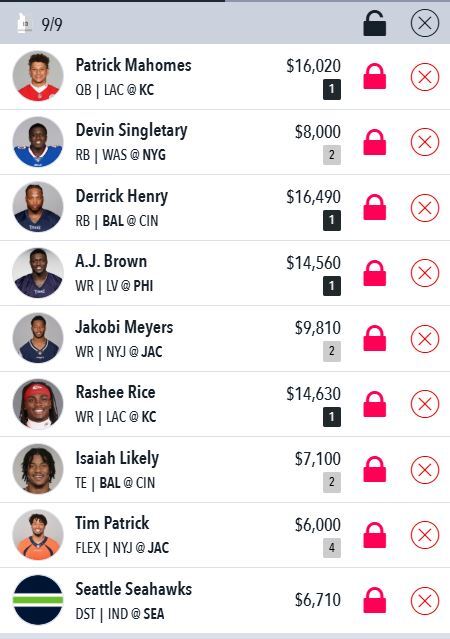
Patrick Mahomes — $16,020
Mahomes is one of the cleanest “pay up and feel good” QBs on the slate because he’s still producing like an elite fantasy scorer even when the Chiefs aren’t perfect. He comes in with 3,398 passing yards and 22 TDs on the season, and when Mahomes gets pushed, his ceiling comes from volume (attempts), efficiency (explosive plays), and red-zone creativity.
The matchup is DFS-friendly because Chargers @ Chiefs is one of the slate’s most stackable games. The way to play Mahomes on Draftstars is rarely “naked”: build Mahomes + 1–2 pass-catchers, then consider a Chargers bring-back to keep the game live. If you’re paying this tag, you’re chasing a 28–35 point outcome — and Mahomes still has that in his range of outcomes any week.
Tyler Shough — $11,780
Shough is the classic Draftstars salary-release QB who doesn’t need to break the slate — he just needs to not tank you while enabling the rest of your lineup to be loaded with touchdown equity.
Your edge with Shough is roster construction: you can jam premium RB/WR/TE pieces and still have a path to first if Shough gets you a serviceable 16–22 and your studs do the nuking. Pair him with a single pass-catcher (or even run him as a one-off if the Saints’ production is condensed), and make sure you’re building a coherent story: if New Orleans is chasing points, Shough’s dropbacks and scramble equity rise. In big-field contests, Shough lineups often win by being balanced everywhere else.
QB Strategy
On a 13-game slate, you’ve generally got three viable approaches:
– Pay-up QB stacks (Mahomes archetype): higher raw ceiling, easier to correlate, but you need to find value elsewhere.
– Mid/cheap QB (Shough archetype): win through stud density and TD equity; correlation still matters, but the lineup’s ceiling comes from your non-QB slots.
– Game-stack or mini-stack emphasis: because ownership spreads out, you can win by stacking one game properly while the field over-diversifies.
Running Backs
Derrick Henry — $16,490
Henry is exactly what you want on Draftstars: touchdown equity + volume + game-script sensitivity that works in your favour when Baltimore controls the game.
Henry’s season profile is still elite: 222 carries, 1,025 rushing yards, 10 TDs. The appeal is simple — if the Ravens get inside the 10, Henry can turn two snaps into 12 points. In tournaments, he’s also a great way to differentiate from the WR-heavy builds that naturally happen on massive slates. The main decision is roster construction: if you’re paying for Henry, you’re accepting that your value needs to come from either QB (Shough) or a cheaper WR/TE.
Travis Etienne — $12,870
Etienne is a strong mid-range RB because his role is built for Draftstars scoring: he can get there on rushing volume, and he can still add receiving points when the game script pushes Jacksonville into more dropbacks.
Etienne’s season production is RB1-quality: 201 carries for 917 yards and 7 rushing TDs, plus 26 receptions (and receiving scores on the year). He’s also the type of RB who spikes when Jacksonville is efficient in the red zone — and he has enough explosive-play ability to create a ceiling game without requiring 30 touches. In lineup builds, Etienne works best as the “RB2 with upside” in a Mahomes stack, or as the “anchor mid-range RB” in Shough builds where you’re paying up at WR/TE.
Devin Singletary — $8,000
Singletary is your true punt-ish RB value — and the main reason he matters is slate shape. On a 13-gamer, you don’t need to dumpster-dive, but you do need at least one slot that lets you access the ceiling of elite pieces. Singletary does that.
His season totals are modest — 86 carries, 306 yards, 3 TDs — so you’re not buying raw talent here, you’re buying salary relief + a path to 12–18 points if he falls into goal-line work or sees unexpected volume. He’s best used in tournament builds where you’re stacking a premium game and need one “don’t die” value piece.
RB Strategy
– Prioritise TD roles over “between the 20s” runners.
– Try to play at least one RB with 25+ point upside (Henry archetype), then decide whether your second RB is mid-range ceiling (Etienne) or pure value (Singletary).
– RBs correlate with game script. If your lineup is telling a story where a team is leading, an early-down hammer RB becomes more valuable.
– Don’t be afraid of WR-heavy builds, but make sure you’re not fading all high-end TD equity at RB — that’s how you get leapfrogged when the slate breaks via rushing touchdowns.
Wide Receivers
A.J. Brown — $14,560
Brown is the kind of Draftstars WR you pay for when you want alpha volume + touchdown access. He’s sitting on 62 catches, 799 yards, 6 TDs this season, and his role is built for ceiling outcomes because he can win at every level (YAC, deep shots, red zone).
The Raiders’ side being messy can actually help: if Philly is efficient, Brown can get there fast; if it’s sloppy and stays close, volume rises. In tournaments, Brown also creates leverage because many lineups will pay up at RB or jam a different high-total game. He’s viable as a one-off, but he’s even better paired with your QB stack if you’re building for a “passing TD concentration” storyline.
Stefon Diggs — $12,020
Diggs will get a second chance at revenge in week 15, as the Pats take on the Bills again. That matters because his DFS value is tied to how New England chooses to attack Buffalo — and in competitive games, Diggs still profiles as a target-earner who can rack up catches even without a massive yards-per-catch day.
On the year, Diggs has 64 receptions for 705 yards (with 3 TDs), which is solid volume for this price tier. The Draftstars angle is ownership: people often avoid “hard” matchups, so Diggs can come in under-owned — and in 13-game tournaments, that’s exactly the type of leverage you want. He fits best in balanced builds where you’re avoiding the ultra-expensive WRs but still want a real 25-point ceiling.
Jakobi Meyers — $9,810
At this salary, you’re looking for a WR who can give you target stability with enough red-zone or chain-moving role to compile points — and Meyers has done that with 55 catches for 636 yards and 3 TDs.
The way to play Meyers is as a stack component with Etienne lineups (game environment correlation), or as a standalone mid-tier WR when you’re paying up elsewhere. He’s also useful as a roster glue piece: he allows your lineup to be aggressive with a Henry/Brown-type spend while still keeping a realistic path to 16–22 points at WR.
WR Strategy
– On a 13-gamer, you can win with two pay-ups + one value, or one pay-up + two strong mid-range. Don’t lock yourself into one construction.
– Prioritise target share + red-zone role, not just “big-play vibes.”
– If you’re playing Mahomes, consider at least one correlated WR slot tied to your stack.
– Ownership spreads out on huge slates, so your leverage often comes from lineup combinations rather than one unique player.
Tight Ends
Brock Bowers — $13,610
Bowers is the premium TE you pay for when you want a legitimate WR-like role. Even in a chaotic Raiders season, he’s produced: 53 receptions, 619 yards, 6 TDs. Week 15 has Raiders @ Eagles, so you can pair Bowers directly with A.J. Brown as a clean mini-correlation piece (if the game stays alive, both can get there).
In tournaments, paying up at TE can be a difference-maker because the position is often fragile — when the expensive TE hits for 25+ and the mid-tier guys dud, you jump a massive chunk of the field. Bowers has genuine multi-TD upside, which is what you’re buying at this salary.
Isaiah Likely — $7,100
Likely is the salary-saving TE who can keep you afloat while you spend elsewhere. He’s taking on the Bengal’s, which is important because we’re targeting environments with scoring access. The Bengals have been easily the worst team at defending the TE position this season, so a real chance for a big Likely game.
His season totals are modest (18 receptions, 223 yards), but the Draftstars point isn’t “Likely is a target hog” — it’s that Baltimore’s TE usage can spike in the red zone and off play-action, and Likely doesn’t need 10 targets to pay off $7.1k. He’s best used as a tournament piece in builds where you’re betting on Ravens offensive success but you’re not fully stacking a Ravens passing game.
TE Strategy
– Decide early: are you paying up (Bowers) for ceiling, or punting (Likely) for roster construction?
– TE is a volatility position. In big slates, it can be optimal to either spend for a true difference-maker or spend down and accept variance.
– TE mini-correlations (Bowers with an Eagles bring-back, Likely with Henry lineups) can add structure without forcing full game stacks.

Defence / Special Teams
San Francisco 49ers — $6,710
The 49ers D/ST gets a strong setup with Titans @ 49ers in the late window. The key DFS note: San Francisco’s defence can create points through pressure and scoring chances even when their offence is controlling the game. They’ve logged 20 sacks and sit at a -4 turnover ratio on the season — not elite in pure turnover luck, but the matchup can still drive scoring if Tennessee is forced into catch-up mode.
In tournaments, pairing the 49ers D with a “49ers control” game script makes sense: short fields, more pass attempts from Tennessee, more sack/INT chances late.
Seattle Seahawks — $6,710
Seattle’s D/ST is in a great late-window environment, as they take on the Colts and 44-year-old QB Phillip Rivers, playing his first game in the league for FIVE years! They’ve produced pressure all year with 41 sacks, and that alone raises the D/ST floor because sacks are predictable fantasy events compared to random pick-sixes.
Seattle is also a strong choice if you’re running late-window stacks and want your defence aligned with a home favourite script. You don’t need a defensive TD — if they get you sacks + a turnover + low points allowed, you’re live.
D/ST Strategy
– Prioritise sacks + pressure rate over “hope for pick-six.”
– Correlate defence with your lineup story: defence works best with lead scripts.
– On big slates, D/ST ownership is flatter — you can play the good defences without feeling like you’re eating unbearable chalk.
Slate Strategy & Roster Construction
1) Stack with intent.
On Draftstars, you’re not just picking players — you’re building game scripts. If you’re on Mahomes, stack him with 1–2 Chiefs pass catchers and strongly consider a Chargers bring-back. If you’re on Shough, accept that the ceiling is coming from your studs and build accordingly.
2) Choose your spend-up identity.
You usually can’t pay up at everything. Decide whether your lineup is:
– RB-led (Henry as the slate-breaker),
– WR-led (A.J. Brown as your alpha),
– TE-led (Bowers as positional leverage),
– or balanced studs (Shough + multiple mid/high spenders).
Final Thoughts
This is the kind of slate where first place is usually won by one correlated ceiling outcome plus two or three correctly chosen touchdown roles — not by trying to cover every game. Build a tight story, embrace a little variance (that’s what big slates reward), and don’t be afraid to be “slightly uncomfortable” with one value piece if it unlocks a lineup that can legitimately score 180+.
Suggested NFL Draftstars Lineup