
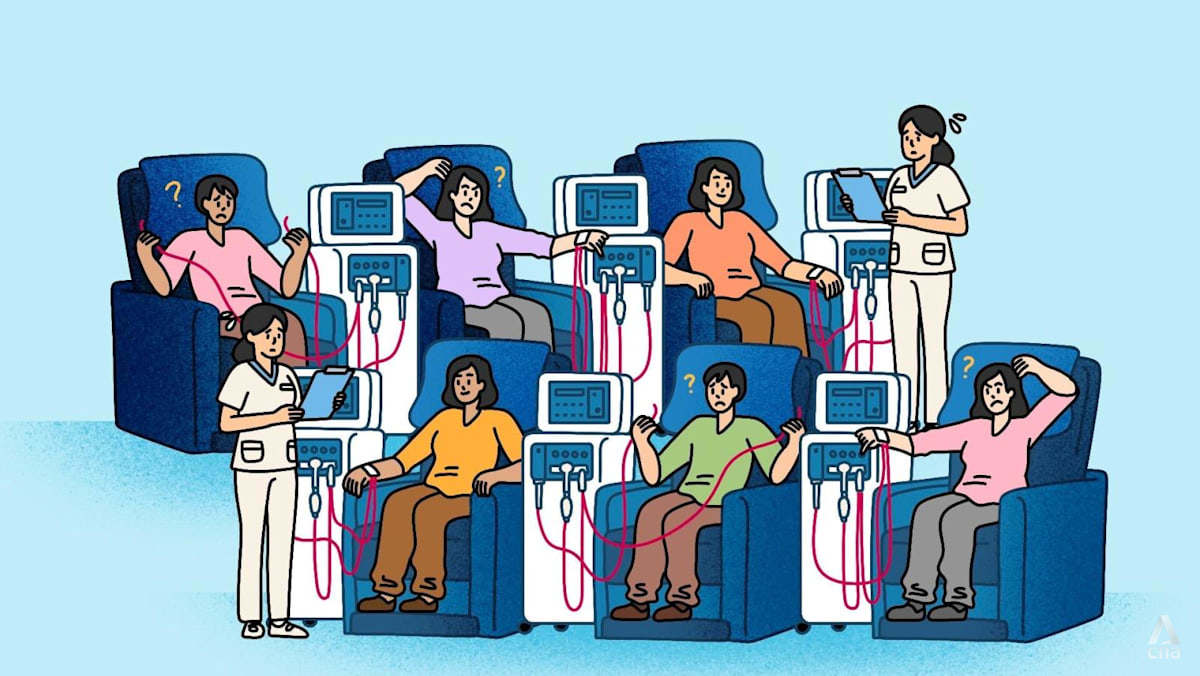
MORE DIALYSIS CENTRES NOT THE ANSWER
For operators, expanding dialysis services to cope with the rising demand is proving increasingly challenging.
Singapore’s largest dialysis provider NKF now operates 45 centres, up from 28 a decade ago. Despite the expansion, it is feeling the strain of increasing medical demands from growing numbers of patients.
A decade ago, dialysis treatment cost about S$26,000 per patient annually. Today, the figure stands at around S$35,000.
The rising costs is less to do with inflation but more do with the increasing complexity of each case.
“Reflecting Singapore’s ageing population, more patients are now frail, have limited mobility, or live with multiple chronic conditions.
“This increases the level of support required, from nursing care and medication management to transport, physiotherapy and emotional support,” said a spokesperson from KDF.
Reflecting KDF’s observations, NUH noted that many kidney failure patients also have conditions such as heart disease, stroke, or peripheral arterial disease, leading to frequent, prolonged hospital admissions.
“These result in heavy utilisation of hospital dialysis resources, including centre space, treatment shifts that are often fully occupied, nursing staff, medical care, allied health services and caregiver time,” said Dr Chua.
NKF currently has a waiting list of about 40 patients waiting to be admitted across eight centres in the northern region and the estimated waiting time for a place could range from a few months to several years.
While building more centres might seem like the simplest solution to this, NKF’s Ms Tan said that it was not the answer, as it is “not a sustainable way forward”.
In the same vein, Dr Chua from NUH noted that the biggest challenge when it comes to scaling capacity is the lead time for new facilities which runs into the years and cannot keep pace with the surge in patient demand, which rose sharply from 2020 to 2023.
Ms Tan said that instead of expanding NKF will have to focus on retrofitting existing facilities and optimising their use which includes finding a way for more patients to receive nocturnal dialysis.
Nocturnal dialysis could help NKF treat more patients without building new centres, but higher operating costs and the need for extra manpower mean the service is limited.
Currently, only three of its 45 centres offer night-time sessions though some other private providers, like KidneyCare run evening or overnight shifts.
“If we are able to add a nocturnal shift to the remaining 42 centres, our capacity could increase by about 2,000 patient slots,” said NKF’s spokesperson.
Manpower remains a constraint, contributing to ballooning costs.
Other providers, including KDF and IKC, have also highlighted sector-wide pressures, with rising demand for renal-trained staff contributing to higher labour costs.