
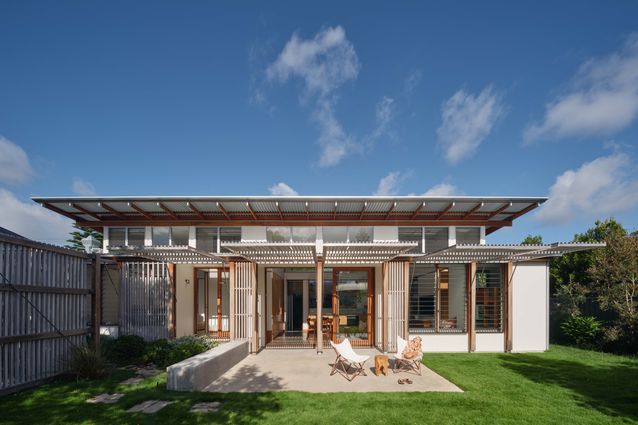
For a house that occupies a small footprint, Moffat Morphing House pulls off some big moves. The 75-square-metre residence – built in the backyard of an existing freestanding shop in the Sunshine Coast suburb of Moffat Beach – is a clever example of gentle density and infill housing on a mixed-use site. The house also possesses a flexible program that will adapt to the needs of its owners over time. Matt Kennedy from Arcke has designed a shapeshifting shop house that breathes new life into a time-tested concept for housing.
The combination of a house co-located with a shop matches the local pattern of one- and two-storey mixed-use buildings that populate Moffat Beach’s main streets. It’s a typology that has persisted since the 1940s, with private dwellings located above or behind retail tenancies. Shop houses provide a gentle – almost invisible – form of density to neighbourhoods. Their prevalence in beachside locations provides accommodation options in summer, when a town’s population swells with the influx of holidaymakers, while maintaining active occupation of the building when the home is empty at other times of the year. Moffat Morphing House renders a twenty-first- century version of the horizontal shop house, where the home is physically detached from the shopfront.
View gallery
In another nod to local vernacular, the compact home is reminiscent of the beach shacks that once dominated the holiday town. The scale of the dwelling – also reflecting that of a modern-day secondary dwelling – reveals its multifunctional intentions. For now, it serves as holiday home for a couple and visiting family, but in time it will become a right-size – or downsized – dwelling for aging in place.
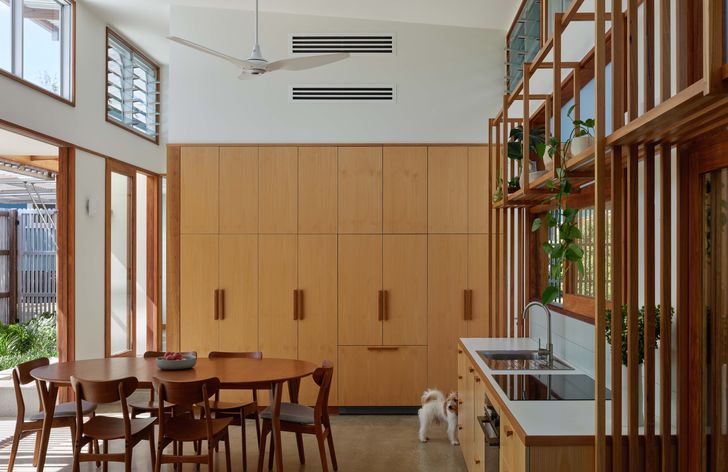
Flexible occupation patterns are enabled by the home’s detailed and efficient spatial planning. Living spaces are prioritised and flow out into the garden, an approach that connects the home with its surroundings. Bedrooms and bathrooms are modestly sized, with sufficient space for sleeping, bathing and minimal storage. Two bunk rooms are recessed as private nooks while also incorporating ample openable fenestrations for daylight and natural ventilation. Such planning learns from the work of Queensland modernist architects including John Dalton, Graham Bligh and John Railton, where family life occurs in shared living areas and, most importantly, in the garden. In the same vein, Arcke’s design for Moffat Morphing House celebrates the Sunshine Coast’s benign climate and the ability to enjoy living in the garden year-round.
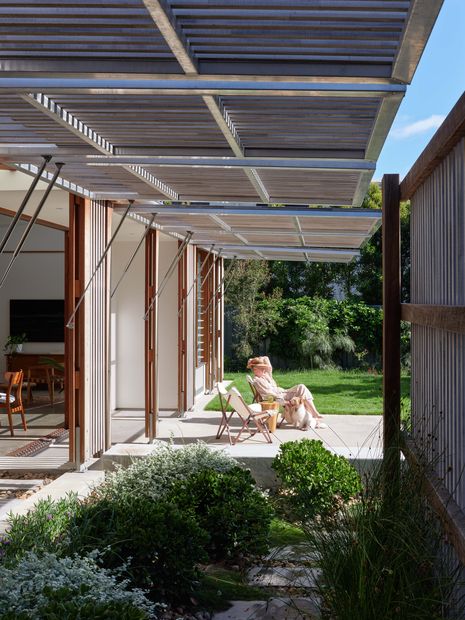
Fringing this connection between the house and the garden are operable screens that lift up along the eastern facade. When they are open, they shade outdoor living spaces that border the home’s perimeter. These shaded edges become interstitial spaces between inside and outside, and expand living spaces when the owners are entertaining guests. When the screens are folded down, they provide shade and privacy for intimate inhabitation. Like an expanding and contracting rib cage, the battened screens allow the house to breathe. When the screens are folded down, doors and windows can remain open to facilitate air movement through the interior and, of course, when open they maximise ventilation and passive cooling for hot and humid days.
The folding screens are a visual and physical signifier for Moffat Morphing House’s shapeshifting superpowers. It’s a clear and thoughtful design strategy that learns from the shop house, the beach shack and the secondary dwelling to enrich the home’s capacity to change and adapt over time as the owners’ needs change.
For more on Moffat Morphing House by Arcke, read an interview with the owners.
View gallery