
“This reliance not only drives up prices, but could also lead to a 14 per cent increase in grid emissions across the NEM [National Electricity Market]. This is not specific to data centre load, but an inherent result of load growth tightening electricity supply in the short term.”
It said that to mitigate most of this impact an additional 3.2 GW of renewable capacity would be required over the next decade, in addition to wind and solar already expected to be built – enough for almost 5 million Australian households.
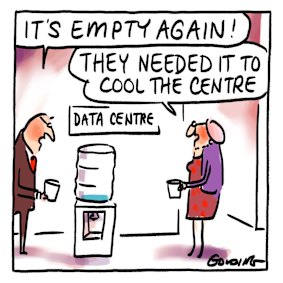
Credit: Matt Golding
“While challenging, if the right incentives were in place to enable this additional renewable generation to be built in those time frames, price rises would be limited to 7 per cent for NSW and 6 per cent for Victoria, with emissions increases eliminated,” it said.
“Price rises could be further reduced by introducing additional flexibility through the deployment of a further 1.9 GW of large-scale battery energy storage systems.”
The CEFC’s head of infrastructure, Julia Hinwood, said that if governments collaborated on policies to manage the demand by co-ordinating on driving some of the new centres towards renewable energy zones that had adequate grid and data collections, water supply and workforces, the new demand could help drive investment towards renewable energy and help stabilise the grid.
The report finds that in some areas, the development of large data centres can benefit grid management. The large and steady demand of data centres can reduce renewable curtailment, which can block green energy from flowing onto the grid during peak generation periods when the sun is strongest in the middle of the day.
This, in turn, could improve the business case for new renewable development and smooth grid supply and demand.
Hinwood said good planning could help Australia support the industry while avoiding problems faced in Ireland, where surging data centre demand now accounts for 21 per cent of energy, and Singapore, which had to introduce a moratorium on new centres.
A spokesman for Climate Change and Energy Minister Chris Bowen said Australia should keep building its reputation as a top choice for data centre development, and that the report showed that if “we get settings right” the industry could drive new investment in clean energy. “Our focus will be ensuring this doesn’t come at a cost to consumers,” he said.
A report published on Monday showed that individual data centres proposed for major cities were seeking daily water volumes equivalent to that used by 80,000 homes, prompting calls for stricter regulation and water efficiency standards.
At last month’s United Nations climate talks in Brazil, Melbourne Lord Mayor Nicholas Reece championed an initiative for cities around the world to develop shared guidelines and standards for low-carbon and water-efficient AI infrastructure.
At the time, Reece said data centres and AI infrastructure accounted for 2 per cent of Melbourne’s energy consumption, which was expected to rise to 8 per cent in five years and 20 per cent by 2040.
Get to the heart of what’s happening with climate change and the environment. Sign up for our fortnightly Environment newsletter.