
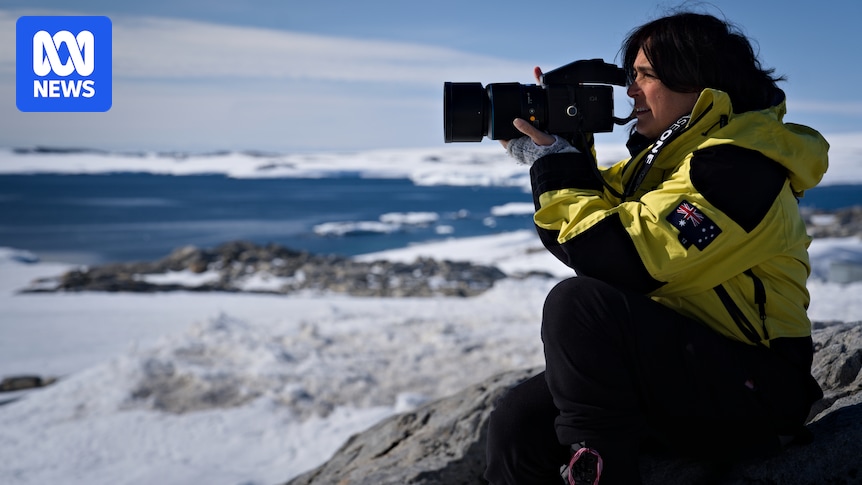
At a penguin colony on the Antarctic coast, Leila Jeffreys has her camera at the ready.
“It’s been something I’ve dreamed about for so many years,” she said as a group of Adélie penguins gathered nearby.
“To finally be in this colony, where there are thousands and thousands of these birds … they’re just extraordinary, they have a lot of character.”
Jeffreys describes herself as an “artist activist” who specialises in bird portraits.
Her images, which have featured everything from cockatoos to kiwis, are exhibited at human scale to highlight the birds’ unique characteristics in fine detail.
“Once your heart connects to the beauty of these incredible beings that we live amongst, then you can’t help but just love them to bits and want to do the right things for them,” she said.
The photographer is on the icy continent as part of the Australian Antarctic Art Fellowship, which gives creatives the opportunity to spend up to four weeks in the polar region.
Jeffreys usually works in an inner-city studio, where her feathered subjects are photographed in front of a large backdrop to remove any distracting elements.
Here in Antarctica, she’s using a much smaller backdrop, placing it near the colony, in the hope the penguins will voluntarily waddle towards it.
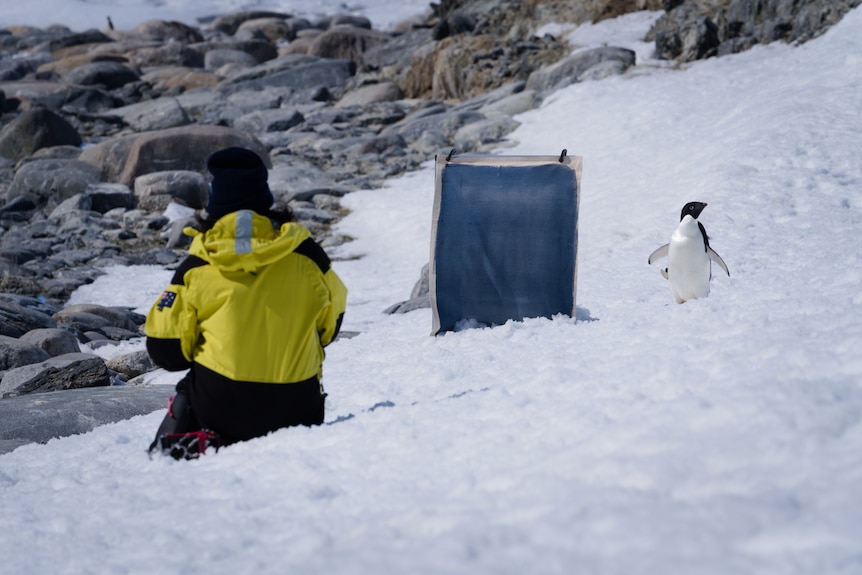
Leila Jeffreys tries to photograph a penguin in front of a backdrop. (ABC News: Jano Gibson)
“Whether they are in front of it, walking across it, inspecting it, it doesn’t really matter,” she said.
“It’s almost a landscape, it’s an experiment.”
After several days of trial and error, the perfect moment eventually arrived when two inquisitive penguins made a dash across the ice to pose right in front of her backdrop.
“Magic happens in Antarctica,” she said.
Jeffreys is planning to publish a book about her experiences in Antarctica and the sub-Antarctic.
Loading…Multimedia artist captures ‘edge of the world’ spaces
Joining her in Antarctica this season is audio-visual artist Polly Stanton, who also received a fellowship.
“I think what’s really struck me being here is just how immense it is and almost how it is so incredibly dreamlike,” Stanton said.
“I understand why it really affects people.”
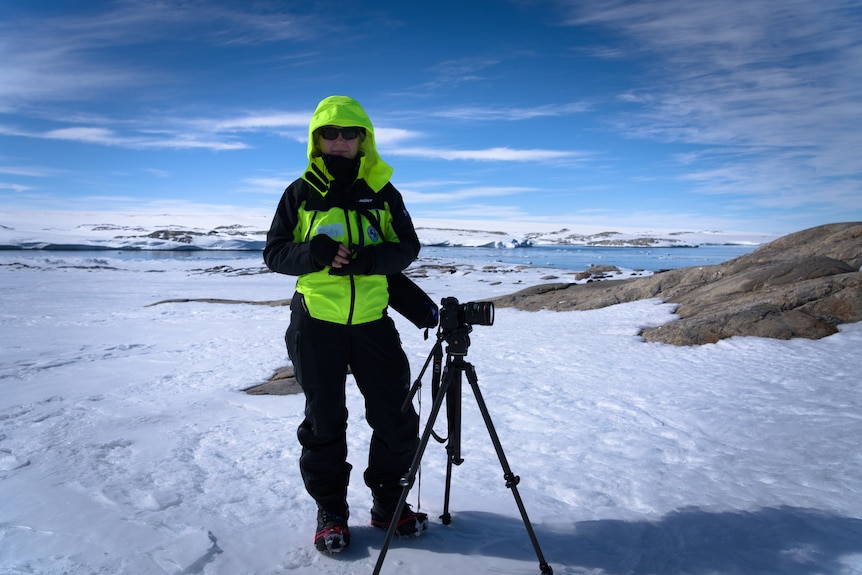
Polly Stanton is planning to create a large-scale multimedia work. (ABC News: Jano Gibson)
Stanton focuses her work on “contested spaces”, where human impacts intersect with the natural world, such as mining sites.
In Antarctica, she’s capturing sound and moving images at Casey Station, including its generator and incinerator.
She’s also filmed the abandoned Wilkes Station, which is littered with waste from the 1960s.
“I’m really interested in environments sort of on the edge of the world in remote places,” she said.
“And how people survive in those sorts of spaces, what they create, what they do in those spaces, and also what they leave behind.”
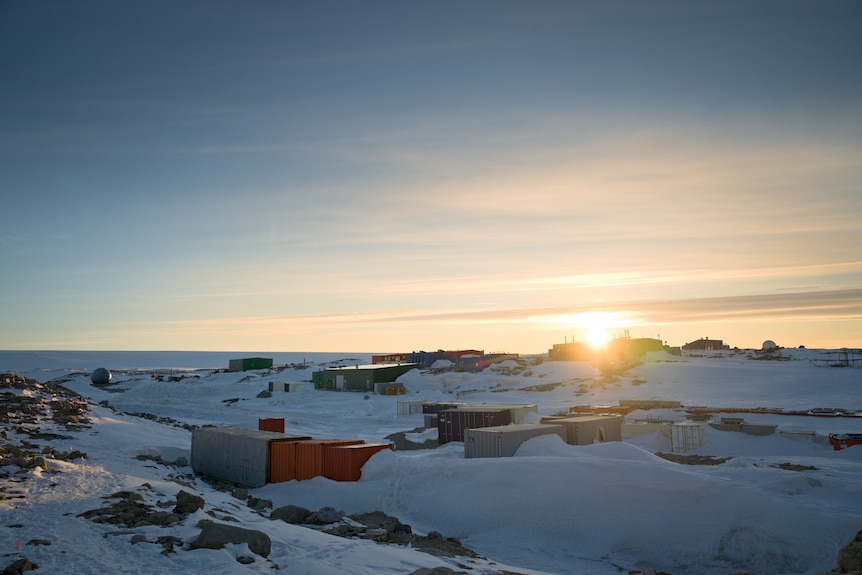
Casey Station is the largest of Australia’s three bases in Antarctica. (ABC News: Jano Gibson)
Stanton plans to create a large-scale moving image work based on her experiences in Antarctica, the first iteration of which will be exhibited in Melbourne next year.
“It’s an absolute privilege to be here,” she said.
“It’s not a space that many people get to experience and the Australian Antarctic Arts Fellowship is really, for an artist, the most logical way to have a chance to come here”.
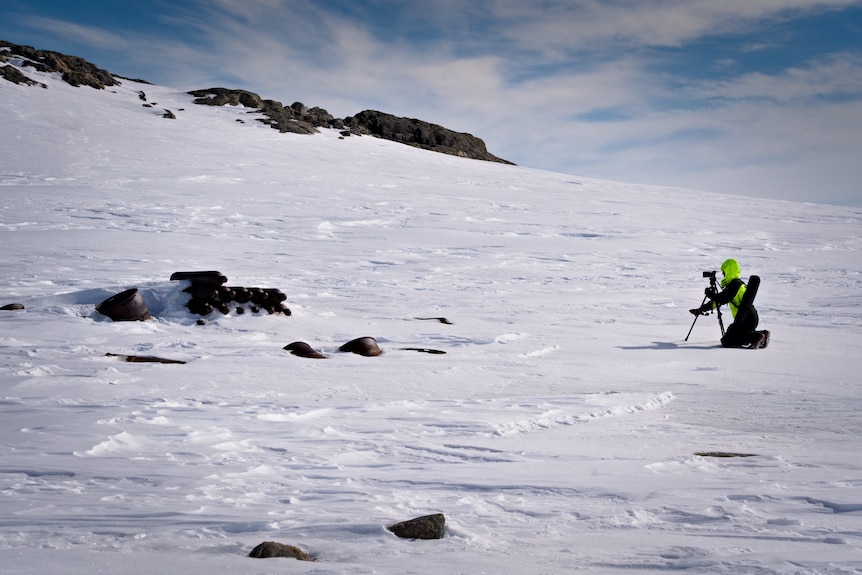
Polly Stanton focuses on “contested spaces”, where humans interact with the natural environment. (ABC News: Jano Gibson)
Applications open for next year’s fellowship
The fellowship program has been running since 1984.
Over that time, more than 80 artists have travelled to Australia’s Antarctic and sub-Antarctic stations, or joined a voyage on the national icebreaker.
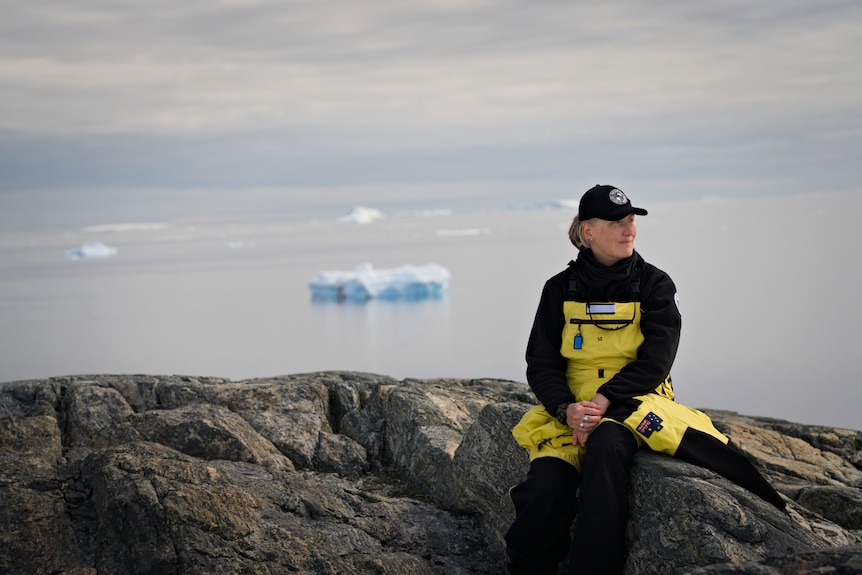
Annalise Rees says the Antarctic Arts Fellowship is open to all types of creatives. (ABC News: Jano Gibson)
Annalise Rees, the assistant director of arts and education engagement at the Australian Antarctic Division, manages the program.
“We’ve had performance works, sound works, there’s been a lot of visual arts, writing, literature, books published,” she said.
“We’ve even had a harpist on the ice [and] there’s been a dancer.
“The works are quite varied.”
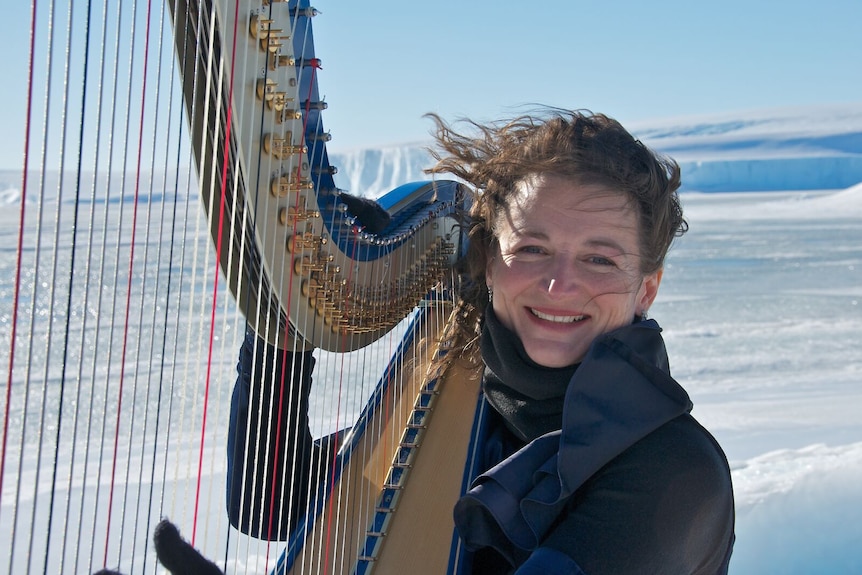
Harpist Alice Giles was an Antarctic arts fellow in 2011. (Supplied: Glenn Jacobson/Australian Antarctic Division)
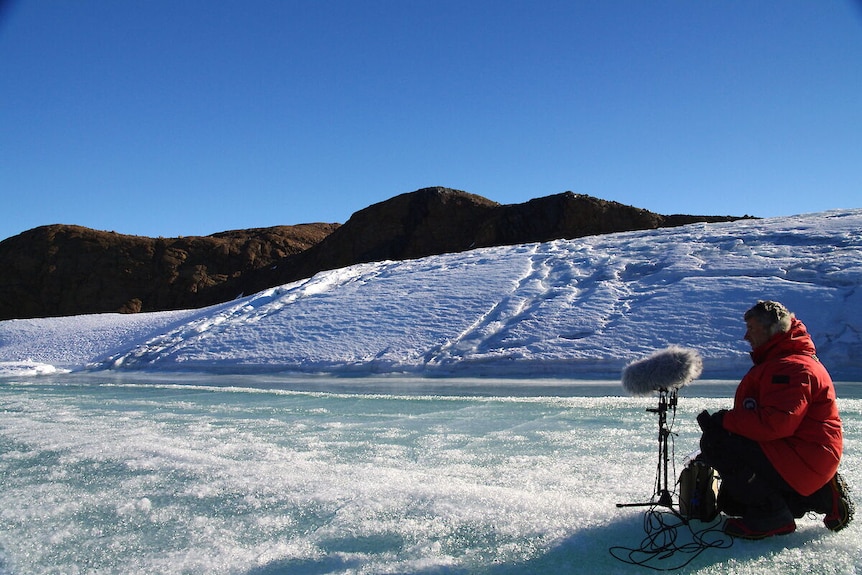
Philip Samartzis recording at Trajer Ridge near Davis Station in 2015 as part of the arts fellowship program. (Supplied: David Atkins/Australian Antarctic Division)
Dr Rees said when the works were exhibited in Australia and abroad, it helped deepen the understanding of the Antarctic region for people who’ve never been able to travel there themselves.
“Art, I think, plays an important role in building connection because it both intellectually and emotionally connects us to something that we may not directly have experienced,” she said.
“And that is Antarctica for most people.”
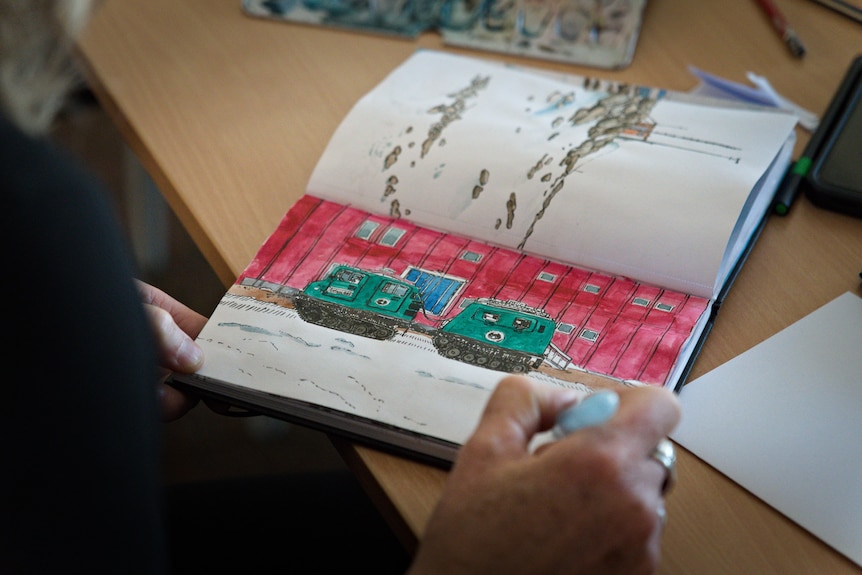
Annalise Rees works on an artwork at Casey Station. (ABC News: Jano Gibson)
Fellows are selected through a competitive process, with about 150 people applying last year.
Expressions of interest for next year’s Antarctic Arts Fellowship open today, with applications due by the end of January.
The ABC travelled to Antarctica with the support of the Australian Antarctic Program.