
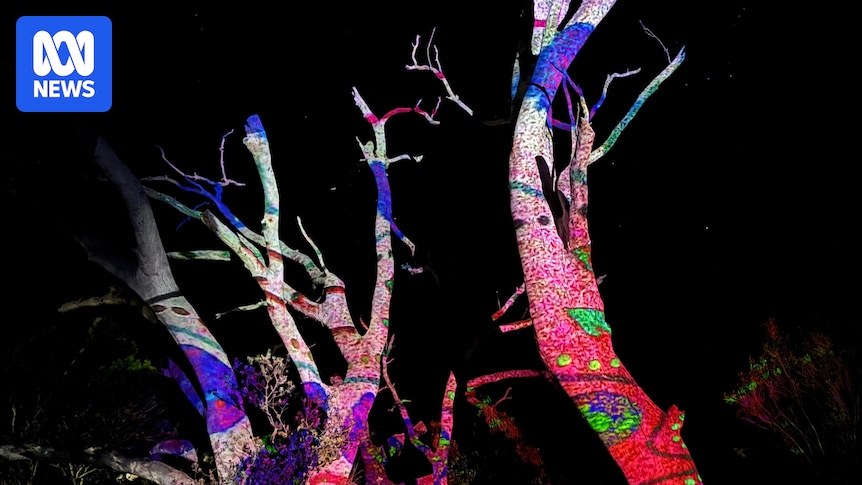
As the sun sets, the banks of the Barengi Gadjin (Wimmera River) in Victoria’s west come aglow with stories of the Dreamtime.
It is a Saturday night, and under the shadows of ancient, towering river red gums the voices of Wotjobaluk elders honour the Creation stories of the Wotjobaluk Nations.
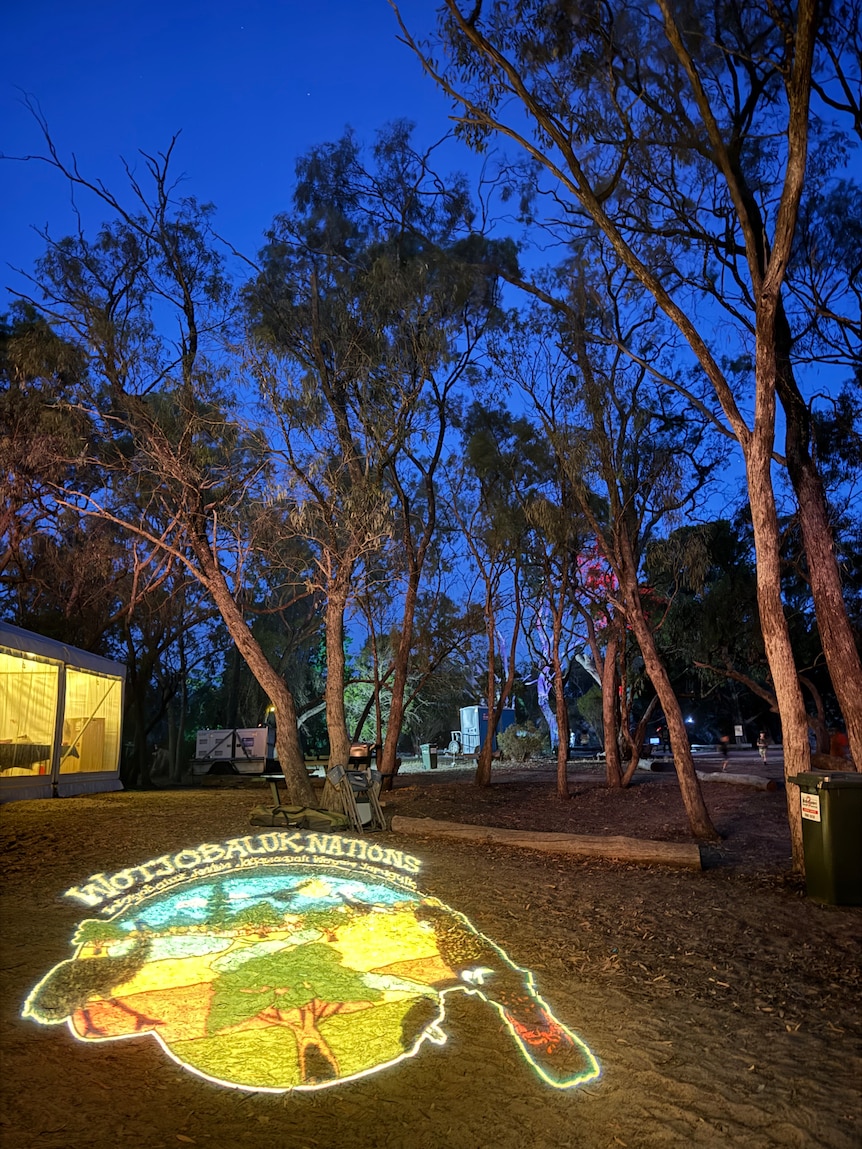
The Wotjobaluk Nations Festival was held at the sacred site of Horseshoe Bend, north-west of Melbourne. (ABC News: Grace Marshall)
The Wotjobaluk Nations Festival was held at Dimboola on the weekend, and included a light show by Wotjobaluk and Ngarrindjeri artist and storyteller Tracy Rigney.
She used dance, animation and multimedia to illuminate culturally significant sites around Horseshoe Bend, in the Little Desert National Park, 337 kilometres north-west of Melbourne.
“It’s this immersive self-guided tour where people can just walk around and be drawn like moths to a flame,” Ms Rigney said.
WARNING: Aboriginal and Torres Strait Islander readers are advised that this article contains images of people who have died.
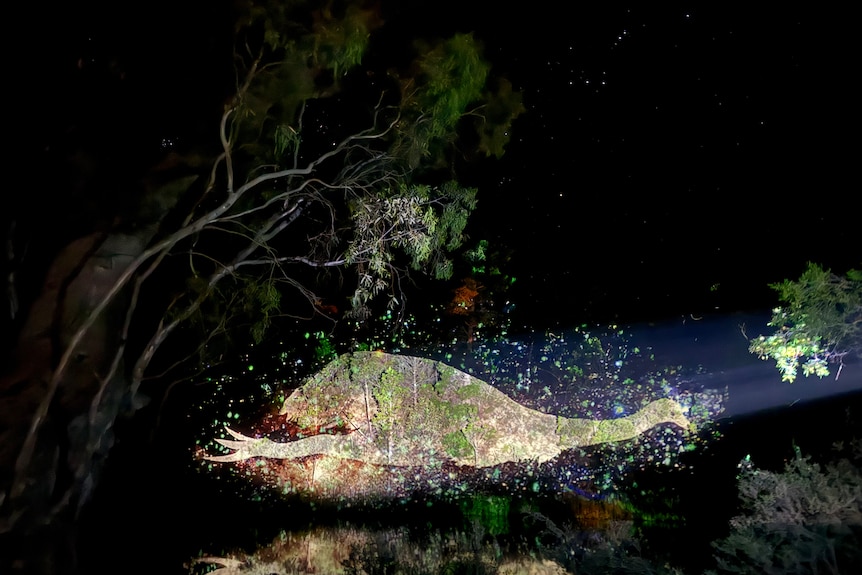
Tchingal, the giant emu is a Wotjobaluk dreaming story. (ABC NEWS: Grace Marshall)
Twelve installations lined the path offering a unique storytelling experience including three Talking Trees and the stories of Bunjil the Spirit Creator, Barra the Red Kangaroo and Tchingal the Giant Emu.
One of the most powerful moments was at stop seven — Bunyo Budnitt.
It is there that a snippet of the history of the Ebenezer Mission was told through projections and ceremonial dance performed by the Dalki Murrup ceremonial performance group.
The Ebenezer Mission station was established in 1859 by Moravian Missionaries and operated for more than 40 years before it was officially shut down in 1904.
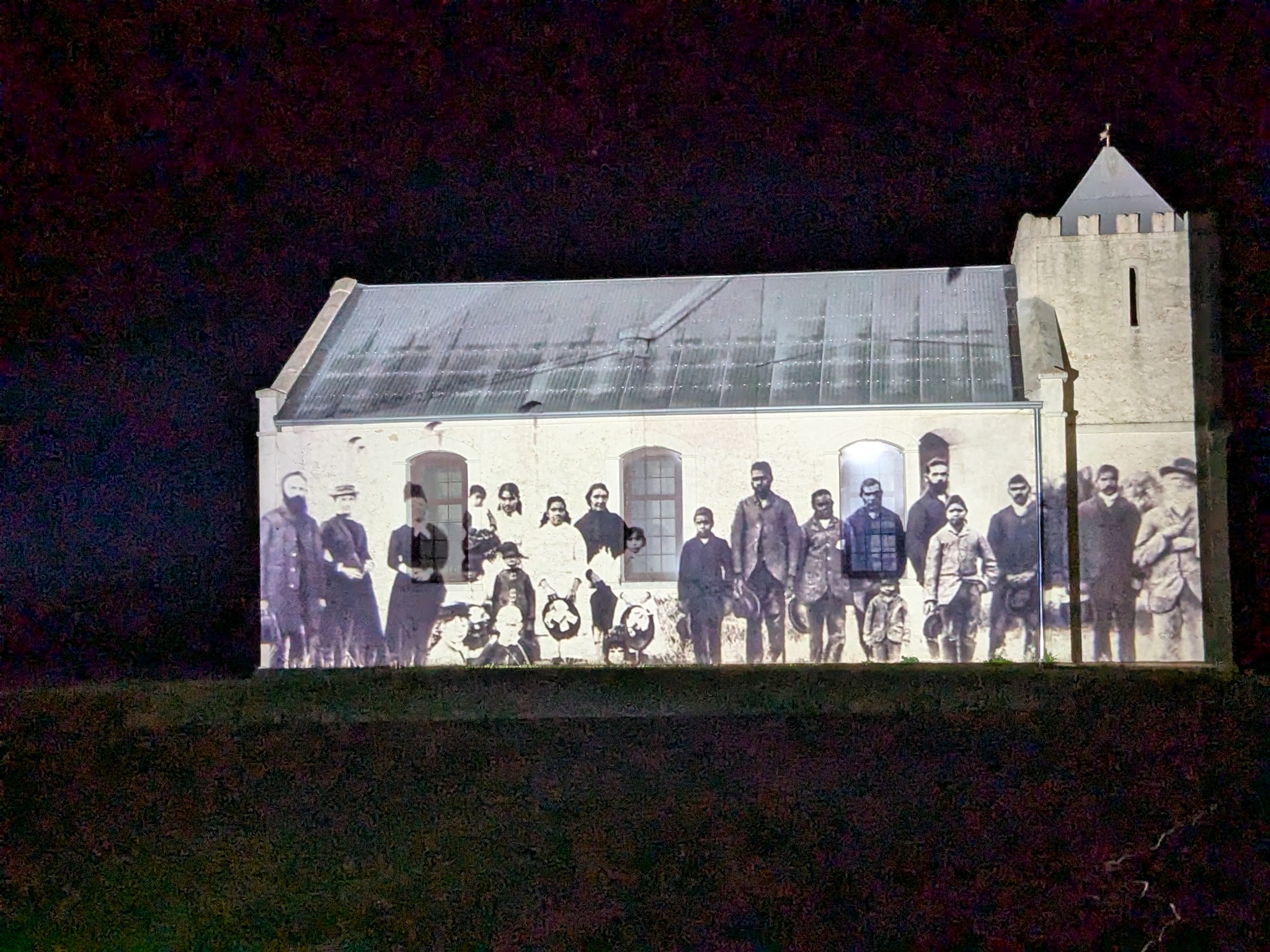
A projection on the former Ebenezer Mission as part of the festival. (Supplied)
Ceremonial dance returns to Country
For this year’s festival, the traditional dance of the Dalki Murrup ceremonial performance group was returned.
“It is all about revitalising our language and having our stories told through dance,” Gunditjmara and Wotjobaluk woman Tanisha Lovett said.
Ms Lovett said the group had been rehearsing for the past year to “create from scratch, what our people spoke before us, shared stories … and the way that they would dance”.
“Building confidence and finding your own identity in where you come from,” she said.
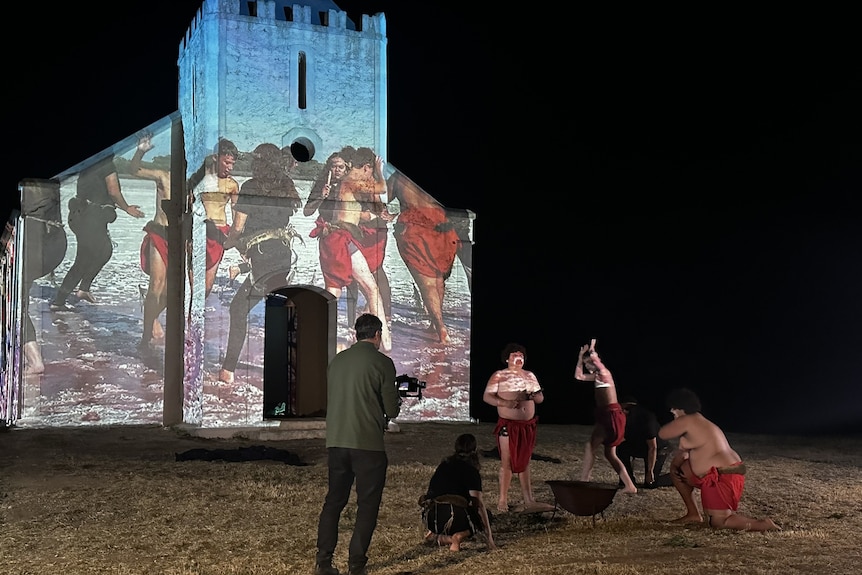
The Dalki Murrup ceremonial performance group dancing at Ebenezer Mission. (ABC NEWS: Supplied)
The performance included a welcome dance, an origin of fire dance, a repatriation dance and a “show-off dance”.
Aunty Janine Coombs, a Wotjobaluk elder and a board director of the Barengji Gadjin Land Council, is proud to see the return of the Dalki Murrup.
“To have that back and to see the younger generations just embrace it and to to see that in all its glory gives me a sense of pride,” Aunty Janine said.
Connection through song
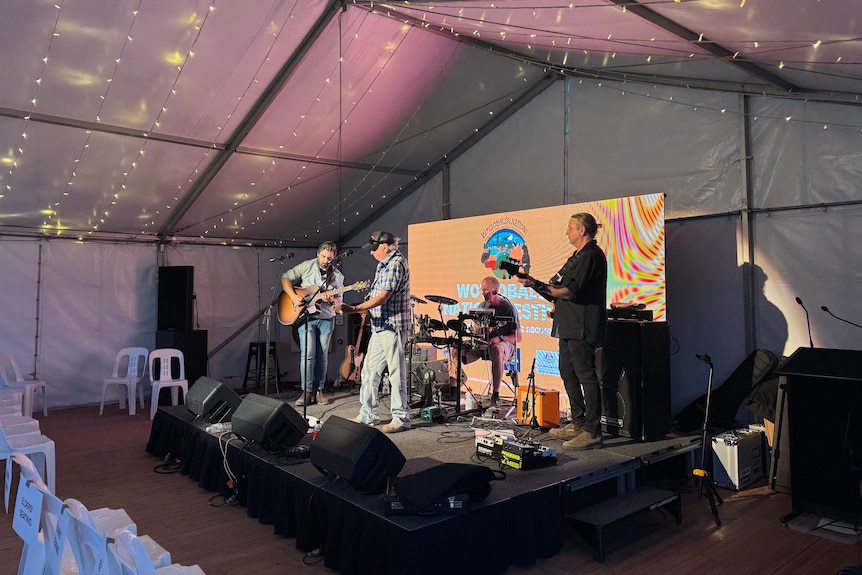
Gunditjmara man Andy Alberts and his band The Walkabouts. (ABC News: Grace Marshall)
Music was a key part of the festival, featuring performances from Wergaia and Wemba Wemba musician Alice Skye, Ngiyampaa singer-songwriter Pirritu and Gunditjmara man Andy Alberts & the Walkabouts.
Alice Skye said she weaved poetry and traditional Wergaia language into her music.
“It opens up a a bit of a portal in a way of connecting with your old people or your ancestors that were speaking language for a very, very long time. And it also just makes Country make sense,” Ms Skye said.
“It’s so awesome to see young people singing in language, it feels really special to see.
“I’m so proud of being from this Country … it’s the best place in the world.”
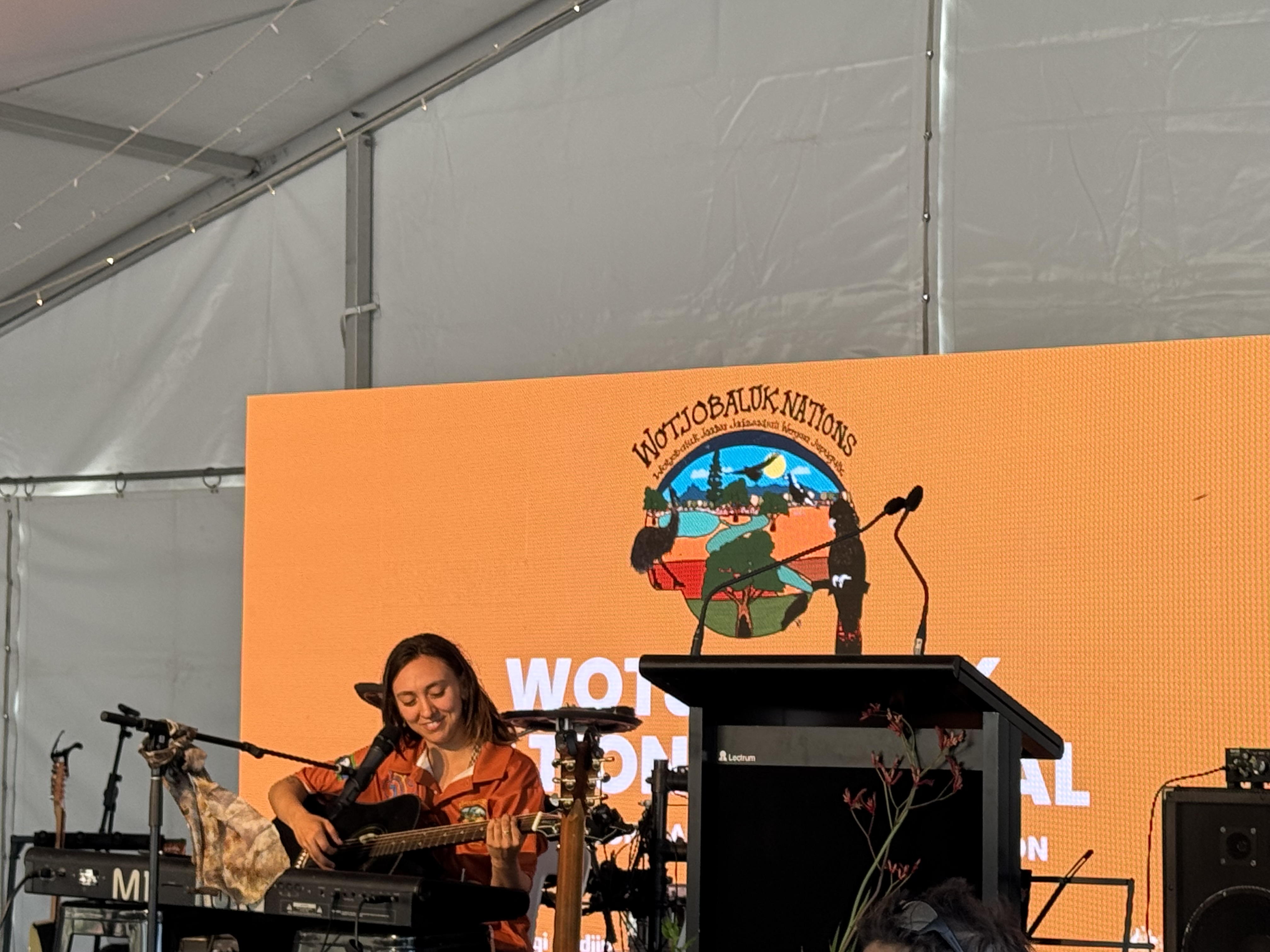
Musician Alice Skye weaves traditional Wergaia language into her songs. (ABC NEWS: Grace Marshall)
Native title recognition
The celebrations over the weekend were a powerful reminder of the resilience, identity and ongoing journey of self determination for the Wotjobaluk Nations.
The federal court’s landmark decision on December 13, 2005, was a historic first consent determination under the Native Title Act 1993 as Victoria’s first successful native title claim.
Aunty Janine said the decision “recognised that our sovereignty was never ceded within Wotjobaluk Nations”.
“Our ancestors fought for what is now being determined as self-determination. The hard work they did to get us here has been formally recognised,” she said.
More than 450 people attended the weekend event.
“It’s about giving our traditional owners, first and foremost, of all generations an opportunity to come together and celebrate such an outstanding achievement,” Aunty Janine said.
Chris Harrison, a Wotjobaluk man and chair of the Barengi Gadjin Land Council, said returning to the place where the agreement was signed was nostalgic.
“Today culminates a whole range of different things that have been brought together over time that we’ve improved and increased along with the organisation to make sure it’s something massive and making sure community is taken along on the journey,” he said.