
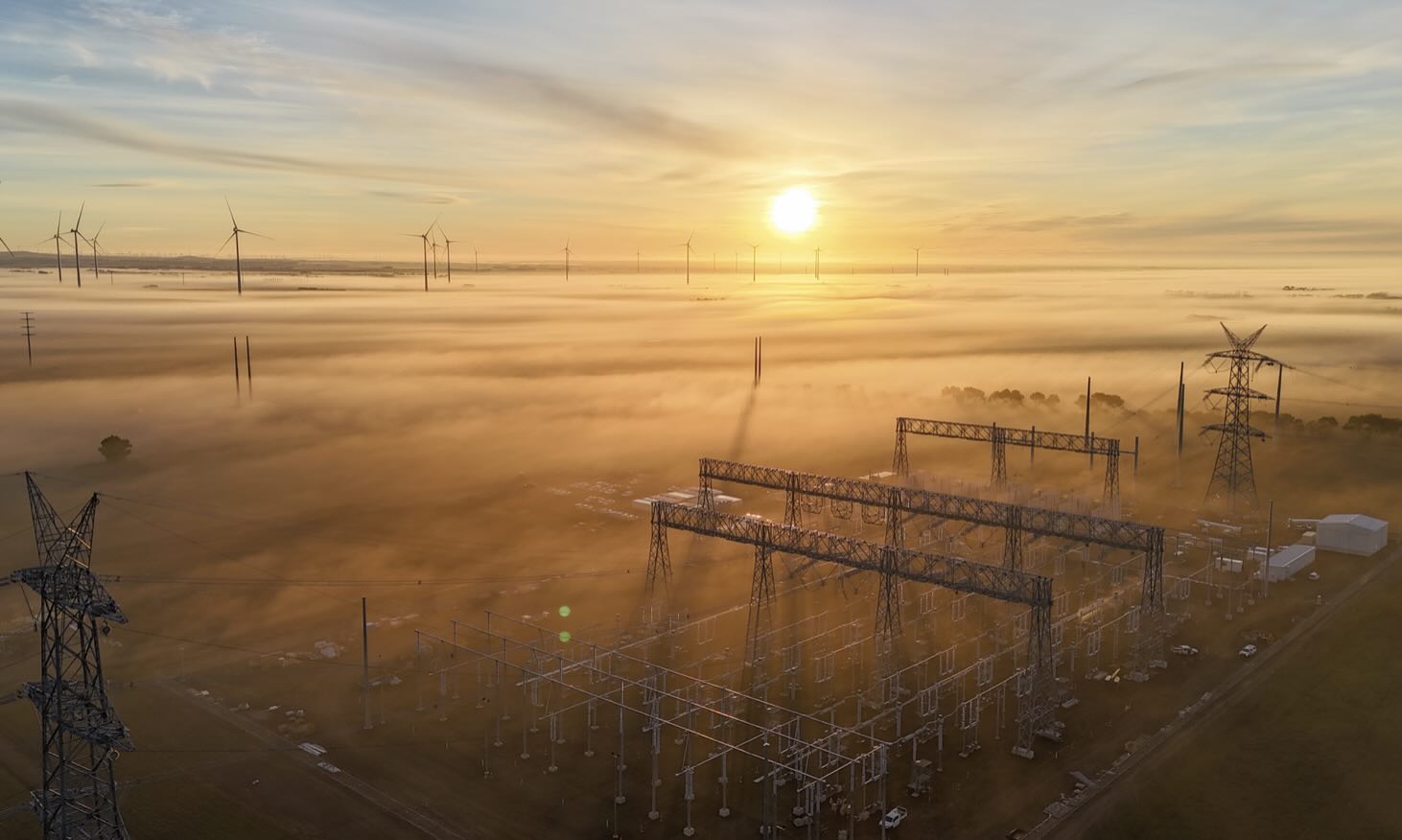
It says a lot about the history of grid connections in Australia that the on-time commissioning of the country’s biggest ever wind farm should even be notable for the breakthrough that it is. And the industry, investors and policy people are hoping it’s not a one-off.
Five years ago, the experienced renewable energy developers who made up the core of the newly-formed TagEnergy were thinking about their plans for what would become Australia’s biggest wind farm, the 1.33 gigawatt Golden Plains project near Geelong.
It was a time, says TagEnergy managing partner Andrew Riggs, when the issue of grid connections ranked as one of the biggest risk factors playing on the minds of wind and solar developers, and their financial backers.
It was a key issue that mattered to everyone: Slower connections mean a slower transisition to green energy and missed targets and higher bills; connection problems add to finance risk, and higher costs.
“When we were getting ready to go to financial close in 2021/22, that was a very different time,” says Riggs, a former head of sales and proposals at global energy giant Siemens.
“We were coming out of the “Rhombus of Regret” (the part of Victoria grid beset by capacity limits and grid connection problems and delays), and people were racking their brains working how to to mitigate the connection process.”
The breakthrough for Golden Plains, Riggs says, came from agreement from the Australian Energy Market Operator to share its models of the grid, allowing TagEnergy and its partners – wind supplier Vestas, VicGrid and AusNet, to test their own modelling off line and work out the best avenue of approach.
Riggs says that it meant that instead of submitting their own plan and waiting for a response, and hoping for the best, the parties were able to forge ahead, armed with the information they needed.
Vestas, the turbine supplier and EPC contractor, submitted a comprehensive R0 package for early assessment in November, 2021. And within nine months the project achieved AEMO’s S5.3.4A compliance, allowing for a Notice to Proceed to be issued on November 22, 2022.
These timelines may mean little to those outside of the industry, but to those wrestling with the complexities and mysteries of connecting into Australia’s long, stringy and heavily regulated grid, it was a landmark.
“Five years ago, investor confidence was at a low (because of the connections problems),”Riggs tells Renew Economy in an interview. “The story here is that it can be done. You can connect large scale projects on time. This is an example that other investors can look at.”
It’s a contrast to the stories that can be told about many other projects stuck in delays to receive grid registration, or who have had hiccups through the commissioning process.
Golden Plains started its commissioning process after the massive 923 MW MacIntyre wind project in Queensland, the smaller 400 MW Clarkes Creek project in the same state, but reached CoD (full commissioning) before both projects.
It reached full output in October, following dozens of grid tests across four Hold Points – many carefully planned through narrow “wind-windows”, some on weekends and overnight – as it ramped up capacity.
The connections process also finished on time despite major transmission failures caused by storms in 2024 – and the tragic death of a contractor working on the transport and storing of a turbine blade.
The 756 MW first stage is now complete. The 576 MW second stage in now being built, and will be progressively commissioning through 2026. A 150 MW, 600 MWh big battery is also being built at the site.
Riggs says the Golden Plains project has also been helped by a change included in the Connection Reform Initiatives that provided improved investment certainty when it came to adding stage 2 to the project.
But the most important part was the fact that the teams working on the project were more or less unchanged. “That is a super important things that you cannot legislate for,” Riggs says. “I have some slides from 2020 where we mapped out how to do it. We allocated the risks, the big thing was keeping the humans the same.”
VicGrid’s head of access and connections Claire Cass said the company worked closely with AEMO to ensure a “seamless process” for the completion of the grid connection.
“Connection of Golden Plains is an important milestone in this transition and in the work to secure Victoria’s renewable energy future,” she said in a statement.
Danny Nielsen, the Australia and New Zealand country head at Vestas said the success highlighted the trust in technology, while AusNet’s chief development officer Jon D’Sylva also credited delivery partners CPP, Jacobs, SRS and Hitachi.
“We have delivered this connection in close collaboration with TagEnergy, remaining focused on system security,” he said. “This milestone demonstrates the critical role collaboration and technical excellence play in enabling Victoria’s clean energy future.”
If you would like to join more than 28,000 others and get the latest clean energy news delivered straight to your inbox, for free, please click here to subscribe to our free daily newsletter.

Giles Parkinson is founder and editor-in-chief of Renew Economy, and founder and editor of its EV-focused sister site The Driven. He is the co-host of the weekly Energy Insiders Podcast. Giles has been a journalist for more than 40 years and is a former deputy editor of the Australian Financial Review. You can find him on LinkedIn and on Twitter.