
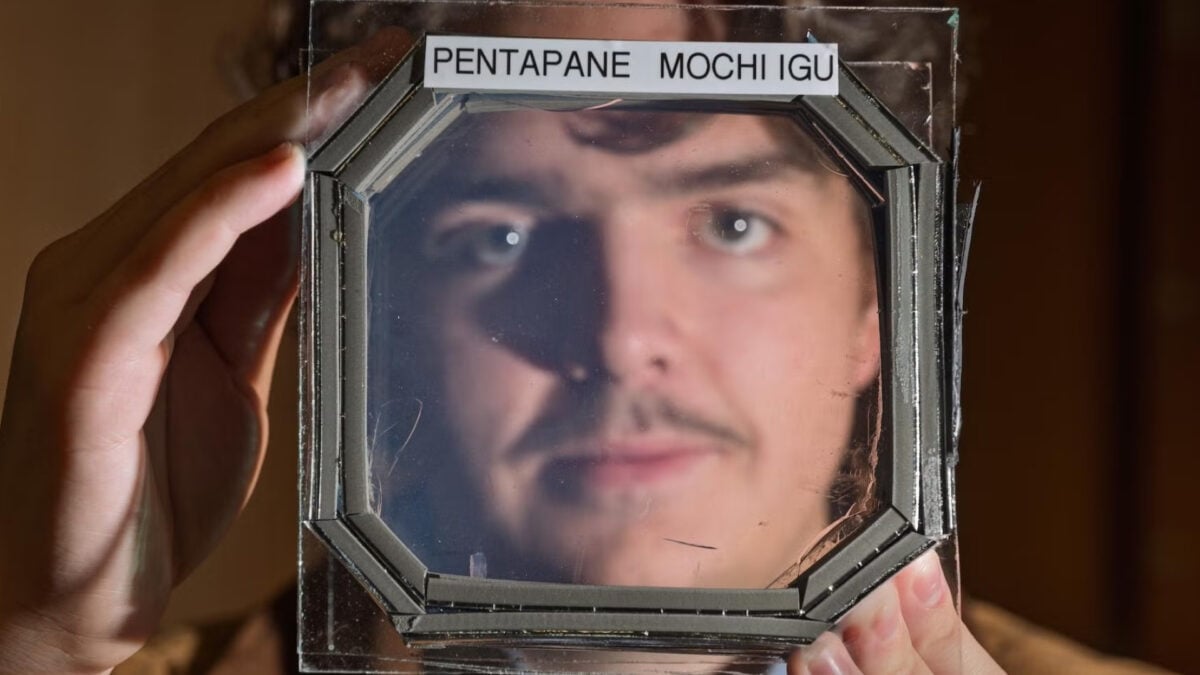
Buildings can leak a lot of heat. Scientists think the remedy might come in the form of fireproof, transparent “Bubble Wrap.”
Physicists at the University of Colorado Boulder have developed a new material called the Mesoporous Optically Clear Heat Insulator, or MOCHI for short. Unlike the name, MOCHI is no dessert—it’s a nearly transparent, long-lasting silicon gel that insulates so well, you could hold a flame on your palm without getting burned. Sounds unlikely? Here’s the video evidence, courtesy of the team:
Scaled up, MOCHI could be a thin sheet applied to windows to make buildings more energy efficient, according to a recent Science paper on the material. Further down the line, MOCHI could also appear in “applications ranging from extraterrestrial habitats to lightweight apparel,” Ivan Smalyukh, study senior author and a physicist at CU Boulder, told Gizmodo in an email.
Bubble wrap air-trappers
MOCHI appears flat and transparent on the surface, but zoomed in, the material is actually a collection of tiny pores thinner than the width of a human hair, according to the paper. The secret to MOCHI’s insulating abilities lies within these small air bubbles, which trap incoming or outgoing heat within their networks.
This mechanism is similar to aerogels, which NASA uses to insulate its Mars rovers. However, the air-trapping bubbles in aerogels are typically scattered throughout the material and reflect light, giving the final material a cloudy appearance.
By contrast, MOCHI reflects around 0.2% of incoming light. About 90% of the material is air, making the material almost completely transparent, Smalyukh explained. For one of their experiments, Smalyukh and colleagues applied MOCHI to a cold window and found that doing so stopped roughly 95% of heat transfer, somewhat like high-performance building roofs and walls—but transparent, he added.
 CU Boulder researchers show off the transparency of MOCHI. Credit: Glenn J. Asakawa/CU Boulder Is your building leaking?
According to Smalyukh, a major motivation for this project was the not-so-ideal energy efficiency of buildings worldwide. Specifically, buildings consume around 40% of energy worldwide, but poor insulation often leads to heat leaks that increase how much energy residents use to keep themselves comfortable, he said.
By contrast, most existing insulation materials are opaque and look unattractive when used on windows or building exteriors. MOCHI was devised to address both issues.
“Suitable building materials and technologies could allow for comfortable indoor environments at no or minimal energy consumption,” he said. “Thus, windows may finally even acquire new functions, well beyond what they are known for throughout the millennia of uses.”
A MOCHI barbecue
That said, MOCHI is still under development, as fabrication still takes quite a long time, the researchers admitted in a statement. But the team is hopeful. MOCHI ingredients are on the cheaper side, which “bodes well” for bringing the product to markets, Smalyukh said in the statement.
The team also sees much potential for MOCHI as a solution for energy sustainability. For instance, MOCHI could be repurposed as solar panels for buildings, especially in climate zones with limited access to sunlight, Smalyukh explained.
As of now, the researchers continue to test and refine their product. It’s also led to some interesting moments, like using MOCHI as a miniature grill to cook some sausages.