
With deep knowledge of who people are, there often develops a mutual forgiveness or blindness to character flaws or judgment failures because, hey, that’s just who they are and how they roll.
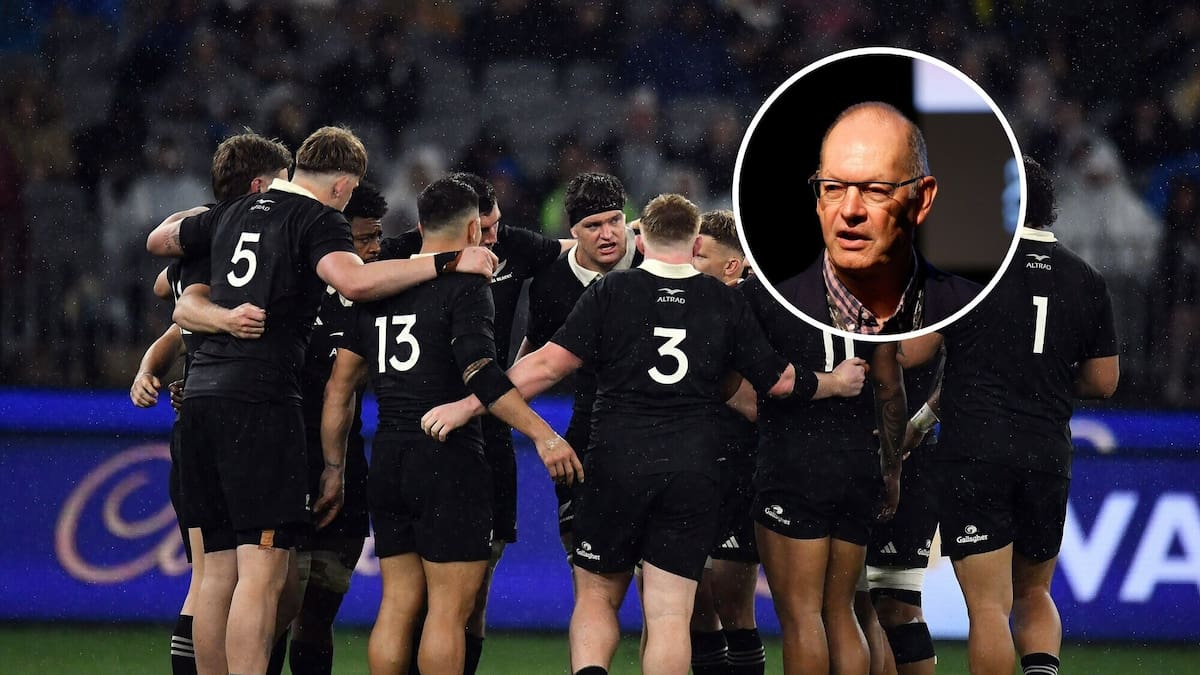
All Blacks captain Scott Barrett addresses his team. Inset: Don Tricker is assisting in the review of the side’s 2025 performances. Photos / Photosport
In a small country such as NZ where it’s almost inevitable that elite coaching teams will have some kind of previous connection, there is a constant need for decision-makers to be assessing whether high-performance environments are using shared histories between key figures to drive a valuable alignment, or whether there is an underlying cosiness through familiarity that is unwittingly softening attitudes and cultures.
This subject of how high-performance cultures should be reviewed and by whom, has been a hot topic for NZ Rugby’s board over the past two weeks.
For the past 15 years or so, responsibility for reviewing the All Blacks season has lain with the head of high-performance and the process has followed a template of interviewing players with a set menu of questions.
There are two problems with that pathway now.
The first is that NZR’s head of high performance, Mike Anthony, has a long working relationship with Robertson which stems back to the Crusaders where the former was the conditioning coach and the latter a player.
Anthony’s objectivity is beyond question and his professionalism undoubted; he was on the panel that chose Ian Foster as All Blacks coach in late-2019, ahead of Robertson.
But when it comes to All Blacks reviews, perception is all important and given the length of Anthony’s relationship with Robertson, the board has decided there has to be a best practice approach that recognises that friendships develop unintentionally.
There is also, however, a sense that the board may hold a deeper uneasiness that the highest echelons of NZ’s high-performance network are bound by interlocking histories, casting doubts on whether there is capacity for the sort of brutal objectivity which drives standards within the best set-ups.
If nothing else, the optics of having an outgoing chief executive who is a former Crusaders teammate of Robertson’s, an interim chief executive, Steve Lancaster, who is also a former Crusaders teammate and who was best man at the All Blacks coach’s wedding and Anthony as head of high-performance, don’t look great.
They are not helped by the fact that the three remaining national assistants – Scott Hansen, Jason Ryan and Tamati Ellison are all also ex-Crusaders.
Robertson has endured accusations of Crusaders bias throughout his tenure for his choice of coaching assistants and some player selections, but the issue is not related to parochialism or anti-Canterbury sentiment, but to the lack of diversity in the set-up and the concern that there could be uniform thinking, few dissenting voices and a comfort level that everyone is locked into a similar mindset and sees the world the same way.
Hence NZR’s board has been persuaded that the forthcoming review into the All Blacks’ season needs a level of independent oversight, which is why Don Tricker will be involved.
The former NZR high-performance manager, who is currently with the San Diego Padres, will be used in an advisory and guidance capacity, with Anthony and NZR’s general manager of professional rugby Chris Lendrum leading it.
It has not given the review the level of independence it truly needs to remove all doubts about its credibility, but Tricker’s experience and expertise in this area is such, that even in an advisory role, there is increased confidence the exercise will be more worthwhile than it otherwise would have been without him.
The second issue that has been the source of lengthy debate is the format of the review.
As Ian Foster wrote in his autobiography, Leading Under Pressure: “There is the formal process conducted by NZR, where they interview each player individually, working through a set formula of questions.
“This is more of an employment process than it is review, and I know several Kiwi coaches who don’t coach in NZ because of the review system, which they believe is flawed.
“How, for instance, can every player’s opinion be of equal value on things like strategy? There is a belief among coaches that NZR has got a habit of collecting the players’ feedback and then sifting through to over-focus on two or three respondents.
“You get two out of 33 players saying the coach sucks and that will be one hour of the review.
“Or you may find that a player was dropped for a few games, so they make negative comments about a coach, and that tends to be given a heavy weighting. How do you balance that to ensure there is perspective and context?”
It’s not clear what format the 2025 process will follow, other than it’s known discussions have been had to try to determine how best to drill deep into the team and hear the unfiltered truth from the players.
The All Blacks have come home from Europe without their coveted Grand Slam, an assistant coach down, confirmation that they face a probable World Cup quarter-final showdown with South Africa, and a raft of questions to answer about whether they are tracking in the right direction or treading water but marketing their stagnation as a consequence of their strategic effort to build depth.
One specific area worthy of deeper exploration is the division of labour within the coaching set-up and for there to be deeper understanding about what each coach does day-to-day.
The Herald has reported several times that Robertson’s set-up, where he self-styles himself as the culture coach, is different to previous All Blacks’ configurations.
But the question is how different, and by extension, how effective? And some answers provided to ascertain to what extent Robertson invokes his authority as head coach to shape strategy, win selection debates and enforce his will when he feels it is necessary.
He has clarified with the Herald that he maintains a high degree of operational oversight, vetoes or amends tactical plans presented by assistant coach Scott Hansen and that he makes the final call in selection and operates in the same way as most other head coaches in the international arena.
However, the Herald has also learned that several players have sought clarity from Robertson about why they were not selected for certain games, only to be told they would need to take that up with Hansen or forwards coach Jason Ryan.
The slightly confused and contradictory picture that is emerging around the coaching set-up, combined with a slightly under target 74%-win ratio, enhances the importance of NZR’s board being furnished with a status report that is a true reflection of the All Blacks coaching set-up and high-performance environment, and not an exercise in reputation protection and relationship preservation.
Gregor Paul is one of NZ’s most respected rugby writers and columnists. He has won multiple awards for journalism and written several books about sport.