Polarized training has become one of the most talked-about concepts in endurance sport over the past two decades, particularly among cyclists searching for the optimal way to structure intensity. Originating from observations of elite Nordic skiers, the model emphasizes doing most training at very low intensity while reserving a small but meaningful portion for high-intensity work—largely avoiding the middle ground. Popularized by sport scientist Stephen Seiler, polarized training has sparked ongoing debate: is it truly the defining feature of elite cycling performance, or simply one effective approach among many? Recent research offers a more nuanced look at how elite and sub-elite cyclists actually train across an entire season, challenging some long-held assumptions about polarization and performance.
Polarized training has entered the training lexicon over the past 15 years, popularized by sport scientist Stephen Seiler. Debate has since been fierce about whether it’s the best training distribution pattern for endurance cyclists. At its heart, polarized training is where the vast majority (anywhere from 80-90%, depending on who you ask), is devoted to Zone 1 (of a 3-zone model) or relatively easy intensity. Most of the remainder is then devoted to high-intensity (Zone 3) training, with very little to no time devoted to the middle Zone 2.
Remember, the popular “Zone 2” training concept is with a 5-zone intensity model, and would fall into Zone 1 of the 3-zone model we mostly use when talking about polarized training.
To avoid further confusion, we’ll save detailed discussion of other models (e.g., pyramidal, threshold, sweet-spot, etc.) for another time, and only explain them briefly where needed down below.
Part of the debate about which model works best may be because analysis of training intensity distribution is often averaged over a very long time such as over an entire year, so some of the details and patterns may get lost. In reality, training and competitive priorities vary over a season, so training intensity distribution may also.

Cove et al. 2025
A more granular analysis of training intensity distribution over the year is the focus of a recent paper in the International Journal of Sports Physiology & Performance (Cove et al. 2025). The other major question is whether there is a difference between elite versus non-elite cyclists.
How was the study conducted?
9 elite (4 females, 5 males) Australian cyclists were recruited. All raced at the international level and included national champions in their disciplines.
8 sub-elite (3 females, 5 males) all raced at the regional level, including some state champions.
Data was analyzed for the 12 months leading up to each participant’s peak event for the year. Power was categorized based on the peak 20 min power obtained over the season during training or racing into 3 zones (0-85%, 86-95%, > 95%). Heart rate was based on maximal values at 0-80%, 81-90%, 91-100%.
Analysis was split into 4×3 month quartiles to get a better handle on distribution over different parts of a season.
The main calculation was Polarity Index or Pi, with a value of 2.0 or higher as a threshold for being considered a polarized distribution, where Pi = log10([time] zone 1 / zone 2 × zone 3 × 100).

Did Any Polarization Happen?
The authors went into this study with the hypothesis that there would be differences in polarity between the groups, namely that the elite cyclists would have a higher level of polarity than sub-elites. Also, they were expecting that the degree of polarity would vary throughout a season.
Before analyzing the results, one thing to keep in mind was that was a study on Australian cyclists, with schedules that can be quite different from European and N. American cyclists. The elite participants, in addition to being competitive throughout the northern hemisphere-dominated professional scene, also need to be competitive during the southern summer.
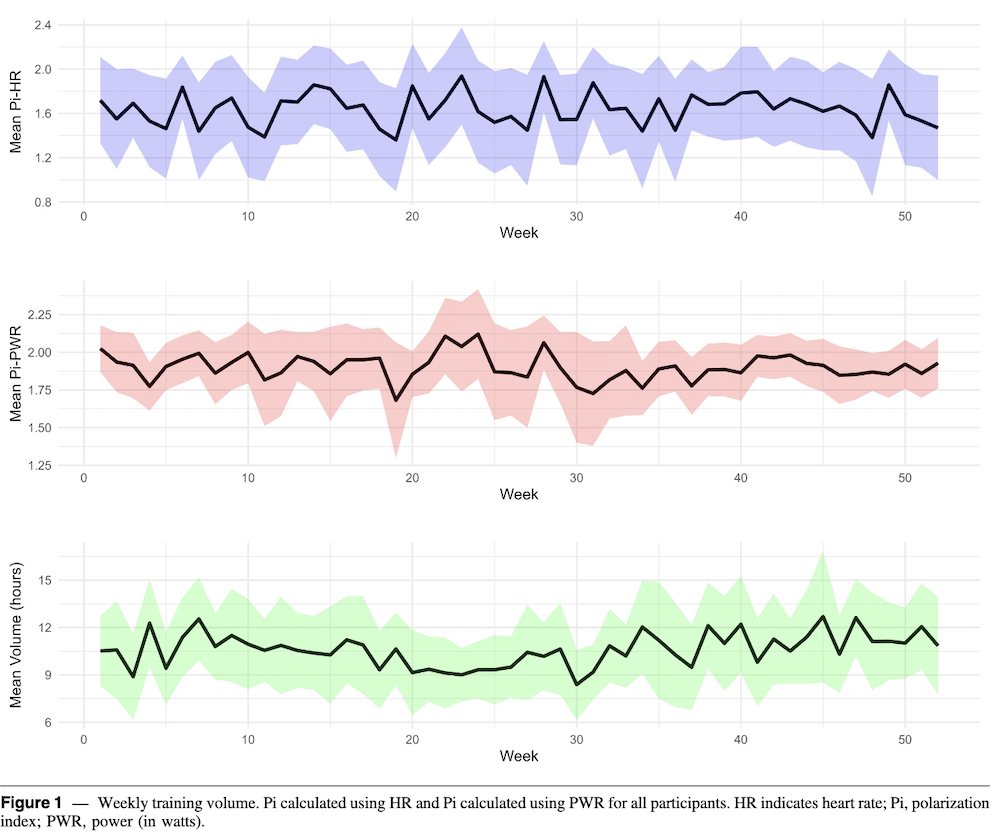
The first major finding from the data was that, in elite cyclists, Pi > 2.0 in the first and second quartiles of the season when based on power. However, Pi based on HR did not achieve the polarity threshold of > 2.0 in any of the 4 quartiles.
The finding of polarity during the preparatory phase but not during the competitive phase was actually different from expectations. Prior studies on cyclists suggest that the highest polarization happens during the competitive phases, when athletes are either racing or recovering.

Any Differences Between Elites and Sub-Elites?
Another finding contrary to the authors’ original hypothesis was that there was NO difference in the degree of polarity between elite and sub-elite groups when analyzed across the whole year. This was true when looking at either power or heart rate.
This would suggest that polarized training by itself wasn’t what separated elites and sub-elites. So it’s not a magic bullet that will automatically allow you to upgrade racing categories, for example. There are many other factors to consider in developing an individualized training program, including: time availability, age/developmental stage, strengths and limitations as a cyclist, racing schedule.
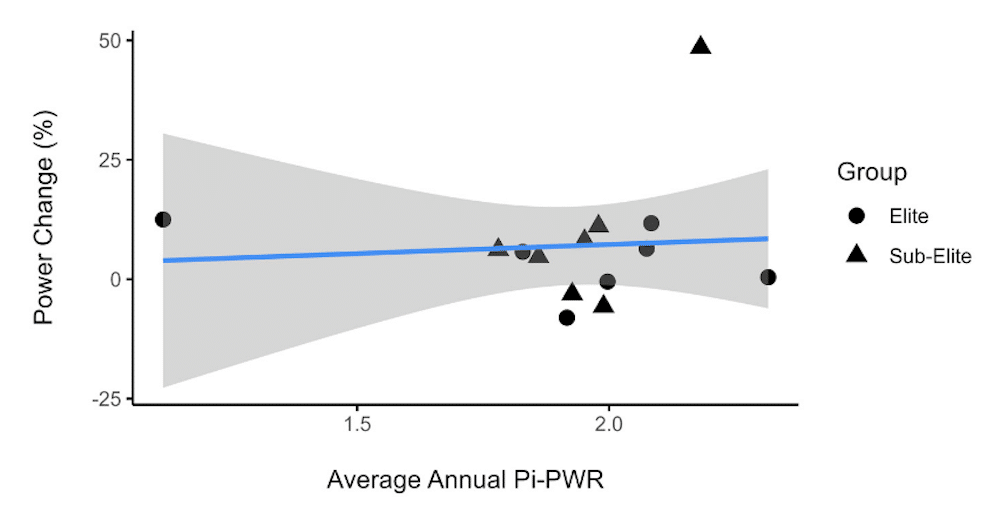
Furthermore, there was no correlation between the degree of polarity and 20 min power in either groups.
Is This the Death of Polarized Training?
Rather than a death knell for polarized training, in my view what this study suggests is that there is no one single template for success. Truly polarized training can work and might be a fundamental requirement for different training phases or for different sports, but it’s also not the only path for endurance athletes.
For example, the needs of a new endurance athlete may be quite different than that same athlete’s needs after 10 years of development as an endurance athlete.
Ultimately, there seems to be many ways to build the basic endurance engine. It’s a truly individualized approach that is best done by matching your current abilities with what you seek to achieve (Crit god status? Gravel ultra-events? Category upgrade?) in what kind of events (e.g., duration, power requirements, terrain). From that analysis, build the plan that works best for you rather than slavish devotion to a single style of training.
Ride fast and far, and have fun!
References
Cove B, Bennett H, Nelson MJ, Chalmers S (2025) Differences in Polarization Index of Elite and Subelite Adult Cyclists During a 12-Month Training Cycle. International Journal of Sports Physiology and Performance 20:1665–1672. https://doi.org/10.1123/ijspp.2024-0436
Like PEZ? Why not subscribe to our weekly newsletter to receive updates and reminders on what’s cool in road cycling?