
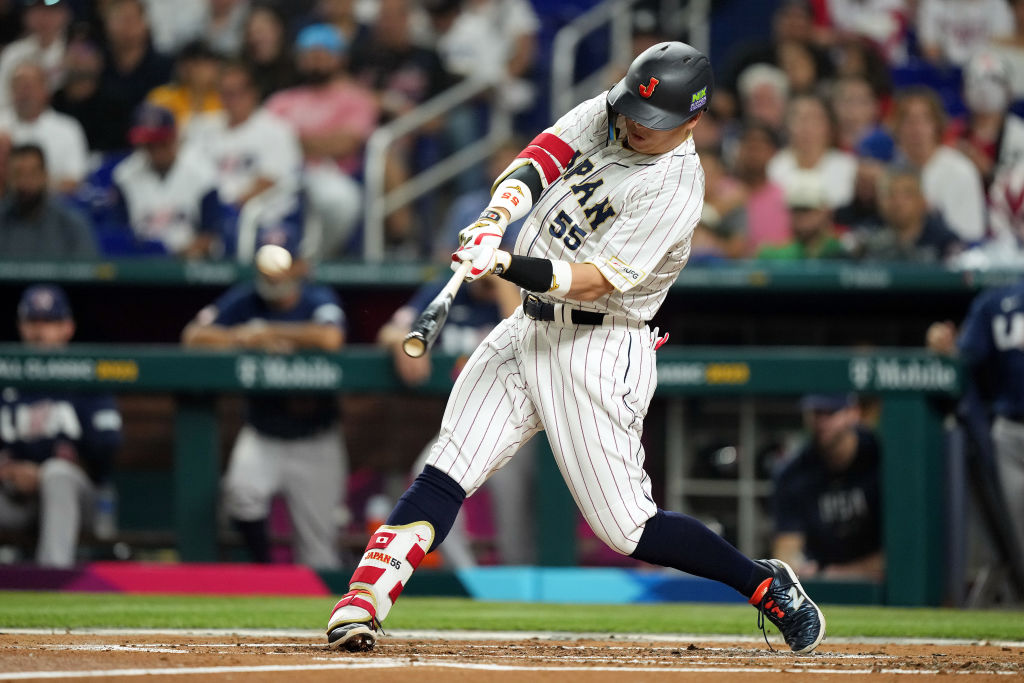
Griffin Wong breaks down the teams most likely to come away with IF Munetaka Murakami when MLB Free Agency wraps up.
Japanese free agents have been all the rage in Major League baseball recently, and for good reason: the Los Angeles Dodgers just won the World Series with arguably the three best ones of the last decade on their roster, including two who joined the roster directly from Nippon Professional Baseball (NPB): World Series MVP and staff ace Yoshinobu Yamamoto and starter-turned-closer Roki Sasaki.
This season is no exception: while there are some strong intra-MLB free agents, including All-Star outfielders Kyle Tucker and Cody Bellinger, Munetaka Murakami and Kazuma Okamoto have both made waves in the market after being posted by their NPB clubs. While Okamoto was posted later and has until January 4 to agree to a contract with an MLB team, the Tokyo Yakult Swallows posted Murakami on November 7, so he has to sign with a team by December 22 or return to Tokyo for the 2026 season.
So far, the rumor mill has been relatively quiet surrounding Murakami, but it’s almost certain that he’ll play for an American club in 2026. He’s well-regarded for his raw power, having hit 56 home runs as a 22-year-old in 2022 (the most ever by a Japanese-born player), and across eight seasons with the Yakult Swallows, he managed a .273/.394/.550 slash line, 265 homers, and 722 RBI’s. The two-time Central League MVP also hit a walk-off double to send Japan to the final of the 2023 World Baseball Classic, where it eventually took down the United States, 3-2, behind a Murakami homer.
Because of Murakami’s limitations as a player — including a high strikeout rate, a propensity to struggle against fast pitches, and defensive concerns — as well as his financial demands (somewhere between $20 and 30 million per season, plus an additional posting fee paid to Tokyo that is likely to end up costing the signing team at least $20 million), he isn’t a perfect fit for all 30 teams. Still, I’ve broken down three that could make sense.
Best Munetaka Murakami Landing Spots
1. New York Mets
When my colleague Garion broke down the chase for Tucker’s services earlier this week, he also included the Mets as the top potential suitor. There are few teams able to shoulder the financial demands of premier free agents like Murakami and Tucker, and New York — which shelled out a record-breaking $765 million to acquire Juan Soto in 2024 — clearly has the ability to pay him. Assuming Murakami ends up signing a contract worth $25 million annually, he’d take up more than a quarter of the payroll on 16 of the league’s 30 teams last season. Realistically, it’s the big teams in the big markets who will end up chasing him.
More than any of the other big-market teams, the Mets need a power-hitting corner infielder. Let’s take a look at the other top five teams by 2025 payroll: the Dodgers have Freddie Freeman and Max Muncy to cover those positions, the Philadelphia Phillies have Bryce Harper and Alec Bohm, the New York Yankees have Paul Goldschmidt and Ryan McMahon, and the Chicago Cubs have Michael Busch and Matt Shaw. Murakami could be better than any of them, but each of those teams has reasons to be satisfied with its incumbents. The New York Mets are the exception.
When Pete Alonso signed with the Baltimore Orioles, the Mets lost a player who’s appeared in all but 24 of their games over the last seven seasons, hitting 264 home runs and making five All-Star appearances. New York is likely to enter the 2026 season with Mark Vientos, who amassed negative-0.2 WAR in 2025 and slashed just .233/.289/.413, as its starting first baseman. It’s not like it was getting much on defense anyway — Vientos ranked in just the 15th percentile in fielding run value and Alonso in the eighth percentile — so Murakami wouldn’t represent a downgrade. Both Alonso and Vientos, just like Murakami, strike out a lot.
The Mets already have a strong third baseman in Brett Baty, so they could pass on Murakami if they believe he’s better suited to stay at the position he’s played since 2021, but many MLB scouts believe he’d be best as either a first baseman or designated hitter in the long run. If New York is one of those teams, he could be a natural replacement for Alonso. The Mets didn’t offer Alonso a new, long-term contract in part because he’s 31 years old, but Murakami is just 25. They also have Murakami’s 2021 Olympic teammate, Kodai Senga, on the roster.
2. San Diego Padres
Like New York, San Diego has a recent history of handing out mega-contracts to free agents, and while some of them have flopped — Xander Bogaerts’ 11-year, $280 million contract, Yu Darvish’s six-year, $108 million deal, and Manny Machado’s 11-year, $350 million pact all represent major question marks moving forward — the 14-year, $340 million contract they gave to Fernando Tatís Jr. has looked good so far. The Seidler family has committed to going all-in to maximize the roster in 2026 as the Padres seek to break Los Angeles’ stranglehold on the NL West. If the Seidlers ultimately sell the team, new ownership might not be so eager to shell out a mega-deal for Murakami, but for now, recent history suggests that San Diego would be willing to pay him.
Machado is entrenched at third base, and with a .275/.335/.460 slash line and 27 homers in 2025, he’s still performing well enough that his contract isn’t yet a massive albatross. However, the Padres have questions elsewhere in the corner infield: Luis Arráez, who manned first base after San Diego acquired him in a 2024 midseason trade, is currently a free agent, and the Padres have shown no indications that they’re interested in re-signing him. Arráez’s issues are very different from Murakami’s: his 3.1% strikeout rate this season is less than one-eighth Murakami’s, but he hit just eight home runs and walked only 34 times. Defensively, he grades out slightly better as a third baseman than Murakami and slightly worse as a first baseman, but both are extremely poor. If San Diego wants to avoid Murakami’s defensive questions entirely, it could also use an upgrade at DH: Gavin Sheets has been worth negative-2.1 WAR throughout his five-year career.
The Padres are in desperate need of a power bat. Despite ranking a solid seventh in batting average and ninth in on-base percentage last season, they finished ninth-to-last in slugging percentage because they hit the third-fewest home runs. The fact that Petco Park is one of the league’s most pitcher-friendly is certainly a factor, but it doesn’t tell the whole story: the Seattle Mariners (third in home runs), Mets (fifth), and Cubs (sixth) all play in pitcher-friendly parks. Plus, San Diego has regular direct flights to Tokyo-Narita International Airport, which has historically been a factor for Japanese free agents.
3. Los Angeles Dodgers
Naturally, the Dodgers have to be mentioned in any chase for a Japanese free agent. Los Angeles has been linked to both Murakami and Okamoto, and it has clearly created a culture attractive to Japanese players. In the past, the Dodgers have gone all-out to attract high-profile free agents, adding Japanese-style toilets to the clubhouse during the Sasaki sweepstakes and adding lots of benefits to Yamamoto’s contract. The World Series MVP added fuel to Murakami rumors by having dinner with him in Tokyo shortly after the Fall Classic concluded.
Los Angeles doesn’t have an explicit need for Murakami’s services, but it also didn’t have an explicit need for a top-quality starter before signing Sasaki and Blake Snell last offseason or for two-time Cy Young Award winner Tarik Skubal, about whom it’s been in discussions with the Detroit Tigers. As the two-time defending World Series champions, any signing that the Dodgers make from here on out will be pure luxury, especially after shoring up their biggest issue with former New York closer Edwin Díaz. But Los Angeles can afford luxury, as it has had a top-10 payroll in baseball in each of the last 14 seasons.
On the field, the fit is murky for both sides, but there’s a case to be made that a long-term partnership would make sense. Murakami probably wouldn’t be an everyday player in 2026, as the Dodgers have Freeman at first base, Muncy at third base, and Shohei Ohtani as the designated hitter, but he might be in 2027 and onwards. Los Angeles does have a need for a corner outfielder in 2026, especially with Teoscar Hernández aging, but a three-game sample size surely isn’t enough to convince the Dodgers that Murakami is viable and they’d surely rather fill that hole with Tucker or Bellinger instead.
If Los Angeles signs Murakami, it’d be a long-term play aimed at replacing either corner infielder. Muncy is still a stellar power bat who walks at an elite rate when healthy, but he’s missed significant time with injuries over the last two seasons and will be 36 by the time the 2026 playoffs start. Plus, while Freeman has fewer health concerns and is under contract for one more season than Muncy, he’s already 36. The Dodgers’ World Series window might not come crashing to a halt any time soon — having the 31-year-old Ohtani, a 27-year-old Yamamoto, and a 24-year-old Sasaki is a good way of guaranteeing that — but they could extend it by replacing either corner infielder with the 25-year-old Murakami.