
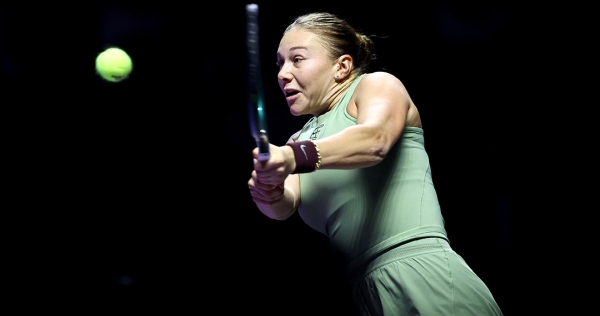
The fact she was able to turn the tables on Swiatek in the US Open quarterfinals, and survive a Naomi Osaka onslaught in the semis to reach a second consecutive Slam final, was nothing short of inspiring.
“I think it just shows that I have worked really hard, especially on my mental game and not giving up,” Anisimova reflected. “I think I have really worked on myself to really be able to handle those moments and to believe in myself, even when it feels like: what is there to believe in, in a way, like, when you’re not playing that well?
“I think I have really done a better job of that, and especially since the Wimbledon final. I think I have really shifted with my attitude.”
In a season of breakthroughs, which began in February with her first WTA 1000 title in Doha, Anisimova forced people to really sit up and take notice thanks to her Wimbledon semifinal win over world No.1 Aryna Sabalenka.
She’s beaten Sabalenka before, but not on the big stage of Centre Court, and rarely when Sabalenka was the game’s leading player and Grand Slam force as she is today. Six years after first appearing in a major semifinal, Anisimova had finally taken a step further.
Then came her revenge victory over world No.2 Swiatek in New York, and a thumping 6-1 6-2 win over world No.3 Coco Gauff en route to the Beijing title. By the time she beat AO 2025 winner Madison Keys at the WTA Finals, she was the only player this year to defeat all four women’s Grand Slam champions of 2025.
She ended the year with 47 match wins – by far her highest tally in a single season – and a sparkling 10-5 record against top-10 opponents.