
And that’s where the show’s fictional physicists failed, Zupan said.
“The Big Bang Theory” ran from 2007 to 2019 and earned seven Emmys. It remains among the most-watched shows of any streaming service, according to Nielsen.
“The general idea from our paper was discussed in ‘The Big Bang Theory’ years ago, but Sheldon and Leonard couldn’t make it work,” Zupan said.
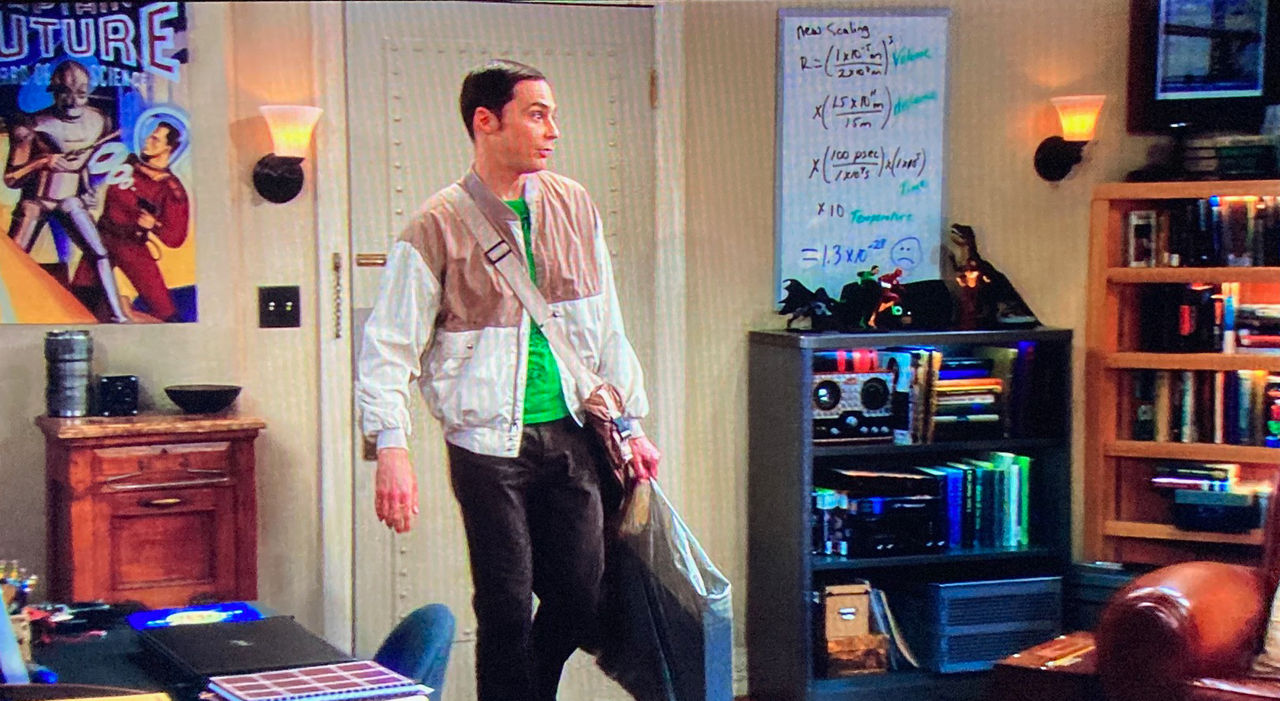
In one episode, a white board features an equation and diagram that Zupan said describes how axions are generated from the sun. In a subsequent episode, another equation appears on a different board. Below the calculations in a different marker color is an unmistakable sad face.
Zupan said Leonard and Sheldon’s equation estimates the likelihood of detecting axions from their proposed fusion reactor compared to the sun — with discouraging results, which explains the sad face.
“The sun is a huge object producing a lot of power. The chance of having new particles produced from the sun that would stream to Earth is larger than having them produced in fusion reactors using the same processes as in the Sun. However, one can still produce them in reactors using a different set of processes,” he said.
The characters in the show never talk about axions or the white boards in the episodes. They’re just an Easter egg for physicists in a show famous for incorporating scientific concepts like Schrodinger’s cat and the Doppler effect into its storylines, along with cameos by Nobel laureates and “Star Trek” alumni alike.
“That’s why it’s fantastic to watch as a scientist,” Zupan said. “There are many layers to the jokes.”
Featured image at top: Researchers examined a particle physics problem that was highlighted on the show ”The Big Bang Theory.” Photo/CBS