
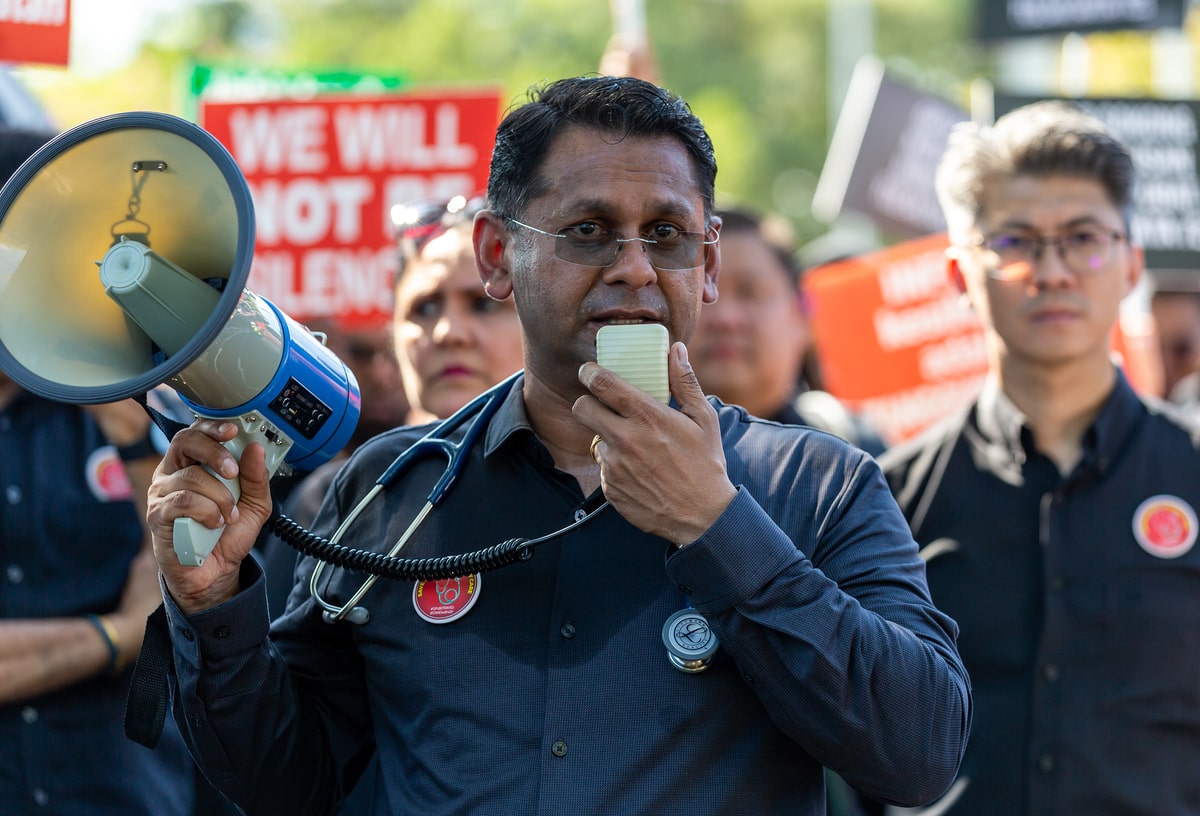
KUALA LUMPUR, Dec 19 — The Malaysian Medical Association (MMA) has estimated that reinstating the progressive Regional Incentive Payment (BIW) allowance structure for doctors costs around RM4.2 million a year.
The doctors’ group’s estimate was based on an assumption of approximately 700 new medical officers posted to Sabah, Sarawak and Labuan each year, with a monthly shortfall of RM500 per officer under the revised structure.
Under the Public Service Remuneration System (SSPA), the BIW allowance for transfers to Sabah, Sarawak, and Labuan was changed to a fixed RM360 monthly rate for officers appointed from December 1, 2024, compared to the old framework of a percentage of basic salary.
The BIW allowance for existing permanent officers appointed before that date was frozen at the last-drawn amount before SSPA implementation.
“The reality is that these states face consistent structural challenges: higher cost of living, logistical limitations, stretched manpower, and fewer training or advancement opportunities. These are challenges not limited to remote areas — they are embedded in the broader ecosystem of care across Sabah, Sarawak and Labuan,” said MMA president Dr R. Arasu in a statement today.
“BIW was never meant as a bonus. It has always been a form of acknowledgement, a modest support recognising the unique challenges in these territories. Cutting it sends a disheartening message to young doctors: that their commitment and sacrifices are less valued depending on when they were appointed.
“Doctors serving in these states make difficult sacrifices — leaving behind family support systems, enduring long hours, and working in settings where the demand often outweighs the resources. Their service is vital to Malaysia’s health care equity, and it deserves to be acknowledged fairly.”
Public Service DG: BIW Allowance Not A ‘Right’
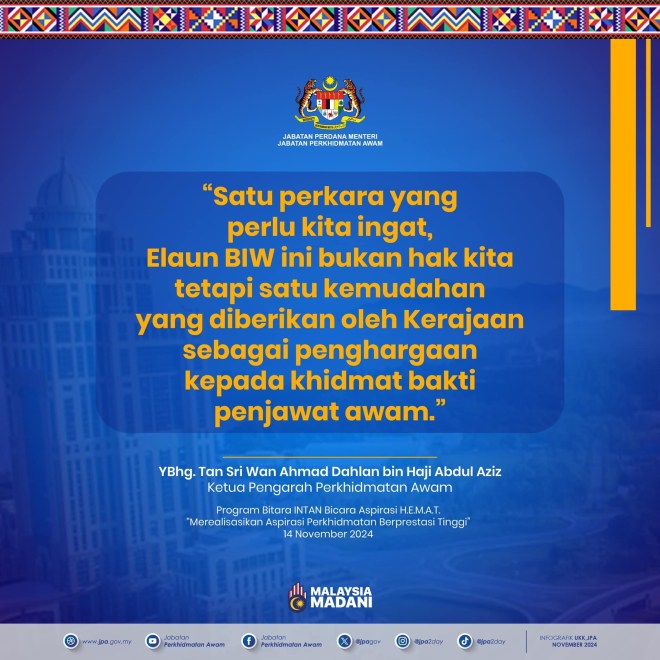 Graphic by JPA posted on its Facebook page on November 14, 2024.
In November 2024, Public Service director-general (KPPA) Wan Ahmad Dahlan Abdul Aziz said the BIW allowance was “special” because, as a percentage of basic salary, it rose in line with salary increments.
“In our study, when the government agreed to revise salaries, we saw that we couldn’t continue with the progressive nature of BIW. So we froze it,” Wan Ahmad Dahlan told a forum, without mentioning the RM360 fixed monthly rate for newly appointed management and professional (P&P) officers posted to Sabah, Sarawak, and Labuan.
“Salary revision imposed a huge financial burden on the government. The prime minister said the financial burden exceeded RM10 billion, but the real figure is bigger, which must be borne by the government, where the Ministry of Finance must multiply efforts to generate revenue to ensure that emoluments and allowances can be paid to civil servants every month,” said the head of the Public Service Department (JPA).
“If we claim everything, I’m afraid that one day, civil servants might not be paid their salaries – this would be an historic first in our country.”
Under the SSPA, which came into effect in December 2024, all civil servants received salary increments, with 15 per cent raises for the P&P group.
Wan Ahmad Dahlan added that the government can review the BIW allowance “when our finances are better” and that “this isn’t the end”.
“We must remember that the BIW allowance isn’t our right, but a facility offered by the government as appreciation for the contributions of civil servants,” said the KPPA.
A year later, the percentage of medical officer no-shows for permanent placements in Sarawak skyrocketed to 43 per cent, as 332 of 764 contract medical officers offered permanent appointments as of November failed to report for duty.
“In the spirit of Malaysia Madani, which upholds values of inclusivity, compassion, and justice, we call for the immediate reinstatement of BIW at its original structure, across all eligible officers regardless of appointment date,” said Dr Arasu today.
“This is not a demand. It is a call for fairness. For those who dedicate their lives to caring for others, fair compensation is not a luxury — it is a basic sign of respect.”