
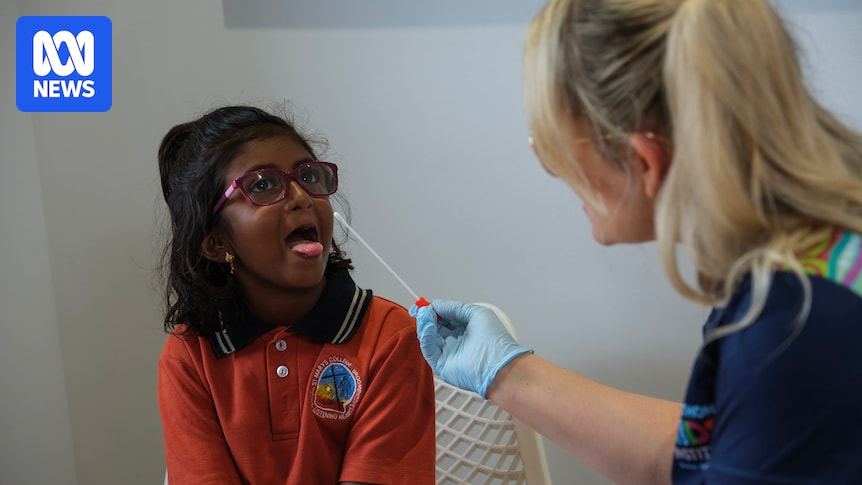
A team of West Australian researchers has found one in six children living in the Kimberley region are carrying the potentially life-threatening infection strep A, with many cases left undiagnosed.
The Kids Research Institute Australia has released its findings from the Missing Piece Surveillance Study, which involved weekly Streptococcus pyogenes (strep A) testing of 250 school students from Broome and Derby, about 2,000 kilometres north of Perth.
Over four years, participants had their throats and any skin infections swabbed and tested for the bacterium, with blood samples sometimes taken.
Professor Asha Bowen from the Kids Research Institute Australia said it was important to focus on links between sore throats and skin sores caused by strep A in remote communities with consistently high levels of the chronic disease.
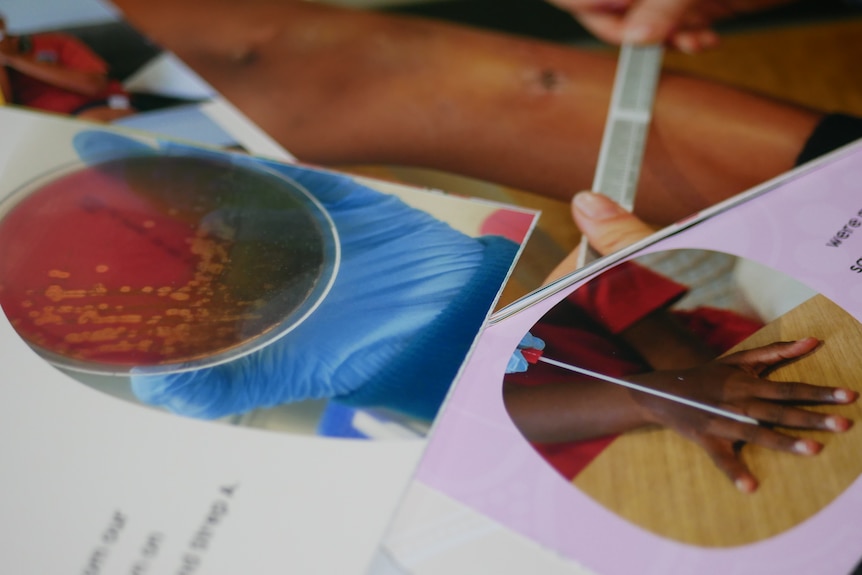
The Kids Research Institute Australia has released three educational books for children about strep A. (ABC Kimberley: Esse Deves)
Left untreated, the often asymptomatic disease can lead to acute rheumatic fever (ARF) and rheumatic heart disease (RHD).
While ARF can be treated, RHD can be fatal, with Aboriginal and Torres Strait Island children 55 times more likely to die from the disease than non-Indigenous children.
‘Certainly concerning’
The project saw the collection of 1,000 throat swabs, 200 skin swabs and 400 blood samples, which were analysed in a Perth laboratory.
Participating children — symptomatic or not — were tested for strep A every three months, with weekly swabs taken from students presenting to school with sore throats or skin sores.
Professor Bowen said the findings showed “significantly more cases of strep A circulating than first thought”.
“The high rate of infection is certainly concerning,” she said.
“[The results] tell us there’s a lot more children at risk of rheumatic fever than are currently being counted through the standard clinic procedures because the symptoms aren’t bad enough for them to think ‘I need to go to clinic’.”
Results help find a path forward
Lead author Dr Janessa Pickering said the findings confirmed some children had recurring strep A infections, but no noticeable symptoms.
“This is important, as asymptomatic strep A infections have been shown to be a key contributor to strep A transmission and could be a vital missing link in the global conversation around RHD prevention,” she said.
“We identified some kids carried the same type of strep A infection for years, while others never got it at all.
“[The results] provide us with a path forward for looking at the protective microbiome, or healthy bugs in the throat, that could be potentially guarding some kids against infection.”
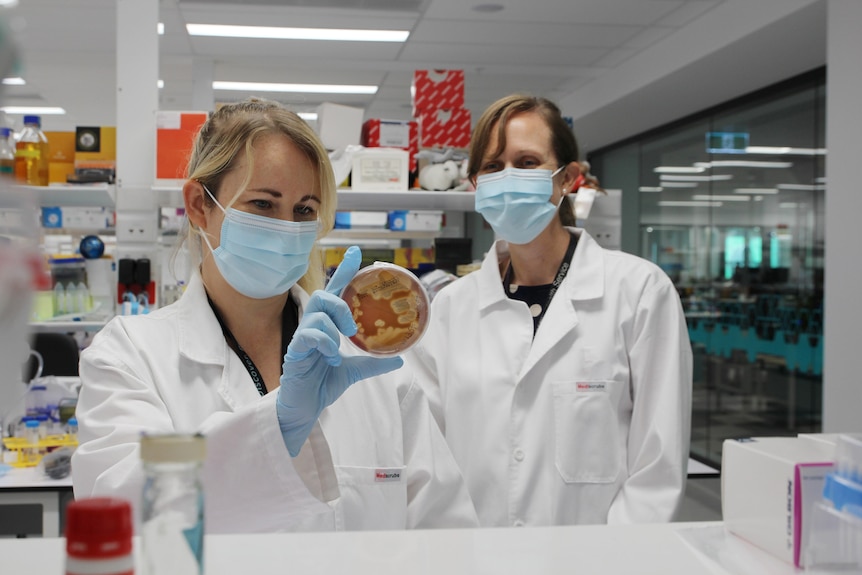
Janessa Pickering (left) and Asha Bowen hope the study helps improve early detection measures in a bid to reduce ARF and RHD. (Supplied: The Kids Research Institute Australia)
Derby Aboriginal Health Service chief executive Shelley Kneebone said while the results were concerning, having greater knowledge of how to tackle RHD was important.
“I hope the true burden of infection discovered will emphasise the need for greater focus on the social and environmental issues that affect our young children,” she said.
Earlier, faster testing trialled
Professor Bowen said despite the “alarming numbers” of strep A in Kimberley communities, a new study had already begun looking at ways to detect and treat it earlier and more quickly.
“We are looking at Point-of-Care tests so a result could be given for a sore throat swab within about 20 minutes of being collected, rather than waiting five to seven days,” she said.
“If they have strep A present, they can receive treatment on the same day.”
Professor Bowen said she hoped the findings would help “inform guidelines and clinical care” and lead to more investment in RHD prevention.
“It really does refine our ability to be able to provide care to the kids who need it the most, as quickly as possible,” she said.