
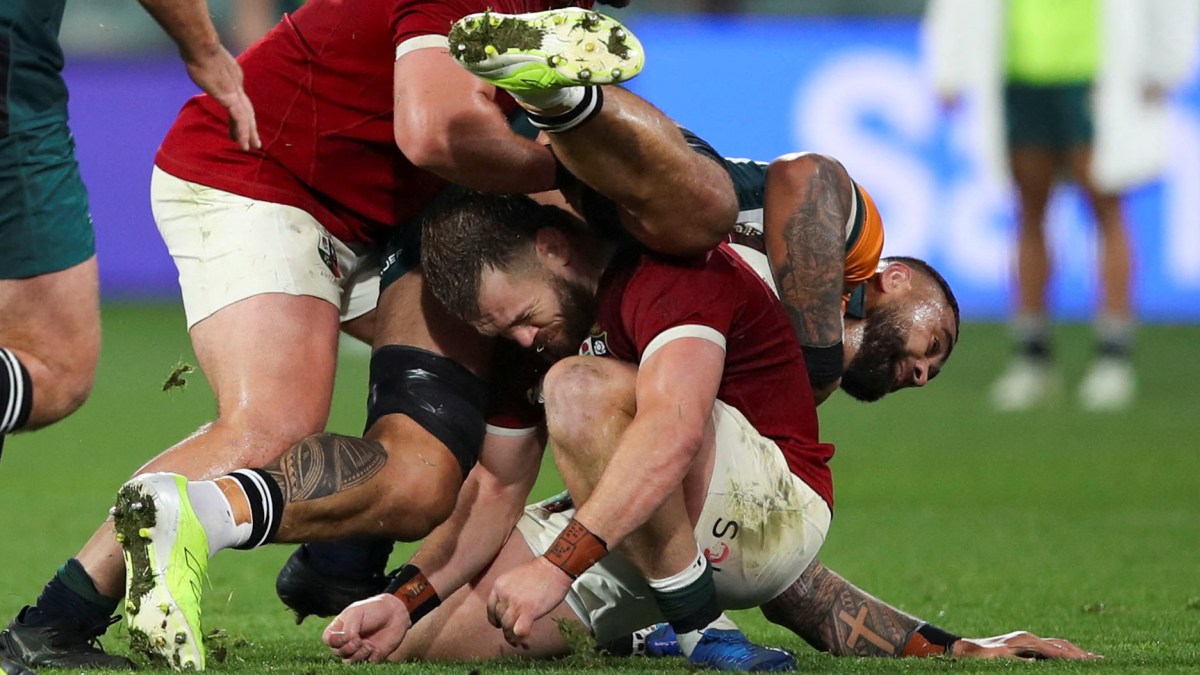
Next year’s Under-20 World Championship will be watched avidly by the sport’s lawmakers. Some would describe the lawmakers as tamperers but, with the wellbeing and safety of players at stake, let’s recognise the idea to drop the tackle height from shoulder to sternum as a genuine attempt to protect this generation of rugby players.
What is reputed to be working at the lower level, where it has been trialled in recent seasons, becomes more difficult to judge as the sport enters its elite top end. The under-20 tournament is perceived as the next stage towards potentially altering the tackle height for everyone — there, tackling below the sternum will be enforced at the elite level for the first time.
Put simply, the sternum is further from the neck and head than the shoulders. There’s a logic involved in forcing people to tackle lower. In an ideal world, everyone at every level of participation would tackle somewhere south of the sternum, arms wrapped around the hips/stomach/thighs. Alas, we do not live in such a world.
The chop tackle, below the knee with no wrapped arm, is somehow still in operation despite its aim being to deprive all bodily control from the tackled man as he flies off his feet. The ankle is the opposite end of the body from the head. Concussion isn’t an obvious risk for the out-of-control attacker, although much else is at risk.
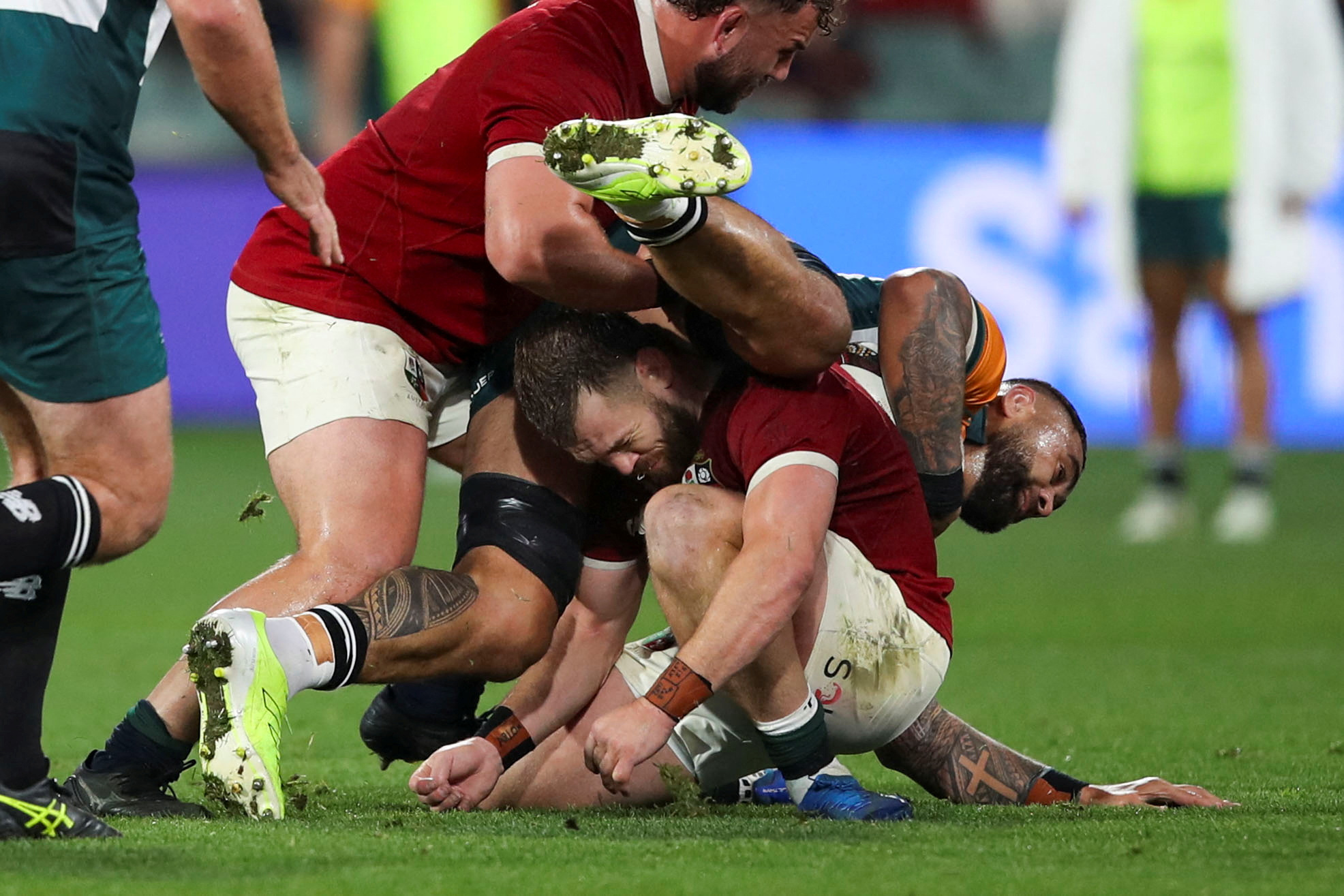
Cowan-Dickie suffered a head injury while trying to make a tackle during the Lions tour to Australia…
MATT TURNER/REUTERS
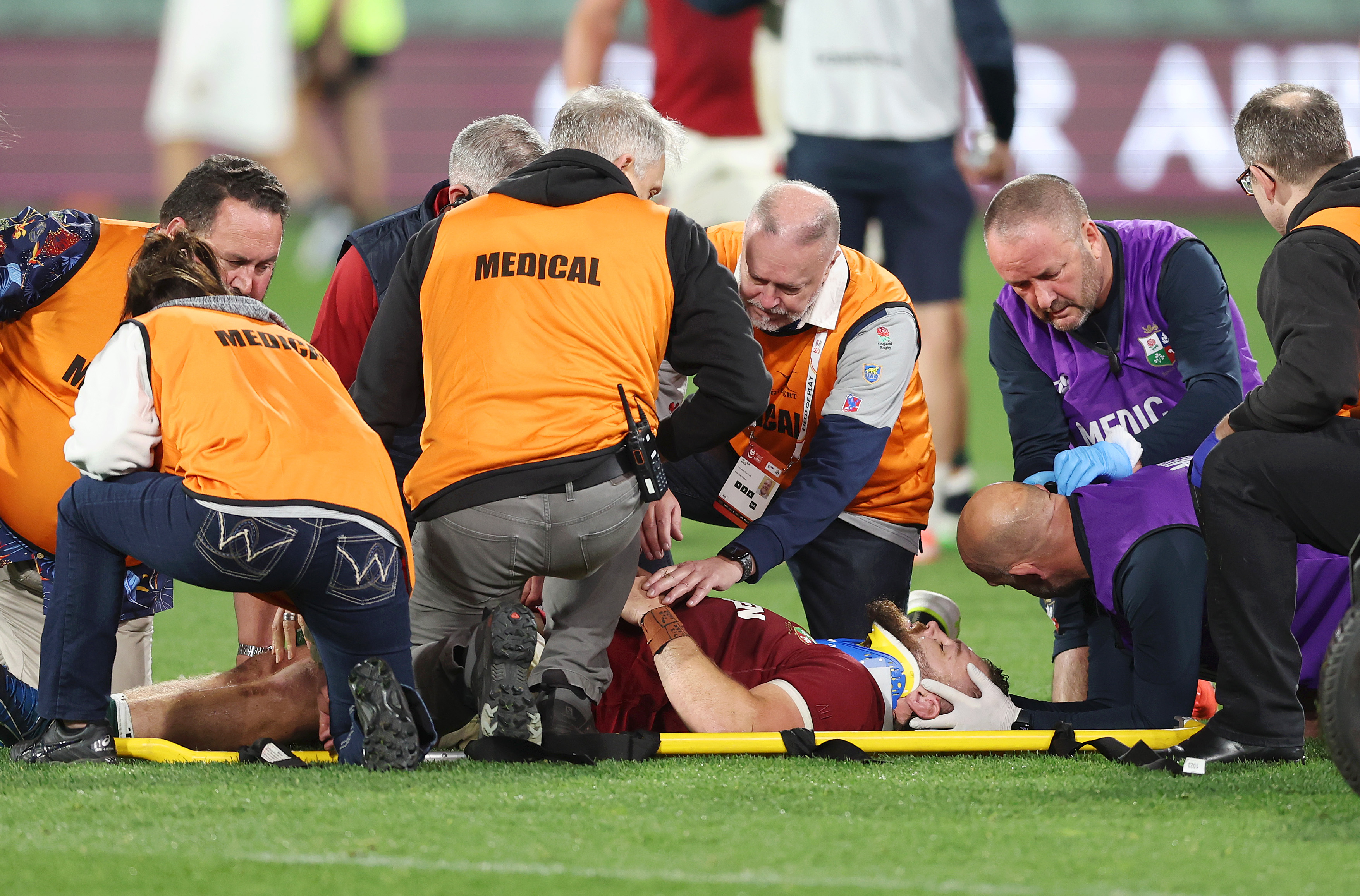
…and had to be removed from the field on a stretcher
MATT KING/GETTY
Chop tackling, as illustrated by Luke Cowan-Dickie, is dangerous for both tackler and tackled. Here, the head comes into play, on the part of the defender. It hurt the Sale Sharks hooker’s chances of being involved in the Lions Test series when he was taken from the field on a stretcher after misjudging a tackle during the midweek tour match against an Australia & New Zealand Invitational XV.
Yet the obsession with concussion — fully understandable — loses its logic when the area impacted upon is the head and neck. In the forthcoming under-20 tournament, the new tackle height law will not be enforced for pick-and-go carries close to the breakdown or when a player dives for the line, which is tacit recognition that the refereeing of the professional code has been too simplistic. If an attacker can be stopped above the sternum when driving low for the line, there must be other instances when the only thing that seems to matter is the “where” of the impact.
In a failed effort to simplify the officiating of the head contact process, referees have followed a protocol, with the first question being “has head contact occurred?” If the answer to this question is in the affirmative, the second question is “was there any foul play?”
The loaded nature of “has head contact occurred” puts the defender on the psychological back foot immediately. If the first question is swapped and the officials ask if there was foul play, things can change and — critically — the process can speed up.
Let’s say the attacking player slips as he attempts to evade the next tackler. The second defender is in a technically good and safe position but the collision, accidentally caused by the late change of direction, results in a clash of heads. Some referees have the courage to call a head collision as pure accident but the vast majority will blow for a penalty and perhaps a yellow card despite the evidence being dubious.
Please enable cookies and other technologies to view this content. You can update your cookies preferences any time using privacy manager.
Enable cookiesAllow cookies once
And, boy, does it take an eternity to go through the four-question process, ending with the question of mitigation. Yes, there can be clear mitigation, but the process is firmly focused on the neck and head. The absolutely innocent defender is supposed to be grateful for a mere penalty against him.
This is the problem with the question of “where” in the professional game. It’s an unfortunately and — I am sure not deliberately — tyrannically framed question where the odds are always stacked against the tackler. The first questions should concern the malice of the act. Did he intend to commit an act of foul play? The follow-up analyses the degree of danger, the recklessness. Then the referee should ponder the accidental nature of the incident. What happened? Not where (on the body) did the incident occur.
World Rugby’s head contact process1) Has head contact occurred?
If yes, continue2) Was there foul play?
If no, play on; if yes, continue3) What was the degree of danger?
If there is a horrendous-looking clash of heads and the defender is wholly innocent, the game should continue when medical checks are completed without the referee, touch judges and Television Match Official taking all tempo out of the game. While health and safety is the priority of elite rugby administrators, it isn’t the be all and end all. People pay good money to watch their clubs and countries play. Officiating has to ensure a flow that is good for the fans and the players. We can’t pretend it’s not business.
Shoulders or sternum? Referees are obsessing with a part of the body. You will have watched matches on television when the referee wants a freeze-frame of the very moment of contact. “Where?” is all that seems to count, because we have no balance between safety and the accidental.
The TV freeze-frame is sensationalist nonsense. The slower the replay, the more it adds an air of deliberation. Again, it is loaded against the accused, in much the same way as the order of questioning during the refereeing process. If requested, a TV assistant producer will roll the replay.
Frame by frame might help ensure a full understanding of the entire incident and not the headline-making pictures so beloved of the online world but, if it is not important, truth comes at a cost. It takes excessive time and breaks the rhythm. Get the big decisions right, don’t worry about the stuff only a TMO might see. Life’s not perfect. Nor officiating.
At amateur level, without television technology and the demands of sport as business, the sternum over the shoulder may very well be a statistically proven good idea, primarily for reasons of safety but also ease of officiating. But the gulf between amateur and professional is great, both on and off the pitch.
Professional rugby feels the pressure to look after its players as well as produce accurate officiating. This week the Chief Cricket Correspondent of The Times, Mike Atherton, dismissed the fury of annoyed England fans when Australia benefited from a blatant technical error in the Ashes with something along the lines of “mistakes happen”. He is right. And a lot more in his and my day than now.
In rugby, and in cricket, it’s not perfection we want but officials with a feel for the game who are able to make a broadly accurate stab at what has happened. “Where was the contact?” is less important than “what did he do?” Such questions will protect players more than the growing irritation of the on-field tribunal farces. You never know, it might even keep 80-minute matches under the tedious two-hour mark.