
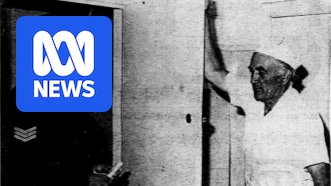
The thousands of people who line up on weekends to buy a fresh loaf of sourdough owe a debt of gratitude to Les Warby.
In 1977 the baker from Kiama, on the NSW South Coast, was jailed after refusing to pay a fine for the crime of baking fresh bread between the hours of Friday evening and Monday morning.
“They [police] just turned up while he was in the bakery and more or less handcuffed him,” his son Richard Warby said.
“He was in his singlet and shorts and they put him in a paddy wagon and took him to Long Bay Jail.”
Mr Warby remembers the time well.
The 83-year-old ran a bakery in Gerringong, while his father operated another nearby in Kiama.
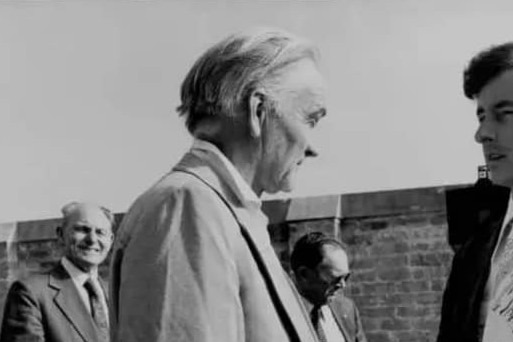
(Left to right) Dick Doman, Bruce East, Les Warby and Fred Wynn pictured outside Long Bay Prison. (Credit: Fairfax Media Archives)
Noticing the weekend influx of tourists to the area, Les Warby saw a business opportunity to provide fresh bread to the masses.
“There were people lined up down the footpath at Kiama,, and we supplied a shop in Wollongong in the main street and they had the same problem — they had lines of people down the footpath of Crown Street,” Richard Warby said.
“Everyone wanted to buy this fresh bread that my father would bake.”
The fight for fresh bread
It seems unfathomable now, but the Bread Act of 1969 made it an offence for a commercial operator to bake or deliver bread on weekends.
When members of the Kiama business community and council heard about their local baker being taken to prison, they piled into a minibus and travelled to Long Bay Jail to pay the fine and have him released.
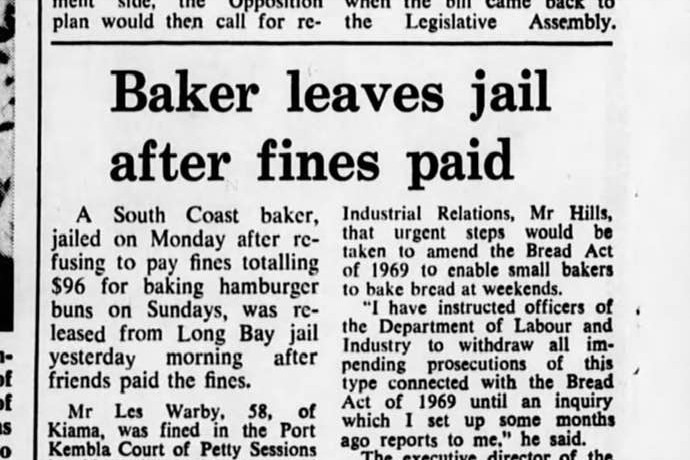
A headline in the Sydney Morning Herald at the time. (Credit: Sydney Morning Herald)
They were also granted a meeting with then-premier Neville Wran.
“After they explained to him what was going on, he said there’s no way in the world somebody’s going to be jailed for working and giving a service to the public,” Mr Warby said.
“We then had a full inquiry into the Bread Act, and I was called as a witness — I had to go to Sydney in the witness box to give my story and they changed the law.”
40th anniversary
The original laws were in place to protect small weekday bakeries, enforce regular working hours and prevent bakeries from selling their product at a higher price on weekends.
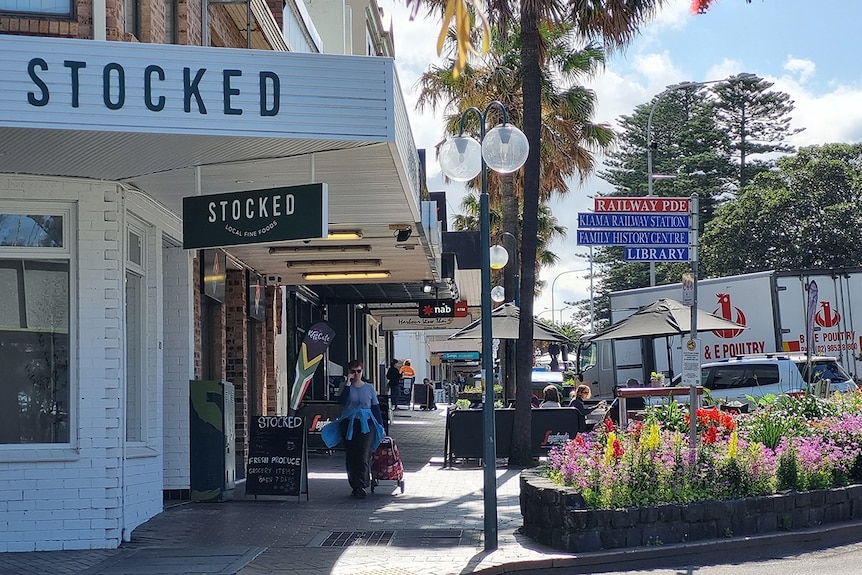
Kiama main street is now teeming with local cafes and bakeries, and is often busiest on weekends. (Credit: Kiama Municipal Council )
Through the Warby family’s advocacy, amendments to the Bread Act were made in 1985 to allow for bakeries to produce bread on weekends.
That then led to the Bread (Amendment) Act 1988, which officially deregulated the rules around bread making, baking and deliveries.
At the time, industrial relations minister John Fahey told the NSW parliament:
“Honourable members of this side of the house are firmly of the view that government has no rightful role in dictating to the bread industry the allowance hours in which baking and delivery operations may be conducted.”
After Les Warby’s brief stint behind bars, he and son Richard combined their bakeries into one shop at Kiama.
Richard Warby said he was proud of his family’s role in changing the law.
“It was something I was very happy to be a part of, and the business thrived,” he said.
“My father believed you can have fresh milk, you could have fresh meat, you could have fresh everything else on a Saturday or Sunday, why can’t you have fresh bread?”