
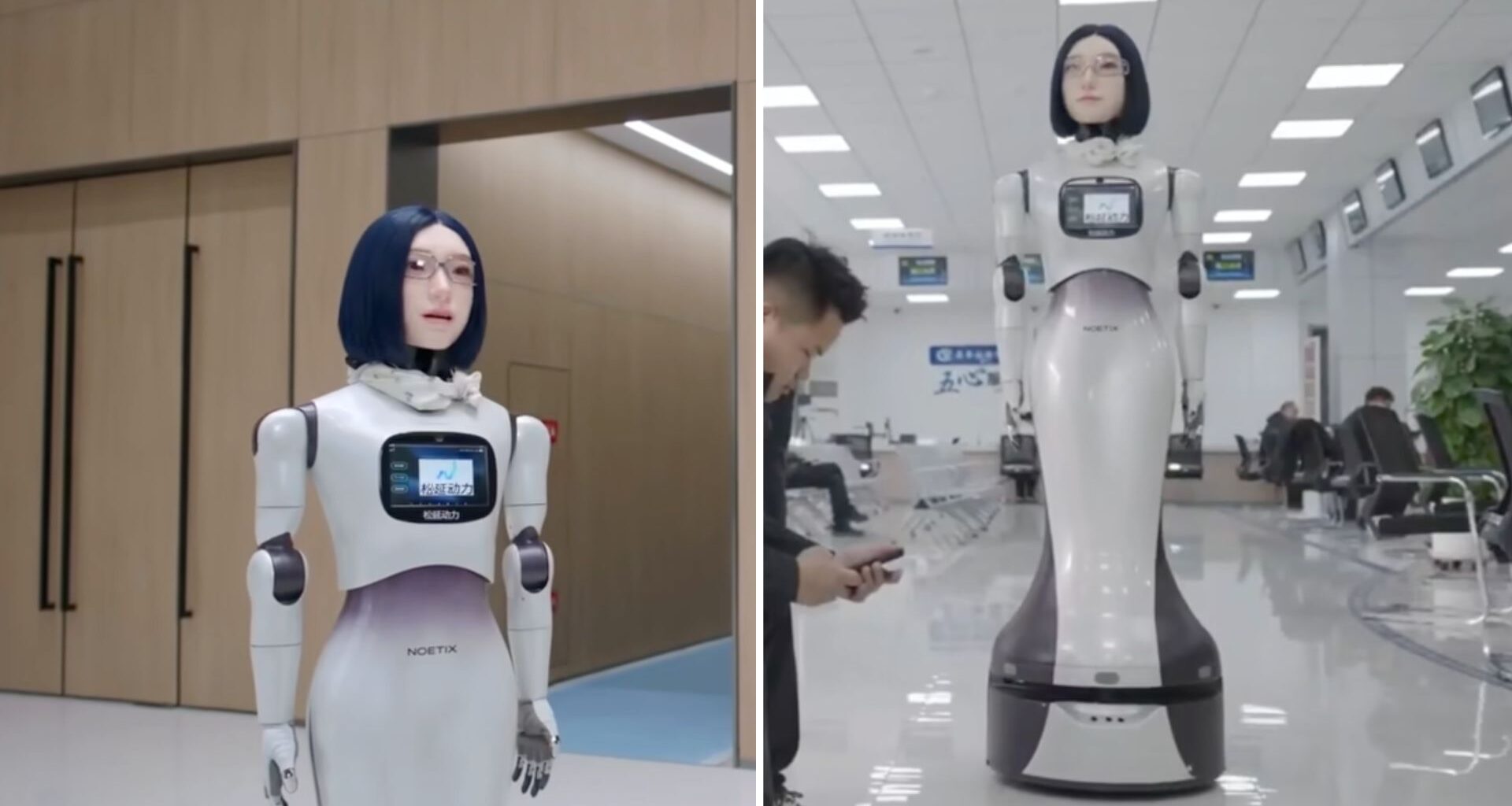
Chinese robotics startup Noextix has introduced a new humanoid service robot positioned as a “professional scene all-rounder” for real-world environments.
Designed for public-facing roles, Noetix’s Hobbs W1 combines a “female-styled” lifelike bionic head and interactive display with dexterous 6-DoF hands and 5-DoF robotic arms.
The robot features fully autonomous navigation, allowing it to perform reception and guidance tasks while moving naturally alongside people.
Noetix says Hobbs W1 can recognize emotions, hold natural conversations, synchronize information in real time, and interact smoothly across a range of professional settings.
In October, Noetix unveiled its child-sized humanoid, Bumi, priced under US$1,400, following a US$41 million pre-B round of funding.
Humanoid for work
The Hobbs W1 service robot is designed to stand out through a blend of social presence and practical capability, positioning it for real-world professional use.
According to Noetix, its most distinctive feature is a bionic-style head paired with an expressive, interactive screen, giving the robot a friendly, approachable appearance.
This design makes Hobbs W1 well-suited for hospitality, retail, education, and corporate environments, where natural interaction can enhance the user experience.
Hobbs W1 is equipped with dexterous six-degree-of-freedom hands and five-degree-of-freedom robotic arms, enabling a range of manipulation tasks not typically seen in reception-focused robots.
These capabilities allow it to gesture naturally, hand over items, and carry out light physical tasks, bridging the gap between purely social robots and functional service machines.
Autonomous navigation is a core part of the platform. Hobbs W1 can map and move through complex indoor environments, perform reception and guidance duties, and support daily operations with minimal human supervision. Its social interaction layer works alongside its physical abilities, making it adaptable to varied professional settings.
Noetix emphasizes that Hobbs W1 is designed to support, not replace, human workers. By handling routine and repetitive tasks consistently, the robot is intended to extend human capabilities while maintaining a personable and useful presence.
Humanoid pricing disrupted
The Chinese startup aims to upend expectations about the cost of humanoid robots like Bumi, which was launched in October.
Following a nearly RMB 300 million (US$41 million) pre-B funding round led by Vertex Ventures, the company detailed how it engineered the child-sized humanoid to retail for just RMB 9,998 (about US$1,380).
At that price, Bumi sits firmly in the consumer electronics category, comparable to the cost of a flagship smartphone or premium laptop, rather than the six-figure price tags typically associated with humanoid robots.
Noetix says the breakthrough pricing is the result of deliberate design and manufacturing choices that target the biggest cost drivers in humanoid robotics. Founder Jiang Zheyuan told TechNode that the company focused on three core areas.
The first is vertical integration. Key components such as control boards and motor drivers are designed in-house, reducing supplier markups while enabling closer hardware-software optimization.
The second factor is structural redesign. By using composite materials with metal reinforcement only where necessary, Noetix reduced Bumi’s weight to 12 kilograms. This lighter structure enabled the use of smaller motors and batteries, further driving cost savings.
The third pillar is a fully domestic supply chain. Almost all components are sourced within China, helping cut logistics costs, speed development cycles, and support rapid product iteration.