
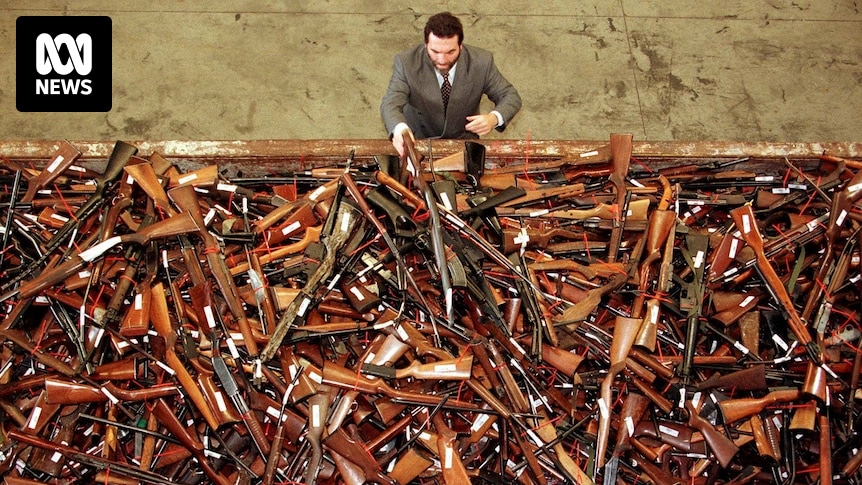
It was an email from a suburban Sydney gun shop that Tracey said made her “furious”.
“As you are no doubt aware, we are facing an unprecedented challenge in relation to firearms legislation in New South Wales,” the email from Magnum Sports, a hunting shop in Sydney’s Upper North Shore, read.
“This is a deeply concerning time for our way of life, our values and our country.”
Tracey lives on the south coast of New South Wales, and asked the ABC not to use her last name because of personal safety concerns.
She is not anti-guns — her husband is a shooter — but says they have been inundated with emails and messages from gun shops and shooting associations over proposed law reforms
“They’re using really emotive language, saying things like, ‘Oh, we’re going to lose our way of life’,” she said.
“But as an individual citizen, it’s not a way of life — it is a privilege to have a firearm, it is not a right.”
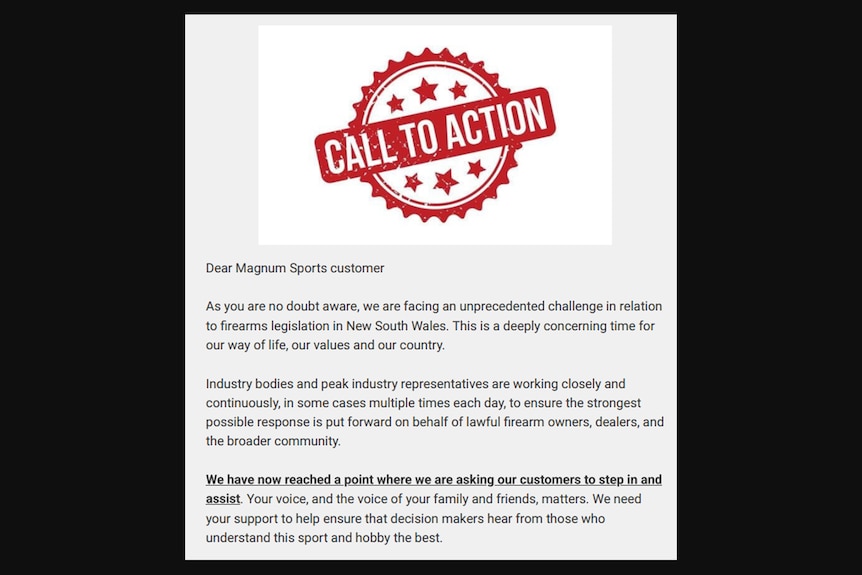
An email to customers from Magnum Sports encouraging them to oppose gun law reform. (Supplied)
The email from Magnum Sports asks people to “please ensure that you BCC” the Shooting Industry Foundation of Australia (SIFA), which is also promoting the campaign.
“We’re both furious at these gun lobbyists and furious at the gun shop owners for choosing a business and profit over innocent people’s lives,” Tracey said.
She said her husband was happy to support gun law reform to improve public safety.
PM announces ‘largest’ gun buyback scheme since Howard era
“He has said he would happily submit to any firearm reform where they say, reduce the number of firearms … or regularly have to be scrutinised by the police.”
In the wake of the Bondi shooting that claimed 15 lives, there are calls for a national firearms register, stricter limits on gun ownership, and tighter rules on rapid-fire rifles.
Late last week Prime Minister Anthony Albanese announced a national gun buyback scheme, the most ambitious since John Howard introduced a similar program after the Port Arthur massacre in 1996.
It has intensified the debate, as gun groups encourage members to fight reforms.
“Stop Minns’ gun grab” and comments from shooters claiming that “taking my guns is taking my way of life” are showing up in social media feeds.
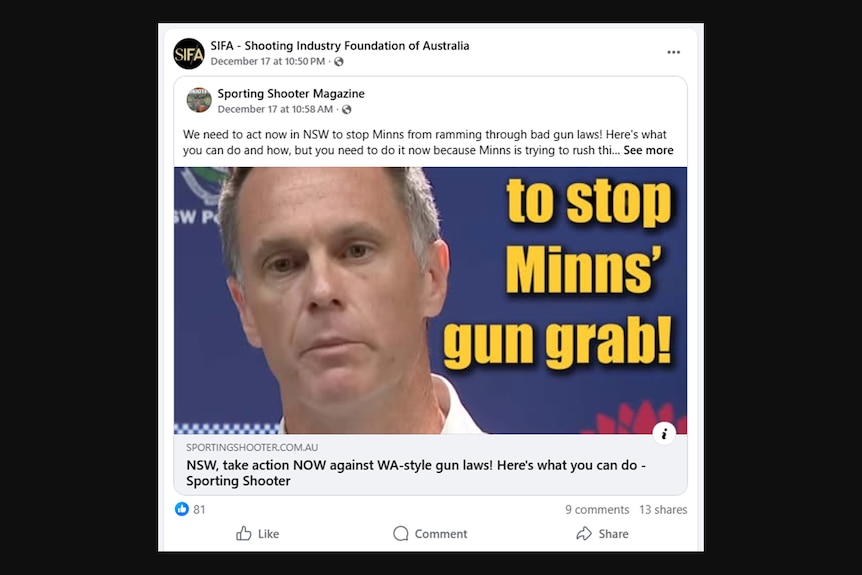
Shooting groups are encouraging their members to resist proposed gun law reforms. (Supplied: Shooting Industry Foundation of Australia)
The SIFA and others are circulating a petition that already has tens of thousands of signatures, and the industry is united in its message that the majority of gun owners are safety-conscious, law-abiding people.
The Sporting Shooters’ Association of Australia (SSAA) said it would continue to “actively participate in our democratic processes”.
“We will also encourage our members to be active participants in political campaigns,” chief executive Tom Kenyon said.
He said firearm use had a long history in Australia.
“These reforms will significantly damage that cultural heritage by restricting access to hunting and target shooting and they will not make NSW or Australia safer,” Mr Kenyon said.
The SIFA called on federal and state governments to “seek feedback from experts on all sides” and “undertake thorough community consultation”.
“Any proposal to further tighten laws must be directed at the failures that allowed a terrorist associate to be granted a firearms’ licence and purchase firearms legally,” the SIFA said in a statement last week.
“Knee-jerk reactions formed within hours of an event will not produce the required outcomes.”
Who needs guns?
In farming regions like the Darling Downs, west of Brisbane, having access to the right gun for the right purpose is key, according to Jim Breeze, captain of the local rifle club.
“In my end of the world, everyone had a .22 and a shotgun,” he said.
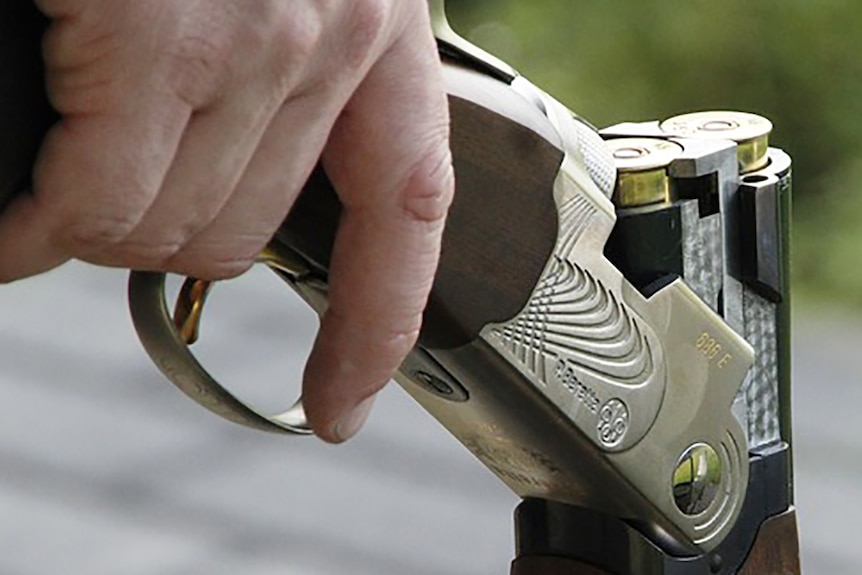
Over and under shotguns are very popular in Australia for clay target shooting and hunting. (Pixabay)
Smaller rifles like a .22 are suited to rabbits and feral cats, while larger pests require larger rounds.
“If they’ve got foxes or other pests that require something a little bit more powerful, a little bit longer range, there might be, say, a .223, a bolt-action hunting gun with a scope on it,” Mr Breeze said.
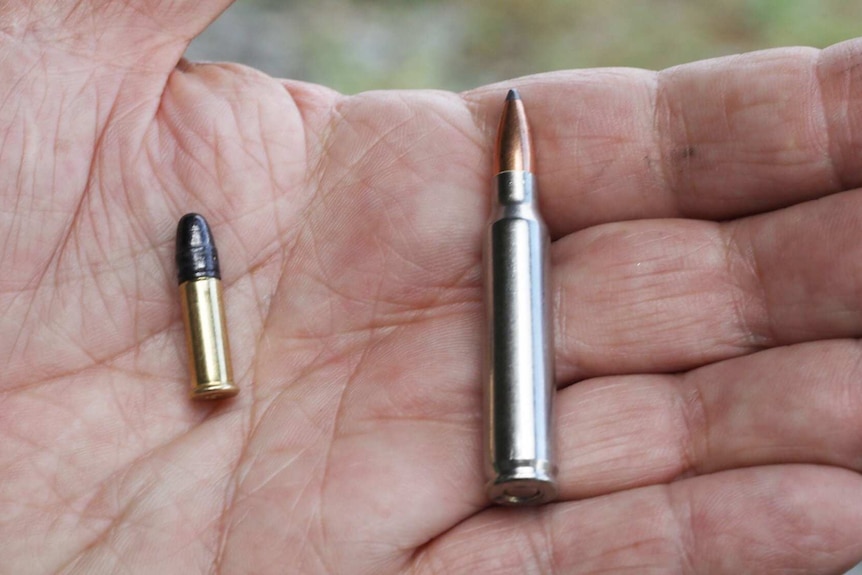
A hand holding a .22 calibre ammunition (left) and larger calibre round. (ABC News: David Hudspeth)
Australia’s firearms are divided into categories based on how the gun operates.
Categories A and B include rifles and shotguns that must be manually reloaded, while Categories C, D, and E cover semi-automatic and military-style firearms that are strictly regulated.
Category H applies to handguns under tight club-based controls.
Owning a gun is a conditional privilege that requires a “genuine reason,” such as farming or sport.
To qualify for a licence and register a firearm under the National Firearms Agreement, applicants must pass a background check, including criminal, mental health, and domestic violence reviews, and complete a mandatory 28-day waiting period.
“I’m glad that they put us through the mill, because no doubt they do find people who demonstrably shouldn’t have a firearm and hopefully they’re excluded,” Mr Breeze said.
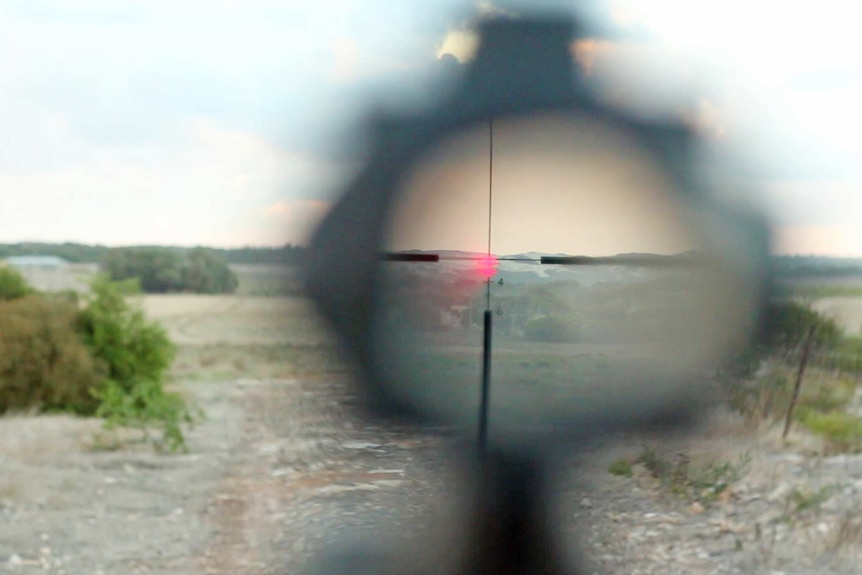
Western Australia recently tightened up its gun laws. (ABC: Chris Lewis)
While the national agreement does not set a limit on the number of guns an individual can own, it does require owners to prove a specific “genuine need” for every firearm they acquire beyond the most basic types.
In states like New South Wales, there is technically no cap on how many guns you can have if you can justify to the police why you need it.
In contrast, Western Australia recently became the first state to impose caps on gun ownership, generally limiting recreational hunters to five firearms and competitive shooters to 10.
Bondi proof that Port Arthur guns laws failing, advocate says
Rapid-firing rifles
Videos of the Bondi shooters show them using rapid-firing “straight-pull” rifles.
These use a simple back-and-forth motion to cycle to the next bullet, making them faster to reload than traditional bolt-action guns, which require four separate movements — lifting, pulling, pushing, and locking the bolt back down before the next shot.
“If the person is a hunter, yes — it’s a valid hunting rifle,” said Gary Howard, a sporting shooter and former gun dealer from Victoria.
“Adding that quick follow-up shot can be necessary to humanely put down wounded game.”
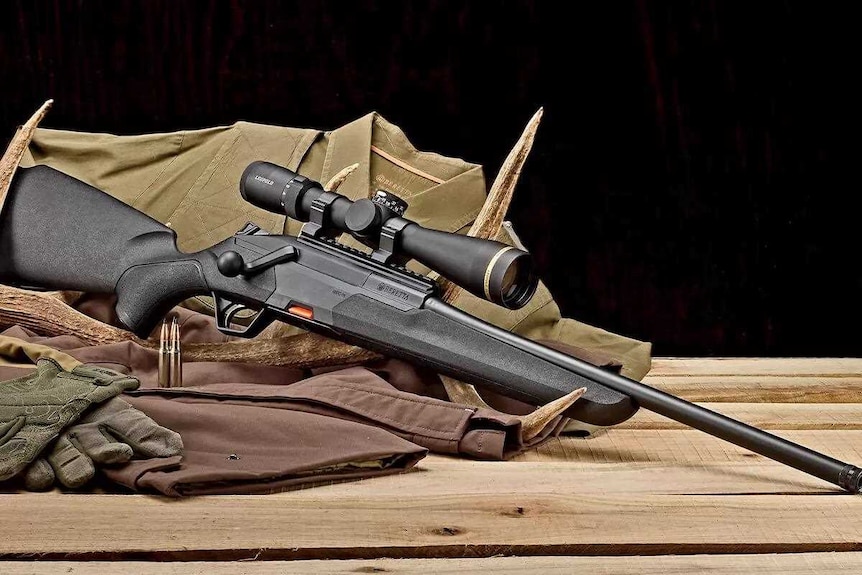
It has been reported that the Bondi shooters used a straight-pull rifle similar to this, as well as a straight-pull shotgun. (Supplied: Michael Anschuetz/RifleShooter)
The SSAA argues straight-pull rifles are essential for pest control.
“Those straight-pull firearms have a place in making sure that you are able to achieve your goal of eliminating as many feral animals as possible as effectively as possible,” Mr Kenyon said.
“Hunters are eliminating millions, literally millions of pigs around the country every year, hundreds of thousands of deer … hundreds of thousands of rabbits and foxes.”
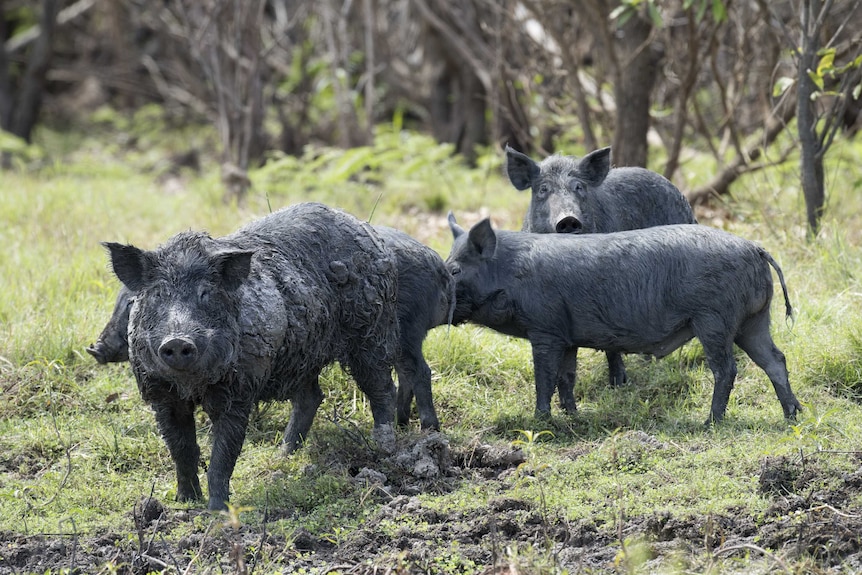
Feral pigs are a major environmental and agricultural pest in Australia (Supplied: Local Land Services)
But the Invasive Species Council questions the effectiveness of recreational hunting and is calling for rapid-fire guns to be banned.
“Firearms are an important and legitimate tool in professional, coordinated feral animal control programs,” chief executive Jack Gough said.
“But firearms are not toys, and not a recreational entitlement — in fact, recreational hunting shows no evidence in effectively reducing feral animal populations.”

The Victorian government provides a financial incentive for the control of red foxes through an active bounty program. (ABC News: Jane Cowan)
The council is urging the NSW government to close loopholes, including banning straight-pull and push-button firearms that are not required for legitimate pest control.
Mr Kenyon dismissed those calls as “fiddling at the edges”.
“None of those things would have prevented what happened on Sunday,” he said.Illicit trade still a problem
Curtin University senior lecturer Stephen Monterosso, a criminal law and organised crime expert, questions the value of further controls on legal gun access.

Stephen Monterosso says the illicit trade in guns is an ongoing issue. (ABC News: West Matteeussen)
“The biggest problem is the illicit trade of firearms principally through outlaw motorcycle gangs, but also other organised crime groups,” he said.
“To my mind this is the nub of the problem as acquiring firearms isn’t that difficult as I understand it, just not from legal sources.”
Dr Monterosso said Australia’s strict, state-based system of licensing and registration could be strengthened by introducing a national firearms register.