
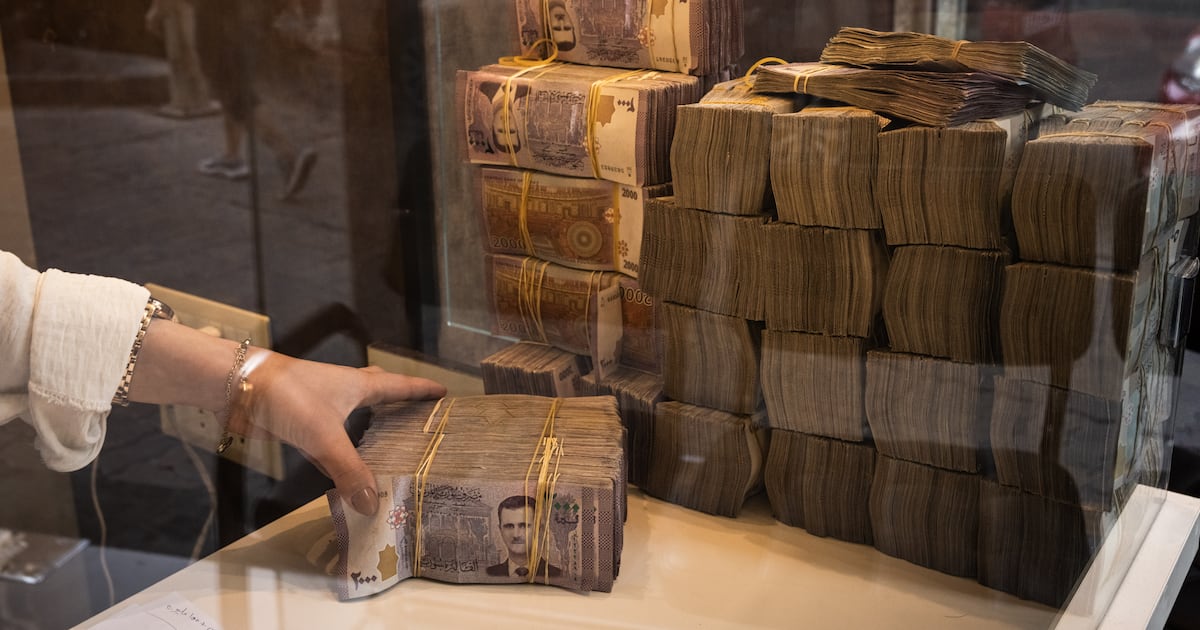
Syria is moving ahead with its plans to issue a new national currency with no delays in implementation, its central bank chief said.
Details about the launch of the currency change will be announced through an official press conference, Abdulkader Husrieh, Governor of the Central Bank of Syria, said in a Facebook post on Sunday.
“The arrangements for the currency change are proceeding in a good way and according to the set plans and with direct co-operation from all the relevant entities,” he said in the post. “There is no delay to what we have planned.”
Mr Husrieh also urged the public to only rely on official announcements and that news attributed to unofficial sources is inaccurate.
His comments come after Syria said this year that it will issue new bank notes and eliminate two zeroes from its currency. The move, which will revalue the pound, is expected to help simplify transactions but will not strengthen the currency amid weak economic growth and high inflation, analysts have said.

Syrians in US mark first year of liberation from Assad regime
“We are working on the currency change process to be smooth to … ease people’s lives and to bolster the confidence of investors and businesses in our national currency,” Mr Husrieh said.
The Syrian economy has been damaged by years of civil war, with the UN’s Development Programme estimating cumulative losses – including physical damage and economic deprivation – at more $923 billion at the end of last year.
Following an economic contraction of 1.5 per cent in 2024, Syria’s gross domestic product is expected to grow by 1 per cent in 2025, according to the World Bank. It cited continued security challenges, liquidity constraints and suspended foreign assistance.
The Syrian pound has lost most of its value since the war in 2011, with the exchange rate now at around 11,000 pounds to the US dollar, compared with 50 pounds to the dollar before the conflict.
Mr Husrieh told the Reuters Next conference this month that Syria plans to launch the new currency in eight note denominations and confirmed plans to remove two zeroes from them in an effort to restore confidence in the pound.
He said Syria would end seven decades of central bank financing of its government budget deficits, and restore confidence in public finances and central bank management, Reuters reported.
“The new currency will be a signal and symbol for this financial liberation,” Mr Husrieh said.
Syria’s central bank this month signed an agreement with payments company Visa to restart operations there after more than a decade.
“We are working to have a fully finished payment system in which we have global partners because … our vision is to have Syria as hub – a financial hub – for the Levant,” Mr Husrieh told the Reuters event.
In November, Syria resumed international financial communications through the Swift network after a 14-year suspension caused by sanctions on the Assad regime.
Mr Husrieh sent the first messages to correspondent banks worldwide, including the US Federal Reserve in New York, marking Syria’s re-entry into the global banking system, Syrian news agency Sana reported
Brief scores
Toss India, chose to bat
India 281-7 in 50 ov (Pandya 83, Dhoni 79; Coulter-Nile 3-44)
Australia 137-9 in 21 ov (Maxwell 39, Warner 25; Chahal 3-30)
India won by 26 runs on Duckworth-Lewis Method
Brief scoreline:
Liverpool 2
Keita 5′, Firmino 26′
Porto 0
Match info
Uefa Champions League Group B
Barcelona v Tottenham Hotspur, midnight
Mercer, the investment consulting arm of US services company Marsh & McLennan, expects its wealth division to at least double its assets under management (AUM) in the Middle East as wealth in the region continues to grow despite economic headwinds, a company official said.
Mercer Wealth, which globally has $160 billion in AUM, plans to boost its AUM in the region to $2-$3bn in the next 2-3 years from the present $1bn, said Yasir AbuShaban, a Dubai-based principal with Mercer Wealth.
“Within the next two to three years, we are looking at reaching $2 to $3 billion as a conservative estimate and we do see an opportunity to do so,” said Mr AbuShaban.
Mercer does not directly make investments, but allocates clients’ money they have discretion to, to professional asset managers. They also provide advice to clients.
“We have buying power. We can negotiate on their (client’s) behalf with asset managers to provide them lower fees than they otherwise would have to get on their own,” he added.
Mercer Wealth’s clients include sovereign wealth funds, family offices, and insurance companies among others.
From its office in Dubai, Mercer also looks after Africa, India and Turkey, where they also see opportunity for growth.
Wealth creation in Middle East and Africa (MEA) grew 8.5 per cent to $8.1 trillion last year from $7.5tn in 2015, higher than last year’s global average of 6 per cent and the second-highest growth in a region after Asia-Pacific which grew 9.9 per cent, according to consultancy Boston Consulting Group (BCG). In the region, where wealth grew just 1.9 per cent in 2015 compared with 2014, a pickup in oil prices has helped in wealth generation.
BCG is forecasting MEA wealth will rise to $12tn by 2021, growing at an annual average of 8 per cent.
Drivers of wealth generation in the region will be split evenly between new wealth creation and growth of performance of existing assets, according to BCG.
Another general trend in the region is clients’ looking for a comprehensive approach to investing, according to Mr AbuShaban.
“Institutional investors or some of the families are seeing a slowdown in the available capital they have to invest and in that sense they are looking at optimizing the way they manage their portfolios and making sure they are not investing haphazardly and different parts of their investment are working together,” said Mr AbuShaban.
Some clients also have a higher appetite for risk, given the low interest-rate environment that does not provide enough yield for some institutional investors. These clients are keen to invest in illiquid assets, such as private equity and infrastructure.
“What we have seen is a desire for higher returns in what has been a low-return environment specifically in various fixed income or bonds,” he said.
“In this environment, we have seen a de facto increase in the risk that clients are taking in things like illiquid investments, private equity investments, infrastructure and private debt, those kind of investments were higher illiquidity results in incrementally higher returns.”
The Abu Dhabi Investment Authority, one of the largest sovereign wealth funds, said in its 2016 report that has gradually increased its exposure in direct private equity and private credit transactions, mainly in Asian markets and especially in China and India. The authority’s private equity department focused on structured equities owing to “their defensive characteristics.”
Match info
What: Fifa Club World Cup play-off
Who: Al Ain v Team Wellington
Where: Hazza bin Zayed Stadium, Al Ain
When: Wednesday, kick off 7.30pm
Mobile phone packages comparison
New schools in Dubai