
We can’t speak for you, but to escape the tyranny of our minds, we’re often listening to podcasts.
We can’t walk to the coffee shop or do the washing up any more without having someone nattering in our ears about something or other — whether that’s the news, two comedians playing made-up games, or new releases in every aspect of the arts.
So, as we enter that weird in-between period of time where there’s a lot of ham but hopefully not too much work to do, we’ve pulled together our favourite podcasts of this year.
We asked friends from across the ABC to share theirs, with a focus on shows that started in the last year or so.
Because while we love Off Menu (this year’s De Niro episode is all time) and If Books Could Kill (always been skeptical of the Let Them Theory? Do we have the podcast for you!) and This American Life (yes, we’re still listening to This American Life), you’re probably already across those.
We hope something in the list below — which includes tales of art fraud, movie recommendations and forensic analysis of the media industry — distracts or absorbs you for a few hours.
Bad Therapist
Ash Compton & Rachel Monroe
From therapy cults to personality tests to life coaches, Bad Therapist is a podcast about the bad actors in the field of psychology.
Monroe describes her podcast as about the “seedy underbelly of the mental health world”. (Supplied: Ash Compton & Rachel Monroe)
It’s hosted by psychotherapist and cultural theorist Ash Compton and journalist Rachel Monroe, who decided to take their fascination with scammers and blend it with their genuine interest in the world of mental health.
Don’t think this is an anti-therapy podcast though. By applying a critical lens to therapy trends like shadow work (and unpacking its origins in Jungian Theory) or the Life Coach School, Compton and Monroe are able to point to good therapy practices.
If you’re a fan of All in the Mind or Maintenance Phase, definitely give Bad Therapy a listen.
— Rudi Bremer
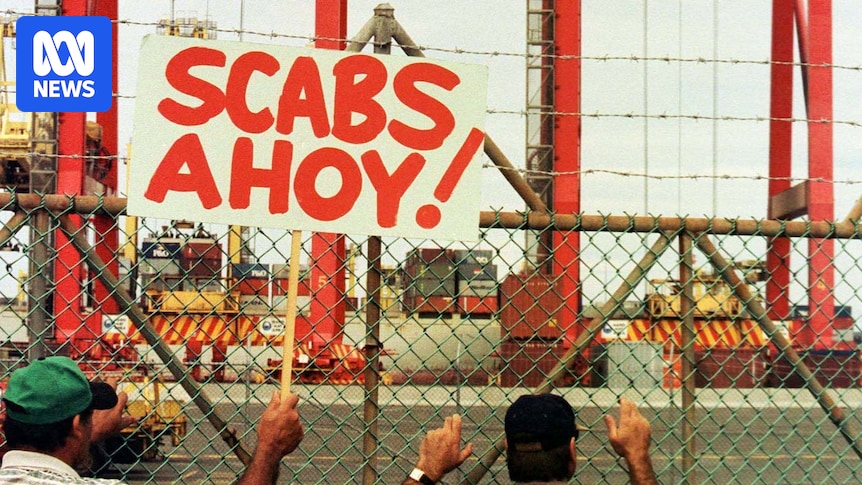
Conspiracy? War on the Waterfront
ABC
On April 7, 1998, more than 1,400 Australian wharf workers were fired.
Overnight, guards wearing balaclavas and leading attack dogs moved onto wharves around the country and shut them down, locking the workforce out.
Listen to ABC Rewind’s Conspiracy?
It was the dramatic beginning of a bitter stoush between one of Australia’s oldest and most powerful unions, the Maritime Union of Australia, and a Coalition federal government bent on reform.
ABC Rewind’s podcast Conspiracy? War on the Waterfront expertly tells the story of how port operator Patrick Corporation got the ball rolling on some of those reforms, by firing every single worker at every one of their terminals around the country.
When Patricks tried to move in an “alternative workforce”, some of whom had been part of a secret overseas training operation, the union set up a ferocious picket that would hold for a month, and questions started flying about just how much then-prime minister John Howard and his government had been involved.
Hosted with wry humour and sharp insight by journalist Jan Fran (ABC TV’s Question Everything; podcast We Used to Be Journos), this is a shocking and riveting story that includes death threats, secret meetings, overseas conspiracies and a legal case ending up in the highest court of the land.
It’s made all the more scintillating by the discovery of documents that incriminate Howard himself, only unearthed in the making of this podcast.
As well as marking an important piece of Australian history, War on the Waterfront demonstrates how this protracted battle had repercussions that are still felt by working Australians today.
As featured historian Dr Geraldine Fela says: “Something very extreme happened: People in balaclavas went into a workplace, threw workers out and locked the gates behind them.
“Whether or not you’re a union member, if you work in this country, that is something that should concern you.”
— Katherine Smyrk
Fela Kuti: Fear No Man
Higher Ground
Fela Aníkúlápó Kútì is a figure of mythic proportions: the father of Afrobeat, an activist and “trickster” who shaped the sound of Africa and its politics. Luckily for us, Jad Abumrad (creator of Radiolab) isn’t afraid to take on big subjects like Kútì — as he did in his stunning 2019 podcast Dolly Parton’s America.
Barack and Michelle Obama’s production company is behind Fela Kuti: Fear No Man. (Supplied: CBC/ABC)
In this 12-part series, Abumrad traces Kútì’s life and music, from his mother Funmilayo Ransome-Kuti‘s activism, to his political awakening in the USA in 1969. Upon his return to his home country of Nigeria, he quickly drew the often violent ire of the state, creating the Kalakuta Republic commune, which he declared independent.
It’s there that he recorded much of his iconic discography and established his Afrika Shrine, the riotous club where his bands performed.
The podcast doesn’t shy away from the problematic parts of Kútì’s life, including his marriages to 27 women in 1978. Many of these women were underage and worked as his back-up singers and dancers. They were dubbed “Queens”, yet have described being abused by him. That leads to a rehash of the perennial debate of whether we can separate the art from the artist — and it’s one of the most nuanced discussions on the topic that I’ve ever come across.
The series makes you think deeply about history and colonialism, as well as the current state of politics, resistance and protest music (where is it?). Abumrad draws on the analysis of African academics, archives and eyewitness accounts as well as interviews with people including Paul McCartney, Ayo Edebiri, Santigold, Brian Eno and Barack Obama.
Ultimately Fela Kuti: Fear No Man is a feast for the ears; Abumrad is a master of the audio documentary form and his distinctively layered and immersive sound design is hard to match. Then there’s Kútì’s music: The extensive use of his catalogue sends this podcast into the audio stratosphere.
— Hannah Reich
Forged
CBC & ABC
I was engrossed by this six-part series investigating a vast art fraud involving the works of Norval Morriseau, the celebrated Canadian Indigenous artist often referred to as the “Picasso of the North”.
Forged is a true-crime series that, refreshingly, doesn’t centre on the violent death of a young woman.
Instead, it hooks listeners in with a Barenaked Lady. When Kevin Hearn, the guitarist for the 90s Canadian indie pop band, learns his prized Morriseau painting is a fraud, he sets out to discover its true origins.
There’s a bungled court case, an unsolved murder and lots of cops talking in cars — all the ingredients true-crime fans love. But at its core, Forged is the story of Morriseau: a self-taught Anishinaabe artist who went from selling paintings door-to-door to an overnight sensation in the contemporary art world.
Host Adrian Stimson, a member of the Siksika Nation, is a knowledgeable and compassionate guide and narrator of Morisseau’s life, art and struggles. As a fellow Indigenous artist and survivor of Canada’s residential schools, Stimson is empathetic, respectful and honest as he describes the complicated intersections of Morriseau’s life; he is simultaneously a superstar artist, upholder of culture, addict, abuse survivor and advocate.
The series’ final episode widens the frame on the global scale of Indigenous art forgery, adding a short foray into the early 00s art fraud that engulfed the works of the celebrated Aboriginal artist Clifford Possum Tjapaltjarri. That postscript really deserves its own series. Luckily, ABC broadcaster Rudi Bremer, a contributing producer on Forged, digs deeper into that story in this episode of Awaye!.
— Beverley Wang
The Last Video Store
DM Podcasts
Change is hard, but The Last Video Store host Alexei Toliopoulos (Finding Drago) makes it look easy. At the start of 2024, the comedian and film expert was faced with a monumental task: turn his long-running film podcast Total Reboot into something new, without his long-time co-host Cameron James (now the host of Pump Up the Jams).
Toliopoulos came out of the gate running with The Last Video Store. Broadcasting from an eerily era-specific re-creation of your local 00s video store, Toliopoulos invites creatives from all corners of the arts world to share their favourite new release and “Weekly” recommendations.

At the end of each episode, Toliopoulos offers his guests a “Staff Pick” based on their choices. (Supplied: DM Podcasts)
Where else can you hear 5SOS’s Calum Hood wax lyrical about his love for Moulin Rouge? Or the Philippou Brothers (Bring Her Back) share how 60s horror thriller What Ever Happened to Baby Jane? influenced their work? Or Keith Urban froth on BMX Bandits (pre-Nicole Kidman fumble)?
While the high-profile guests are alluring, The Last Video Store also makes cinematic discovery extremely accessible. Even if you’ve never heard of a guest you’ll walk away from every episode with at least three guaranteed movie recommendations.
Toliopoulos keeps listeners coming back with his affable personality and encyclopedic knowledge of film and TV, but the real secret sauce is his ability to coax out the passionate inner film nerd in all of the familiar faces that visit his video store.
The Last Video Store is comfy, friendly film listening that will make you feel welcome, no matter your cinematic knowledge.
— Velvet Winter
Pablo Torre Finds Out
The Athletic
Are we watching the end of the narrative podcast? This year saw another wave of redundancies and shuttered studios that seemed to signal the end of an explosion in investment and creativity launched by Serial in 2014.
There have certainly been some green shoots this year, including the excellent second season of Shell Game, a farcical exploration of our AI-soaked future, and the return of the beloved Heavyweight, with more tender and funny stories of personal drama.
In August, The New York Times signed Pablo Torre Finds Out to a multi-year distribution deal reportedly worth 7 figures. (Supplied: The Athletic)
But the podcast that stands out to me is Pablo Torre Finds Out, a US-based sports news podcast that exploded in 2025 with a series of big stories. It mostly functions as the host, Torre, telling two guests (usually other journalists or comedians) a story at length. It’s carefully structured but barely edited. The show is geared to the maximalist, video-first appetite of younger audiences.
It has also become a vehicle for real journalism. In 2025 Torre and his team (invisible but surely numerable given the workload) took on a corrupted player’s union, a shady billionaire seemingly handing a star player money under the table and the bizarre relationship between one of America’s most famous sporting coaches and an ambitious former cheerleader 50 years his junior.
Pablo Torre Finds Out is not the podcast I listened to the most in 2025, nor is it my favourite of the year. But it dominated my algorithm for months at a time with scoop-y investigations, and I’m glad to see evidence that great stories can still find an audience, even if the product looks a little different.
— Eric George
Proxy with Yowei Shaw
Radiotopia
Have you got a problem, conundrum or niggling issue you just don’t know who to talk to about? Well, those life quandaries are the basis for the podcast Proxy.
Dubbing herself an “emotional investigative journalist” (I cringed at first, but it kinda makes sense after you listen), Yowei Shaw (Invisibilia) listens to the issue someone is facing, then sets out to find someone perfectly qualified to help them process it.
Shaw has said on the podcast talking to a stranger means “you can ask questions you wouldn’t be able to ask; say things you wouldn’t be able to say; be less defensive, more open”. (Supplied: Radiotopia)
This proxy person could be an academic with expertise in forgiveness, who can give advice to a woman struggling to let go of childhood trauma while maintaining boundaries. The proxy could be someone who left their husband for a woman and is ready to answer the questions a man couldn’t ask his ex-wife who did the same.
This is a podcast about how transformative it can be to find just the right person to talk to.
The range of dilemmas and proxies are incredibly broad, but both callers and proxies come to the podcast with such startling vulnerability that every single one hits hard. Get ready to learn some things, laugh out loud, and do a fair amount of weeping.
— Katherine Smyrk
Question Everything
Brian Reed
2025 has felt like the year for independent media. In Australia, independent newsletters and podcasts written and hosted by highly regarded journalists, including Deepcut News, Lamestream and We Used to Be Journos, have all broken stories without the machinery — and baggage — of the mainstream media.
At the same time, they’ve challenged audiences to up their media literacy, forensically dissecting how stories on controversial subjects, including the war in Gaza, have been reported.
Lamestream and We Used to be Journos are part of a global trend of podcasts critiquing the media, including Question Everything, hosted by seasoned American journalist Brian Reed (behind controversial podcast S-Town; The Trojan Horse Affair).
Question Everything is the latest podcast from Brian Reed, who previously investigated a 2014 letter alleging an Islamist plot in the UK in The Trojan Horse Affair. (Supplied: Brian Reed)
Since the end of last year, Question Everything has looked at the state of journalism in America, including the level of mistrust audiences feel and the industry’s increasing polarisation — a reflection of the wider community.
This year, the podcast has even turned towards advocacy, laying much of the blame for that fragmentation on the shoulders of tech companies — and pushing for legislative change that would make them liable for the hate speech, misinformation and more that’s spouted on their platforms.
It’s also made time to talk about the Epstein files; the targeting of an Argentine journalist with pornographic deepfakes; and how conspiracy theories — including that the Sandy Hook shooting was a false flag — are propagated online.
Altogether, Question Everything is a fascinating and at times troubling look at journalism today that makes me thankful for the existence and support of both independent journalism and public broadcasters in Australia.
— Hannah Story
Sea of Lies
CBC
Sea of Lies opens with a classic true crime set-up: a dead body, pulled out of the ocean by father-and-son fishermen. The man is wearing a suit and a Rolex watch, and his only identifying feature is a tattoo.
The preliminary police investigation turns up scant information until, finally, two names emerge: David Davis and Ron Platt.
Sea of Lies host Sam Mullins is also a performer and TV comedy writer, and his sense of narrative and timing comes through in the podcast. (Supplied: CBC)
But then, a bombshell: The police discover one of these men has assumed the identity of the other. By the end of the first episode, questions abound. Who are these two men? How did the body end up in the ocean? Was it murder?
The second episode looks into the life of Platt and his association with the enigmatic Davis, a story that takes surprising turns along the way. A warning: It also includes discussions of sexual abuse.
Host Sam Mullins speaks to all the significant figures involved in the story, including the police, who are more than happy to revisit what remains one of the biggest cases any of them has ever worked on, and Platt’s ex-girlfriend Elaine, who introduced Platt to the fast-talking Davis.
Mullins knows he’s onto a good thing, teasing out the story at a satisfyingly suspenseful pace. It’s definitely one to cue up on your next road trip over summer.
— Nicola Heath
Wisecrack
Tenderfoot TV
You’re a comedian staying at your parent’s house for the night after a local gig, and the three of you are caught on the murky edge of a violent crime. It’s an incident you will go on to describe as “the most terrifying night of your life”.
So, what do you do? Write a comedy show about it, of course!
Wisecrack is not a “whodunnit”, Tovay told The Guardian. “This is really an exploration of backstory.” (Supplied: Tenderfoot TV)
English stand-up comedian Edd Hedges did just that, creating a show all about his experience that American true-crime TV producer Jodi Tovay stumbled upon one rainy day at Edinburgh Fringe.
Her investigative senses tingling, Tovay couldn’t stop thinking about Hedges and what happened (no spoilers here), so she followed up. And his strange story just kept getting stranger.
This is partly a true-crime pod, but one that really wrestles with the why of the crime, tracking the long road of misfortune and disadvantage that underpins a horrible act. It’s also partly a comedy pod, but one that really dives into the motivations beneath creating a show based on trauma.
Both gripping and funny, Wisecrack keeps you guessing until the end, and will live rent-free in your head for a long time after that.
— Katherine Smyrk