
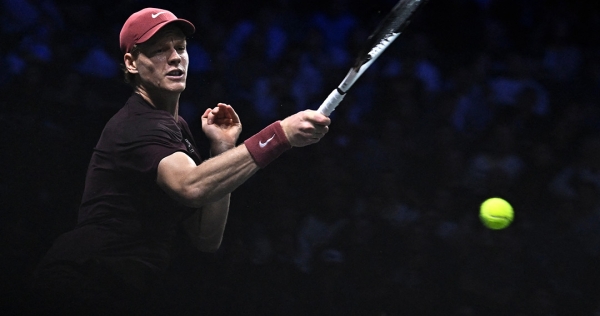
He may slot in at No.2, but metrics suggest Sinner was the game’s true benchmark, finishing the year No.1 in the ATP’s serve, return and pressure metrics. In his eighth year on tour, he refined his return positioning and grew more composed in long, high-stakes rallies.
Despite averaging a modest six aces a match, Sinner’s serve is unforgiving. His bendy frame coils, then snaps open, winning nearly 80% of points behind first delivery, 59% behind his second, and closes out a whopping 92% of service games.
At the other end, Alcaraz’s gifted anticipation gives him a slight edge on first-serve reads. But nobody punishes a missed first serve more ruthlessly than Sinner, who wins a tour-best 58% of second-serve points.
There are fleeting pockets of opportunity when facing Sinner. Nobody understands that better than Zverev, whose matches with the world No.2 are always tense.
“He had two chances to break me, and he used both of them. I had a lot of chances, and I didn’t use any,” Zverev said after the ATP Finals, his third defeat to Sinner in less than a month.
“I felt like the match was closer than the score maybe says. I thought it was a very high-level match… Don’t always judge it by the score.”
Sinner erased 72% of the break points he faced in 2025, perhaps the clearest reason behind the hollow stares his opponents routinely carried into press conferences.
Yet it was Sinner himself whose blank expression after the Roland Garros final captured the year’s deepest heartbreak.
Up 5–3, 40–0 in the fourth set of a back-and-forth epic against Alcaraz, Sinner failed to convert, and the Spaniard rode a wave of momentum to claim his fifth Grand Slam title.
A lesser player might have let that moment haunt him, but a month later at Wimbledon Sinner returned unchanged, bludgeoning his way to the final and beating Alcaraz in four sets.