
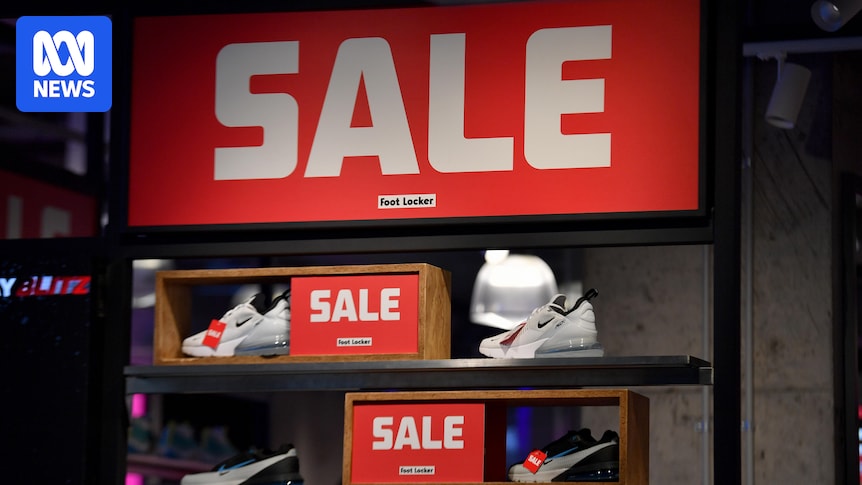
Australians are expected to spend a record $1.6 billion on Boxing Day, supported by higher demand from population growth and revived household spending after three interest rate cuts from the Reserve Bank.
That is a 4.3 per cent increase on last year, according to research from the Australian Retailers Association (ARA) in partnership with Roy Morgan.
Boxing Day is on December 26, 2025, and is a crucial shopping event for many retailers across the country.

Chris Rodwell says Boxing Day sales have enduring appeal. (ABC News: Craig Hansen)
“Retailers are finishing the year on solid footing,” ARA CEO Chris Rodwell said.
“The growth we’re seeing highlights both the resilience of the sector and the enduring appeal of Boxing Day as a premier discount event.”
Household goods, clothing, footwear and accessories, and department stores are expected to outperform on the day, driven by strong demand for value, post-Christmas discounts and the redemption of Christmas gift cards, the peak body said.
The full post-Christmas week (December 25–31), which includes Boxing Day, is forecast to reach $3.832 billion in spending, up 4.4 per cent on last year.
“Consumers are still being careful with their money, but sales events continue to play an important role,” Mr Rodwell told the ABC.
“Shoppers are planning purchases, looking for value and using promotions to manage household budgets, particularly when it comes to larger items.
“Population growth is also contributing to higher overall demand.”
Discounting and stronger purchasing power drive sector rebound
Mr Rodwell told the ABC that there had been “a return to solid growth across the retail sector throughout 2025 after a couple of challenging years”.
“That improvement has been gradual rather than dramatic, which suggests the market is settling into a more normal trading pattern and providing a stronger base for key sales events like Boxing Day,” he said.
AMP economist My Bui has observed that retail sales have started improving since late last year on the back of improving consumer sentiment, real wages growth, tax cuts and interest rate cuts.
The Reserve Bank has cut the interest rates three times this year, bringing the official cash rate down from a 12-year high of 4.35 per cent to 3.6 per cent.
“Over the 12 months to September, we have seen household consumption up by 2.6 per cent, higher than the population growth rate, which means that we have finally seen an increase in spending volume per person,” Ms Bui told the ABC.
“Spending per capita was going backwards in 2023 and 2024.”

My Bui says consumer sentiment has improved. (Supplied: My Bui)
She added that although there had been a rebound, there were still some weaknesses in the sector.
“Retail trade margins are still down from last year as consumers are still very price conscious,” Ms Bui said.
“Retail business conditions are still among the lowest among all industries.
“And employment within the sector is still down over the year.”
Black Friday sales eat into Boxing Day
Boxing Day sales have become relatively less important for retailers, with Black Friday and Cyber Monday promotions ahead of Christmas gaining in prominence over recent years.
“Traditionally, December is the biggest month for retail sales, accounting for 10.5 per cent of total annual retail spending in 2025,” Ms Bui said.
“But this share has gone down from 12.3 per cent in the late 1980s, while the share of spending in November has gone up, especially since 2019, as more retailers choose to discount prices over Black Friday and Cyber Monday.”
Black Friday sales shoppers binge their way into debt
While official ABS figures on November retail sales will not be out until January 12, Westpac’s card spending tracker showed “a solid but unspectacular turnout for ‘Black Friday’ and ‘Cyber Week’ sales.”
“Total card activity across discretionary goods categories was up around 5 per cent on the same period last year,” noted Westpac economist Matthew Hassan.
“Clothing and footwear was notably stronger. While positive, annual growth was broadly in line with card activity more generally and with pre-existing trends, i.e. sales were up on last year but do not look to have outperformed.”
Interest rate hike prospect adds uncertainty for the sector
The recovery in consumer confidence and household spending has particularly aided discretionary retail.
IG market analyst Tony Sycamore said the consumer discretionary sector — which accounts for about 6.4 per cent of the ASX 200 and encompasses non-essential categories such as retail, travel, leisure, automobiles and media — has outperformed consumer staples this year.
He noted that shares in Harvey Norman have gained more than 50 per cent year-to-date on strong sales growth, improved profitability and favourable macroeconomic conditions, such as falling interest rates boosting consumer spending.
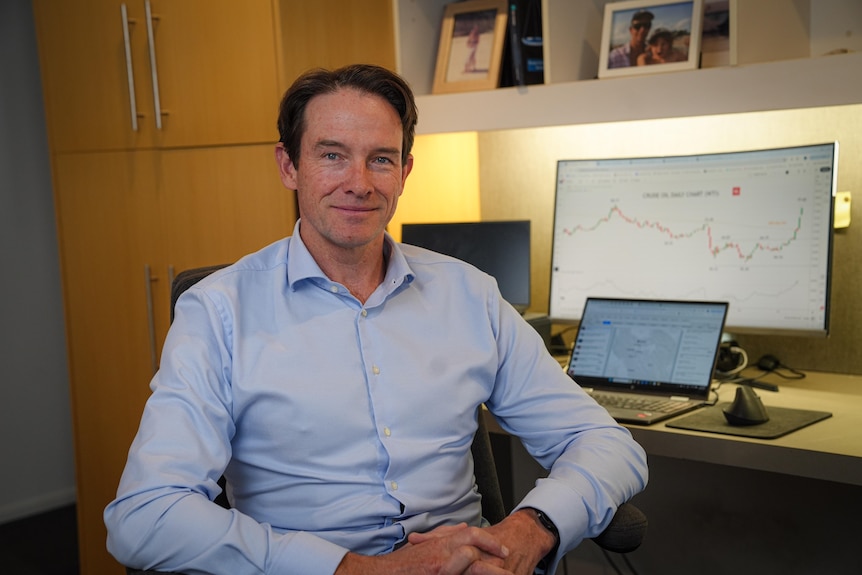
Tony Sycamore says discretionary retail spending has outperformed consumer staples. (ABC News: Daniel Irvine)
“[The consumer discretionary] sector is up only 2.83 per cent year-to-date after being up more than 18 per cent year-to-date in August,” Mr Sycamore told the ABC.
“The rally reversed sharply from October, as hotter-than-expected inflation data prompted markets to shift from pricing in RBA rate cuts to pricing in potential rate hikes.”
In December, at the Reserve Bank’s last press conference of the year, RBA governor Michele Bullock’s comments signalled that rate cuts were over and rate rises were back on the agenda.
Mr Sycamore said he expected two rate hikes of a quarter of a percentage point in June and November, which would see the cash rate finish 2026 at 4.10 per cent.
“Higher rates would raise mortgage repayments, erode disposable incomes and dampen household spending, especially in discretionary areas such as retail, travel, hospitality and apparel.
“Consequently, consumer discretionary stocks are likely to encounter significant headwinds as consumers turn more cautious and household budgets come under pressure.”
The boss of the retail lobby group agreed.
“Uncertainty around interest rates is likely to weigh on confidence next year,” Mr Rodwell said.
“When households are unsure about future borrowing costs, they tend to be more selective in their spending, which means growth is expected to remain steady but measured.”