
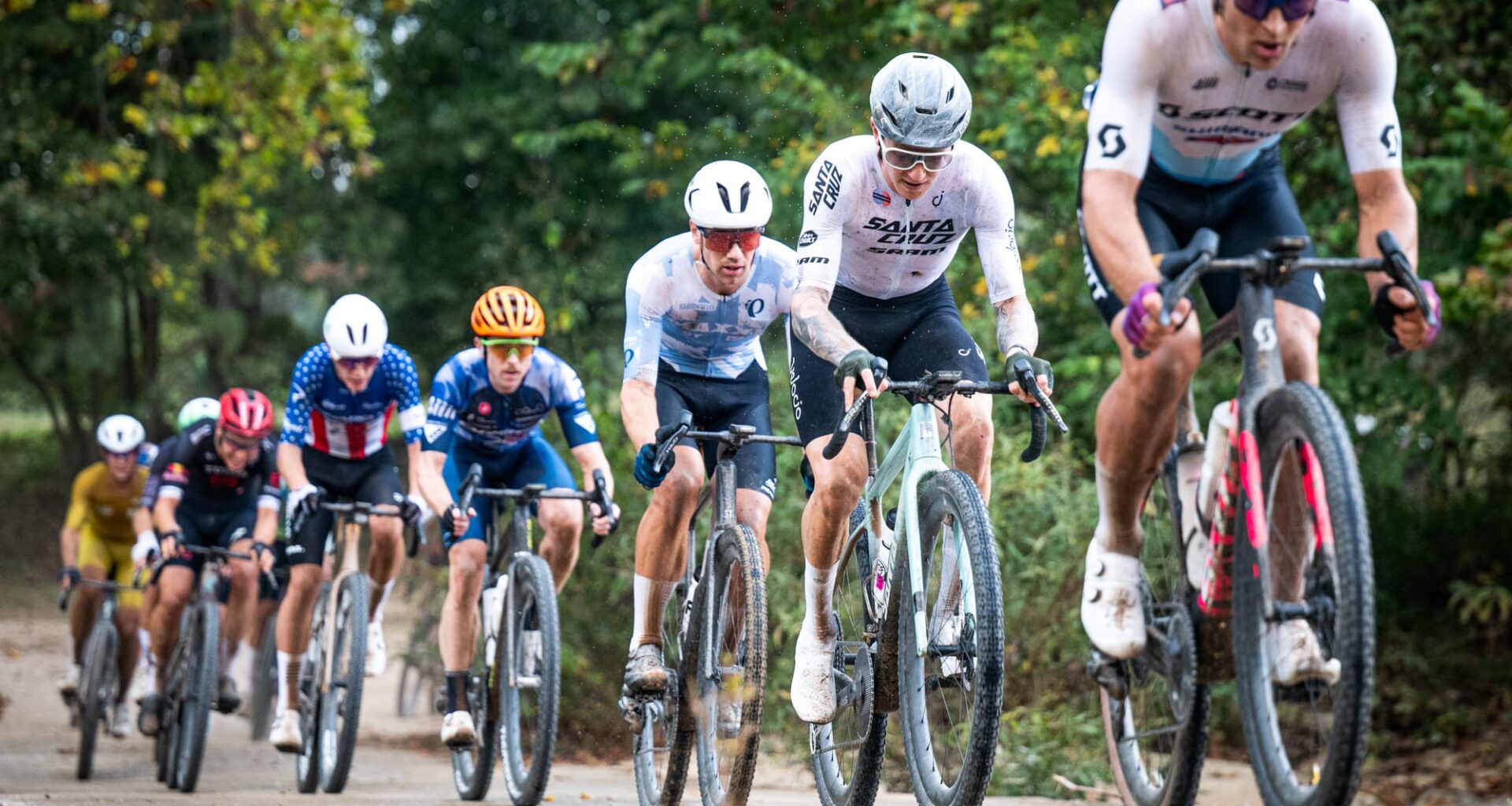

As we close the book on 2025 and with 2026 right around the corner, it’s a great time to ponder: Who are the best gravel racers in the world right now?
Thomas Euler is a gravel fanatic. Besides writing about gravel on Escape Collective, he has his own “gravel-coded” The Gravel Stack Substack. He also hosts the Gracing podcast, where he (p)reviews gravel races, often with the top pros who competed.
I set out to answer this question and rank the top 25 gravel racers from across the globe. In this piece, we will look at the men. The women’s ranking will follow soon. And if you’re interested in some deep cuts, the riders who sat on the bubble and just missed the top 25, make sure to subscribe to my newsletter The Gravel Stack.
Given the title, you may be wondering … What are power rankings? Glad you asked. First, let me tell you what they are not. They are not a GOAT (greatest of all time) ranking. Rather, they aim to capture who is best at this moment in time. They are a snapshot based on recent performances, not a comparison of the entire body of work that riders bring to the table. As you are about to find out, it’s not a simple exercise in the fragmented world of gravel racing, where riders can have vastly different programs. But that’s also the reason I consider it a worthwhile undertaking.
In the end, the rankings are an attempt to provide everyone interested in gravel an orientation on which riders are worth watching.
Creating gravel power rankings has been on my to-do list for a while, and now that we have all the data from the 2025 season, the timing to actually start the project seems perfect. I don’t have any races to cover, so why not prepare for the 2026 season that is about to start in about eight weeks?!
How the sausage is made
When you start such an undertaking, you first need to decide on a methodology. While these rankings are called Power Rankings, we are not looking at FTP numbers nor Critical Power data here. Watts certainly play an implicit role in the ranking you’re about to indulge in, but I’m not going for a science-y physiology data comparison piece. Rather, I’m basing these rankings on real-world performances and results.
While you can’t win gravel races without sufficient power, there are more facets that go into results, from bike handling skills to tire selection. And the most substantial – and actually available – dataset that allows us to infer the level of pro racers is race results. So we use these. And as we are interested in recent performances, I only collected 2025 results data.
Tiers of races
That leads to the first complicating factor. A basic reality of bike racing is that not all races are created equal. There are races with tough courses and stacked fields, say Unbound and The Traka, and there are local grassroots races. Then, there is the basic reality of data availability.
On the road, we have an established system with various designations. We have Monuments and Grand Tours, WorldTour races, 1.Pro, and so forth. In gravel, we do not have this officially, but luckily I already had started to develop a tool a while ago, the Five Tiers of Gravel Races. Based on the logic I laid out there, I put particular focus on riders’ results in the top two tiers of the pyramid, namely Gravel Monuments and Gravel Classics.
I introduced my Gravel Monuments list earlier this year and did not make any amendments to it. Thus, the five Monuments (which actually come down to six races, in an odd, gravely quirk) are:
Unbound 200The Traka (200 & 360)Lauf Gravel WorldsBWR CaliforniaThe Rift
While I did not yet release my complete list of Gravel Classics, I created a preliminary version for our purposes here:
SBT GRVLBig SugarThe GrallochSea Otter GravelRanxoThe Hills
(Mid South is also on the list, but it did not happen this year, and so doesn’t factor into the rankings.)
Official title races, too, fall in the category of races that matter more and, thus, are harder to win. This includes the UCI World Championships, Continental and National Championships. I also tracked those separately (and yes, the depth of national championship fields can vary immensely. I factored that in, to the extent it’s possible).
I also tracked stage race GC performances separately and factored them in.
Considered races
As these are gravel power rankings, I included only gravel races, as well as Life Time Grand Prix’s two “Xtreme Gravel” races, i.e. Leadville and Chequamegon.
As a data source, I relied on ProCyclingStats for the most part. PCS started collecting gravel race data a while ago and, by now, the site has a solid (though not complete) dataset. Thus, I included all results that made their way onto PCS. They have results from all major gravel races, including the LTGP gravel races, the Gravel Earth Series, and the UCI Gravel World Series (UGWS) races, as well as a fair number of independent race results from all over the world.
Because Leadville and Chequamegon are officially MTB races and, thus, not on PCS, I obtained those results from Athlinks. Lastly, I also included Crusher in the Tushar, using results from Athlinks.
While some minor races may be missing, I don’t think they’d impact the rankings significantly. After all, we are looking for the top 25. To be considered in that company, you need to perform on the sport’s biggest stages.
Win rates and other percentages
A key aspect of performance I wanted to understand is how consistently good a rider is. To express this in data, I created and tracked three stats for every rider:
Win rate: how many races did a rider win, as a percentage of their total race days?Podium rate: same as win rate, but additionally including all 2nd and 3rd placesTop 10 rate: All top 10 results as a percentage of all race days
As you will see, I treated those as interesting but, in their current form, not critical data points. So should you. Here’s why: To be really useful, these numbers would have to factor in a race’s relative difficulty level and weigh them accordingly. I haven’t yet developed that system and didn’t want to overload the piece with new, complex stats. It’s a future project. As of right now, every rider’s percentages can be created very differently; one rider’s excellent numbers may be based on lower-tier race results, another’s on only Monuments and classics. Keep that in mind when looking at the numbers.
Finally, let me point out two peculiarities regarding that data.
Number of race days: This number only includes gravel race days, no other disciplines. Notably, most gravel races apparently don’t report DNFs. So DNFed days are often not included. As this is consistently the case for all riders, that should be fine. But a few races did report DNFs and I counted those as race days. It didn’t distort the results. But it was relevant in one case, so I made a remark there.
GC results: As GC and stage results both matter when judging a rider’s level, I counted both. That’s also common practice in road racing. That, however, means that riders who participated in stage races can reach over 100% in their win/podium/top 10 rates. Assume a simple example of a rider having raced a two-day stage race, winning both stages and GC. He’d have three wins in two race days, for a 150% win rate. As some riders actually did have an above-100 top 10 rate, I also included their theoretical maximum.
Eligible riders
The goal of these power rankings is to identify who the best gravel racers are right now. To that end, I only included riders who race gravel at least somewhat regularly (sorry, Florian Vermeersch) and who we can expect to race gravel regularly next season again (sorry, Frits Biesterbos; but the WorldTour contract you likely got in part thanks to your excellent performance at UCI World Champs presumably takes the sting out of not being on my little list).
Momentum: Recency bias by design
While I included data from the entire 2025 season, I weighted results from later in the year more heavily than older performances. This recency bias is purposeful because we are interested in the current state of affairs. Form ebbs and flows, and so will the riders’ positions in these rankings. If a decision came down to a head-to-head comparison and one result was from February and the other from October, I regarded the latter as more important.
Top 25 Men
Without further ado…
25. Paul Voss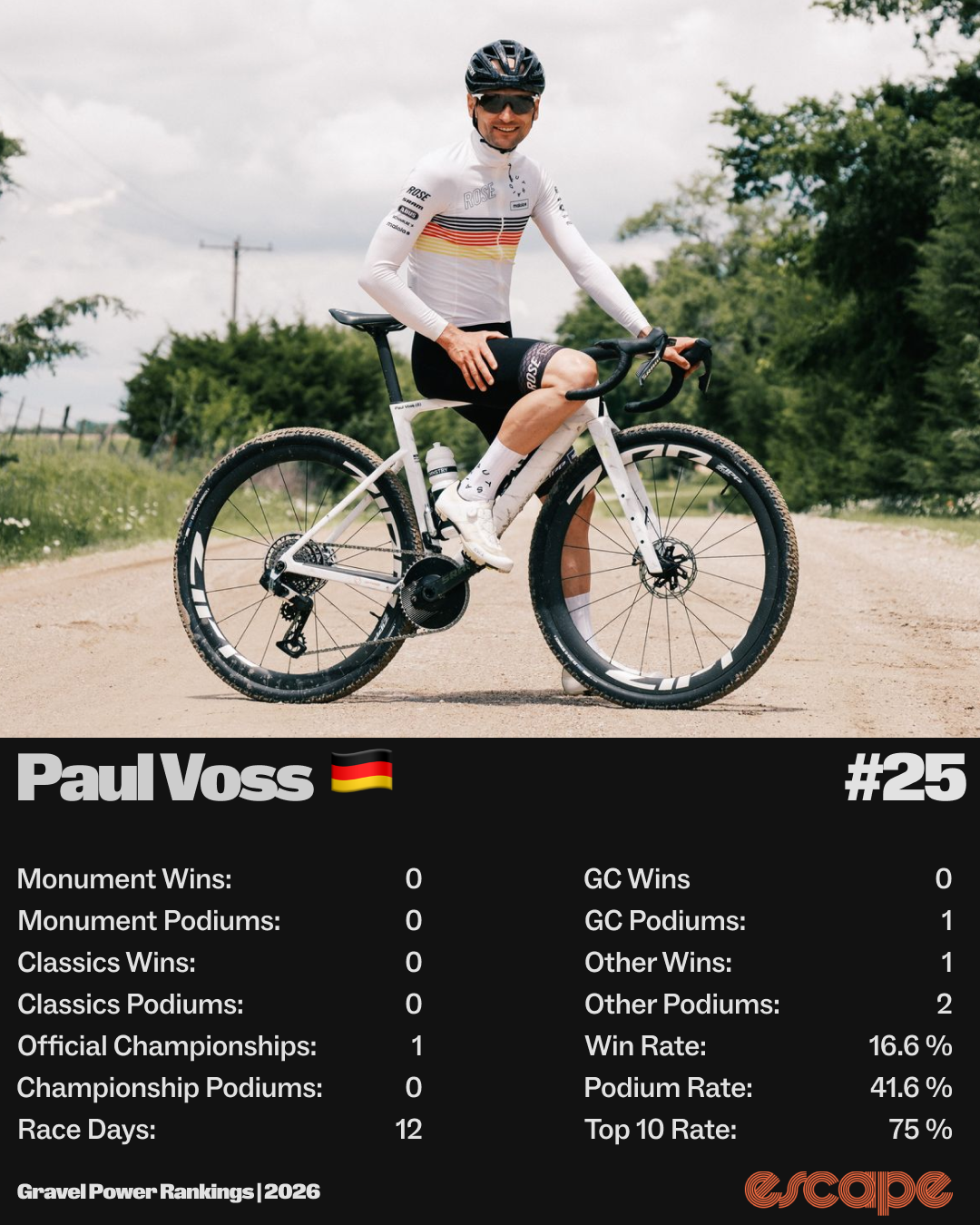 Photo: Pierre Barton
The former WorldTour pro’s season was somewhat derailed by health, injury, and tire mishaps. Still, Voss is one of the fastest guys on gravel. While he lacked an outstanding international result this year, he managed to defend his German national championship title against strong competition that included Frederik Raßmann (who was the winner of the 2024 edition of Traka 200 for approximately 15 minutes before being relegated thanks to an illegal feed) and Tim Wollenberg. His top level shone through earlier in the season when he was third at Santa Vall and eighth at Sea Otter. He also won the inaugural Rad am Ring Gravel Race. That may not be the biggest race, but winning basically any gravel event is hard these days. Thus, it matters. Even though Voss is approaching his 40th birthday, I anticipate he still has a few good results in his legs in 2026.
Full disclosure: I might be biased as Voss and I regularly podcast together and his Autsaid feed is the home of my Gracing pod.
24. Piotr Havik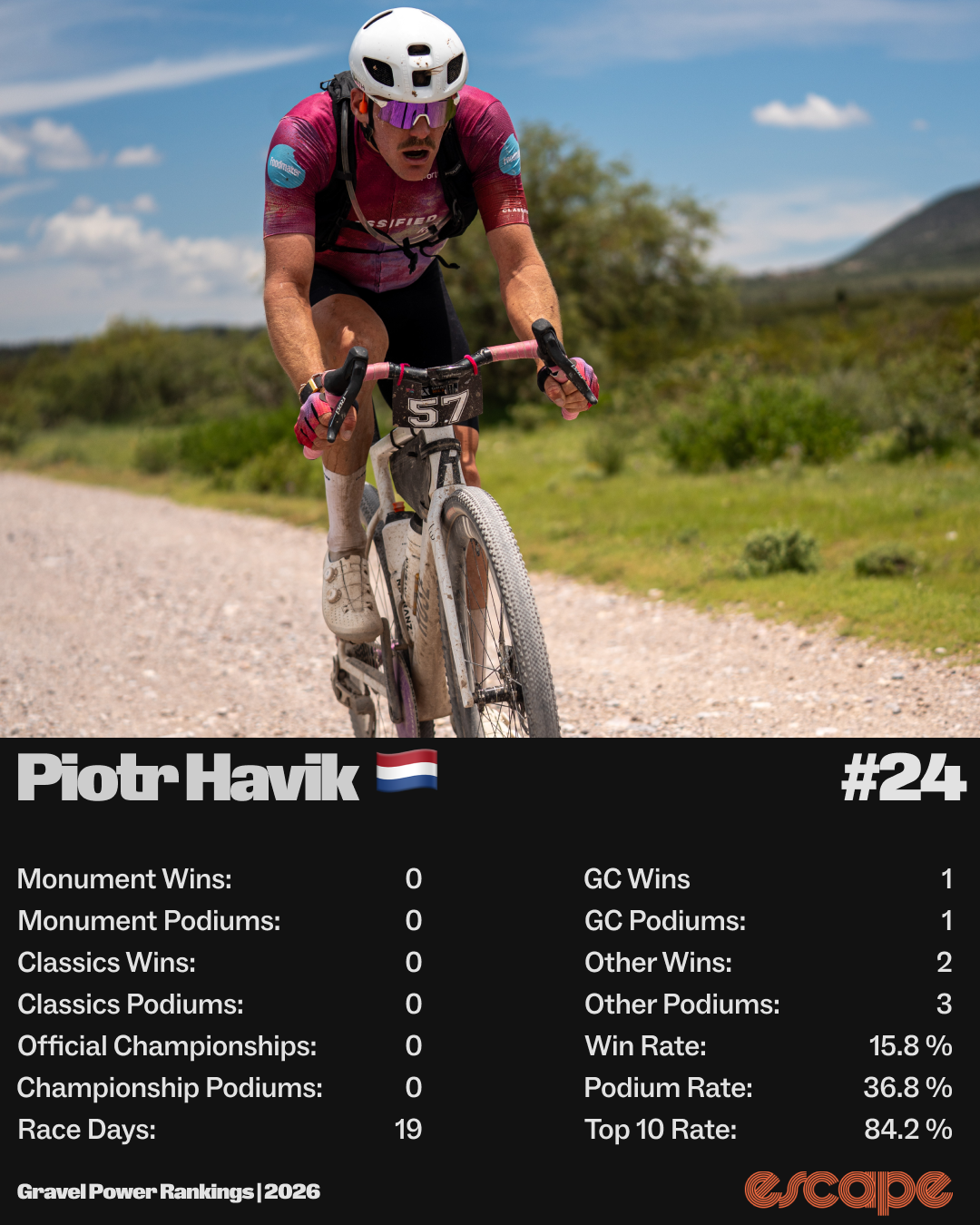 Photo: Gravel Earth Series – Gravel Mexico
The runner-up in this year’s edition of the Gravel Earth Series (GES) got there thanks to his good race selection. By focusing on some of the smaller events of the series – which have less stacked fields – and winning two of them in Gravel Mexico and Gravel Weekend Latvia (where he also won the GC), he collected a fair chunk of GES points. He also podiumed in GC and two stages at Tierra de Campos and at Megre Gravel. When he raced in fields packed with hitters, Havik was usually behind the pointy end of the races, which is why you don’t find him higher in the power rankings.
23. Tiago Ferreira 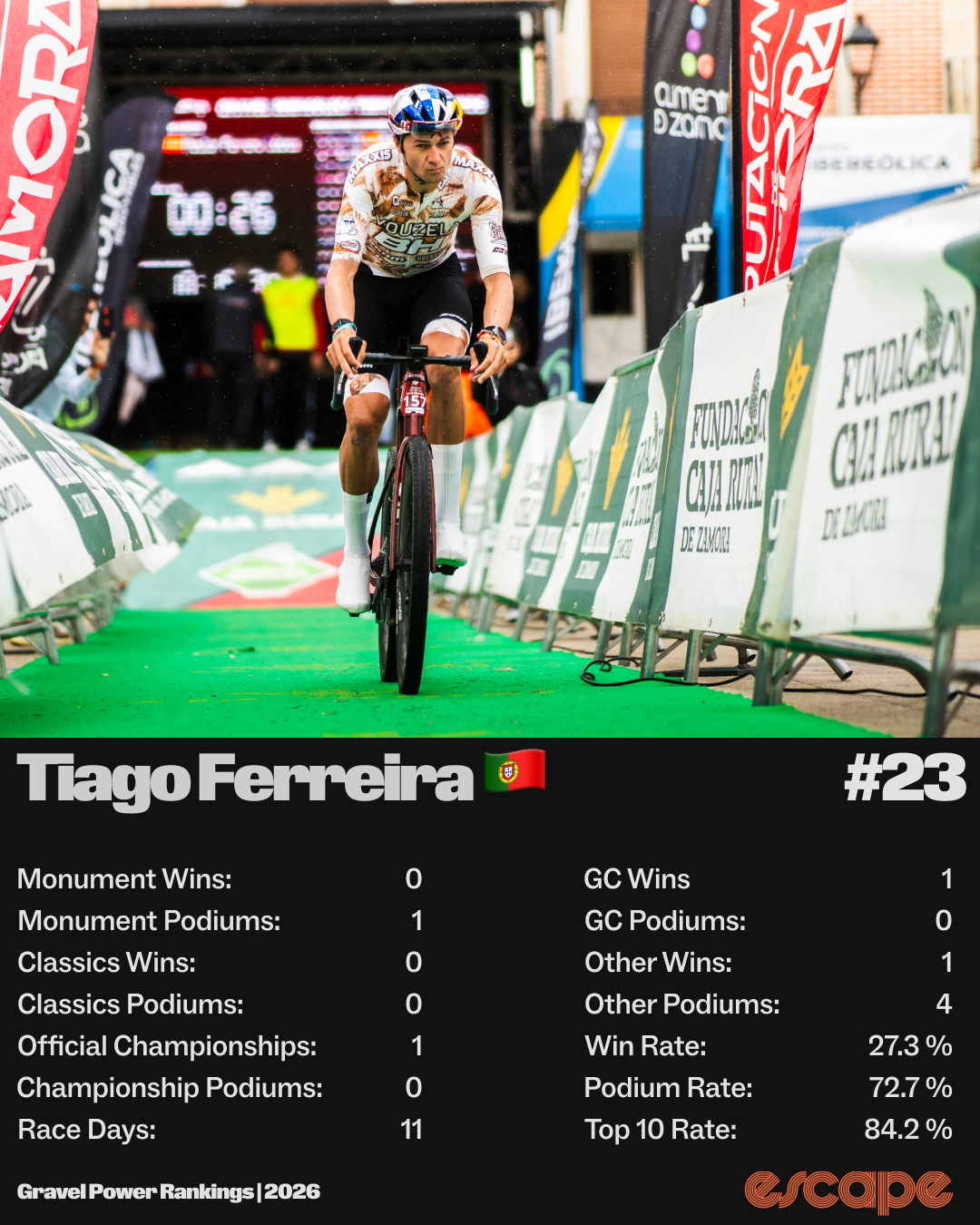 Photo: Gravel Earth Series – Tierra de Campos – Diego de la Iglesia Rodríguez
The Portuguese gravel pro – and Red Bull athlete – kicked off his season with two second places at the UCI Castellon Gravel Race (behind Alejandro Valverde) and at Utopia Gravel. He proceeded to win the Tierra de Campos stage race, part of GES, and took a stage win in the process. He also won the Portuguese National Championships.
His strongest result of the year was his (second consecutive) second-place finish at The Rift, for a gravel Monument podium. The only rider who managed to beat him in the Icelandic volcano landscape was Magnus Bak Klaris, while Ferreira finished ahead of riders like Petr Vakoč and Tobias Kongstad, both of whom rank much higher than him here. Given that The Rift has the shallowest field of all the Monuments, it does not catapult Ferreira higher up in the standings. Neither do his very solid podium and top 10 rates, as his strong Tierra de Campos showing, which did not feature top-level competition, inflates them.
22. Hugo Drechou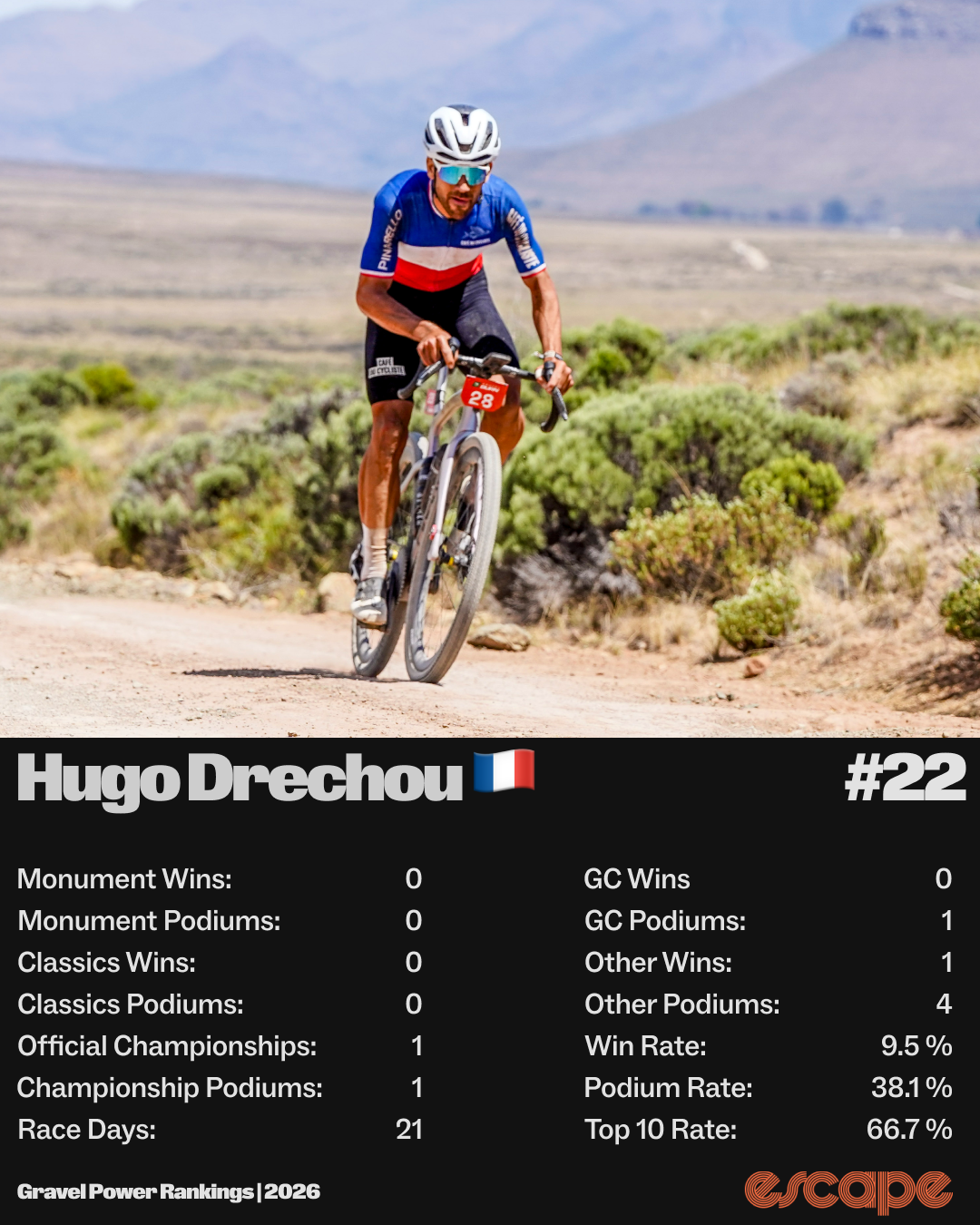 Photo: Bruce Viaene/Gravel Burn
Those of you who primarily follow the Life Time Grand Prix may remember the French mountain biker and gravel pro as yet-another European dropping out of the series. But Drechou still had several notable results this year. After winning La Bescanonina Gravel in Spain early in the year, he later went on to win the French national championships. He also podiumed in two UCI GWS races, and finished just off the podium at BWR Arizona.
Drechou fortified his position in these rankings at the European Continental Gravel Championships with a strong third place. He sealed the deal at Gravel Burn, where he finished third on GC and on two stage podiums. These strong results towards the end of the season give him some extra points in the momentum category. What stops him from placing higher up? At Gravel Monuments and Classics, he got decent but no superb results. His 15th at Lauf Gravel Worlds, 19th at Sea Otter, and 25th at The Traka 200 all lower his win, podium, and top 10 rates.
21. Daan Soete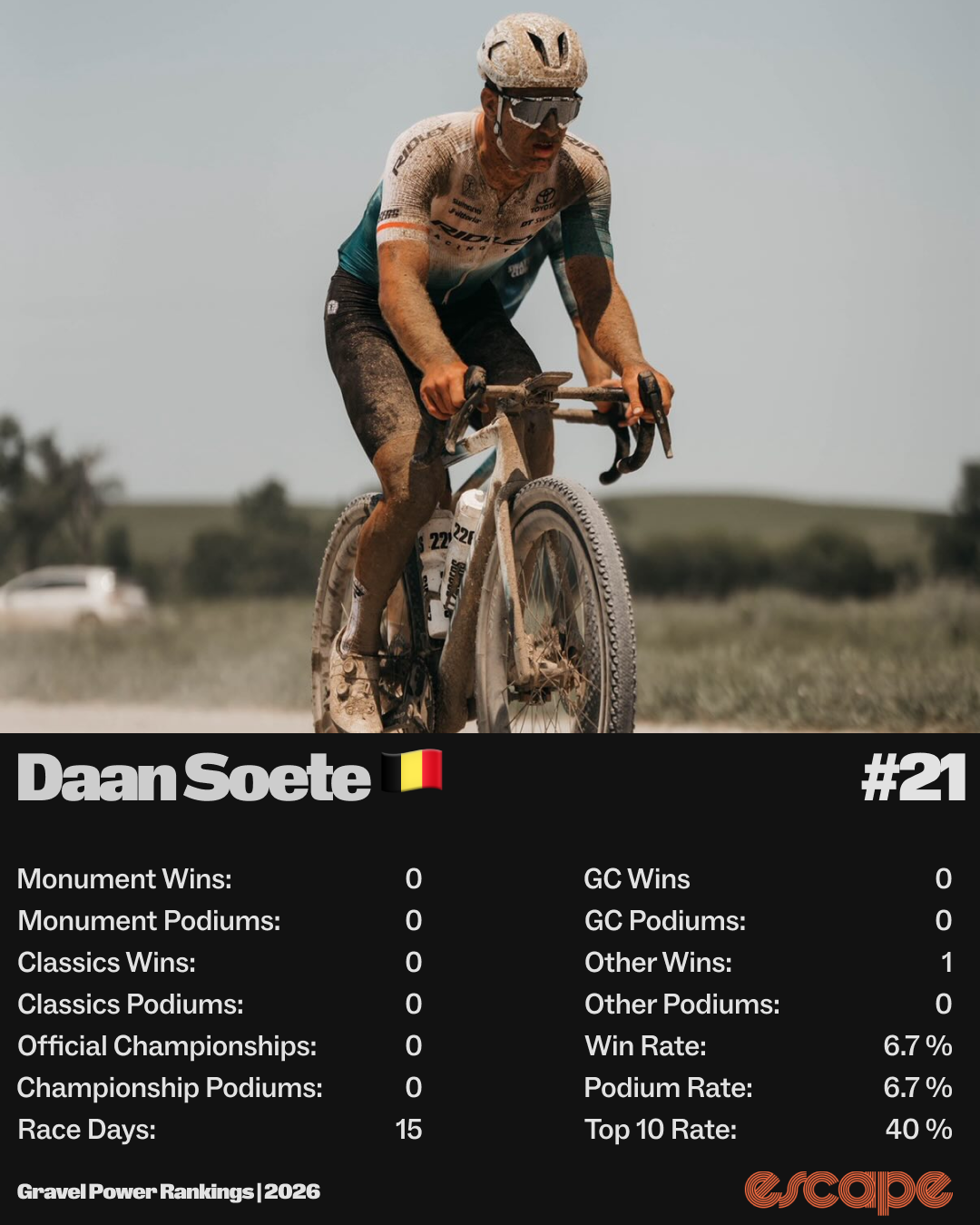 Photo: Ridley Racing Team
You may not know Daan Soete, but you should, even though his numbers may not reveal his talent immediately. The Belgian former roadie, who has converted to gravel for the most part this year, may not have a single standout result, but he has been there or thereabouts in the biggest of races.
His sole win this year came late at Sea Otter Europe in Girona, where he beat the likes of Dorian Godon (then at Decathlon-AG2R La Mondiale, next year an Ineos Grenadier), Stan Dewulf (Decathlon), Vakoč, and Romain Bardet. That is a pretty stacked field and makes for a nice boost in momentum.
If you consider this too Euro-road-coded, fair enough. Soete also held his own in gravel’s main events, as proven by a 13th place at Unbound, sixth at Traka 200, and seventh at the mud fest that was The Hills. And his 15th place at the UCI World Champs, among a bunch of WorldTour pros, underscores that Soete is a high-level racer, even though his stats above don’t show it at first sight.
20. Peter Stetina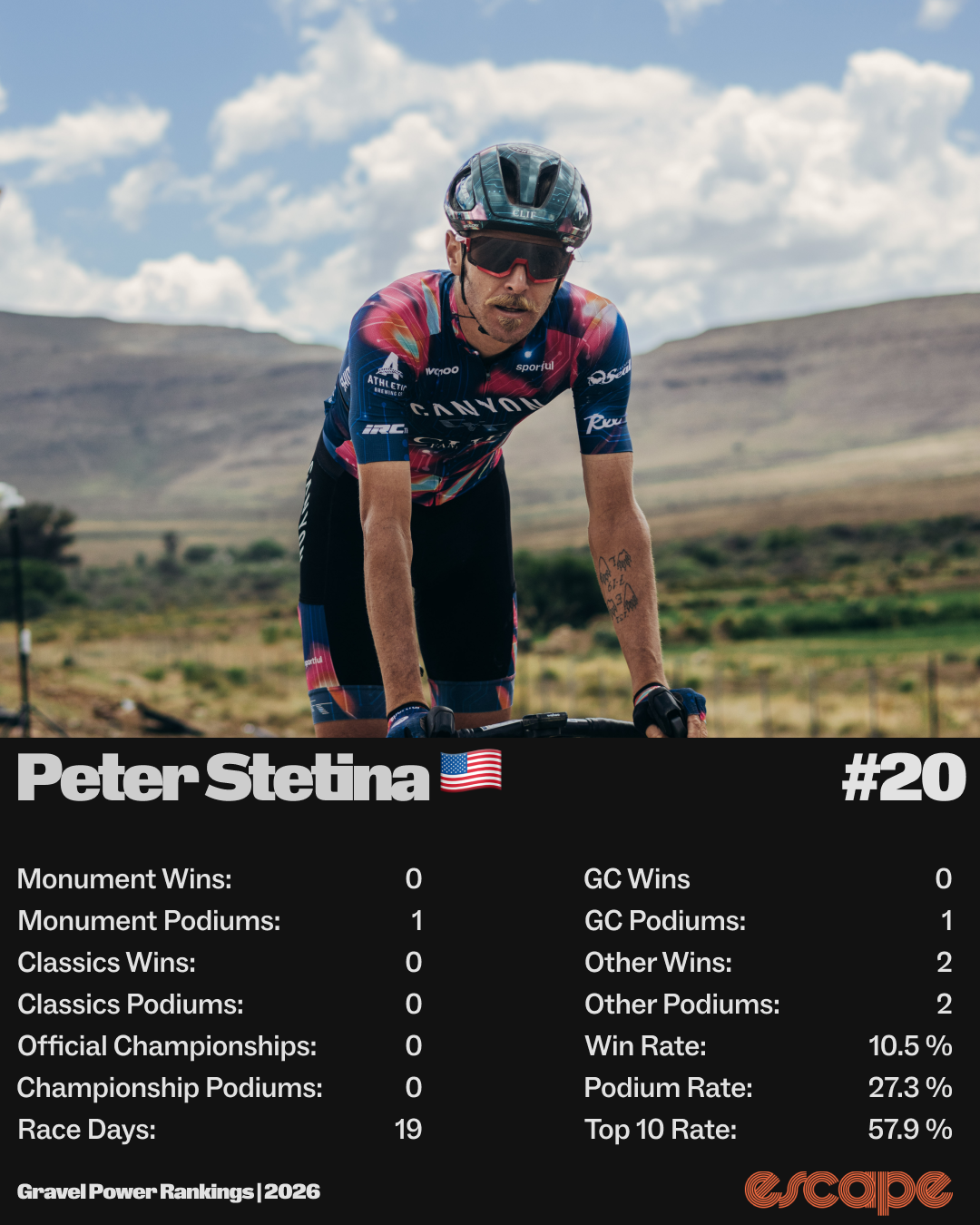 Photo: James Cameron Heron/Gravel Burn
And just like this, we’re entering the top 20. The honor of opening them goes to, arguably, one of the biggest names in gravel, Pete Stetina. While he recently announced his transition from full-time competition into a “player coach” role at Canyon, he’ll stick around the gravel circuit and line up at the occasional race, which is why he still gets his spot.
He ranks here on the back of consistent good results in some of the biggest races in gravel, accompanied by a couple of smaller wins. He took the latter at Low Gap and Lost and Found. His marquee results this year were second places at BWR California and Rebecca’s Private Idaho. In both races, Matt Beers was the only one who beat him. Stetina was also in the top 10 at Traka 360, SBT GRVL, Sea Otter Gravel, and the US National Championships. That’s the kind of resume that will get you into the top 20 around here.
19. Anton Stensby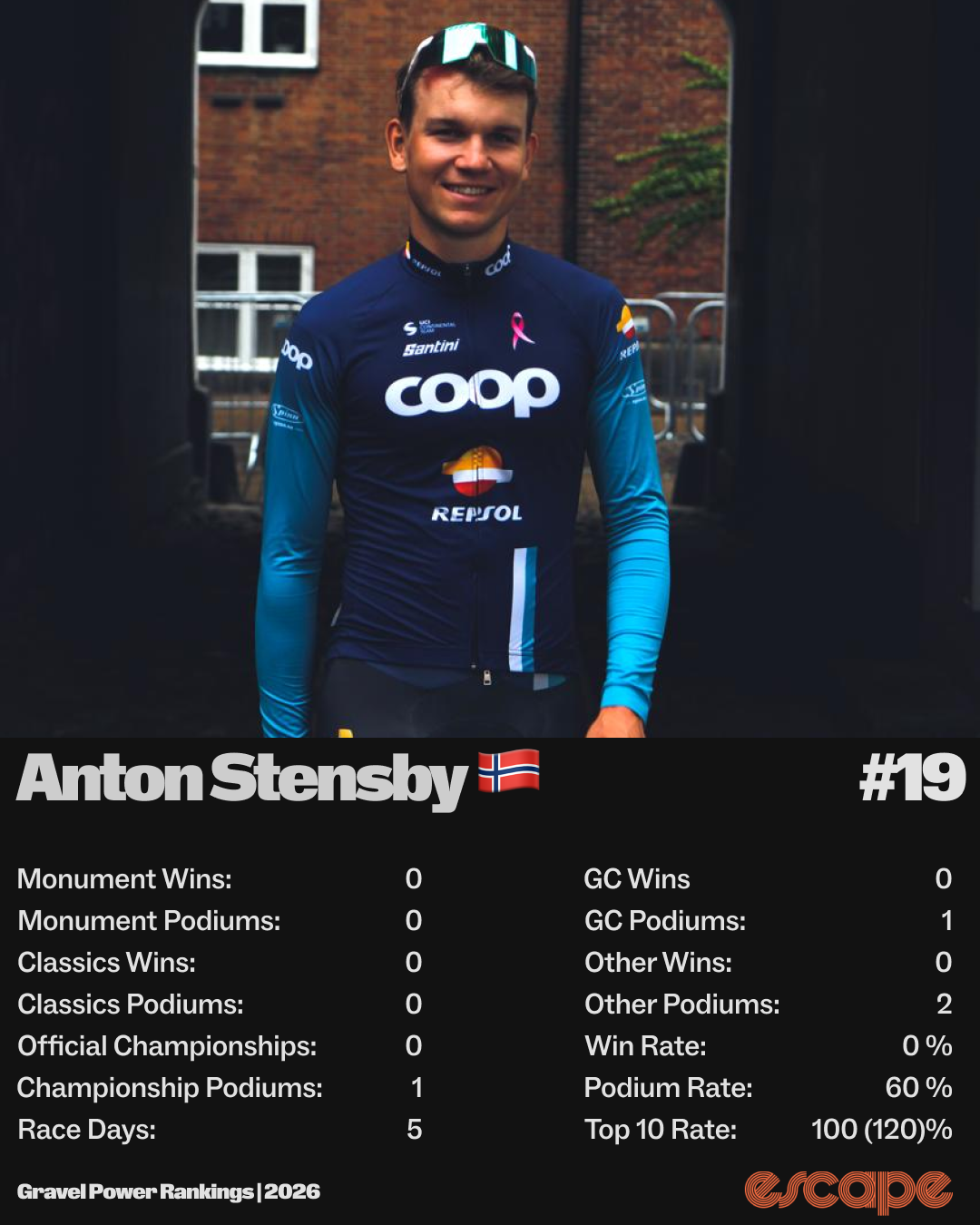 Photo: Tore André Aase Vabø
Unless you’ve read my piece about the new faces at next year’s Life Time Grand Prix, chances are you never heard of Anton Stensby. He’s a Norwegian roadie who just dabbled in gravel racing this year. But the outcome of his tinkering is his admission into the LTGP. Is his selection justified? Gravel, Grit ‘n Grind was his first big gravel race. The Swedish three-day stage race includes a UCI GWS event on the second day. Anton was second on stages 2 and 3 and in the GC. In the process, he beat guys like Voss, Havik, and Bardet.
He then picked the European Championships as his second gravel race and, once again, finished in second, beaten only by Mads Würtz Schmidt. His third and last gravel race so far was the UCI World Champs. While he did not finish on the podium there, he got a strong 14th place, sprinting for 11th with Soete, Gianni Vermeersch, Quinten Hermans, and Toon Aerts, i.e. rather illustrious company.
In short, Stensby made quite an entry into the world of gravel. Combined with the late-season momentum, it gets him right in the top 20. We’ll soon find out if he can pick up where he left off.
18. Brennan Wertz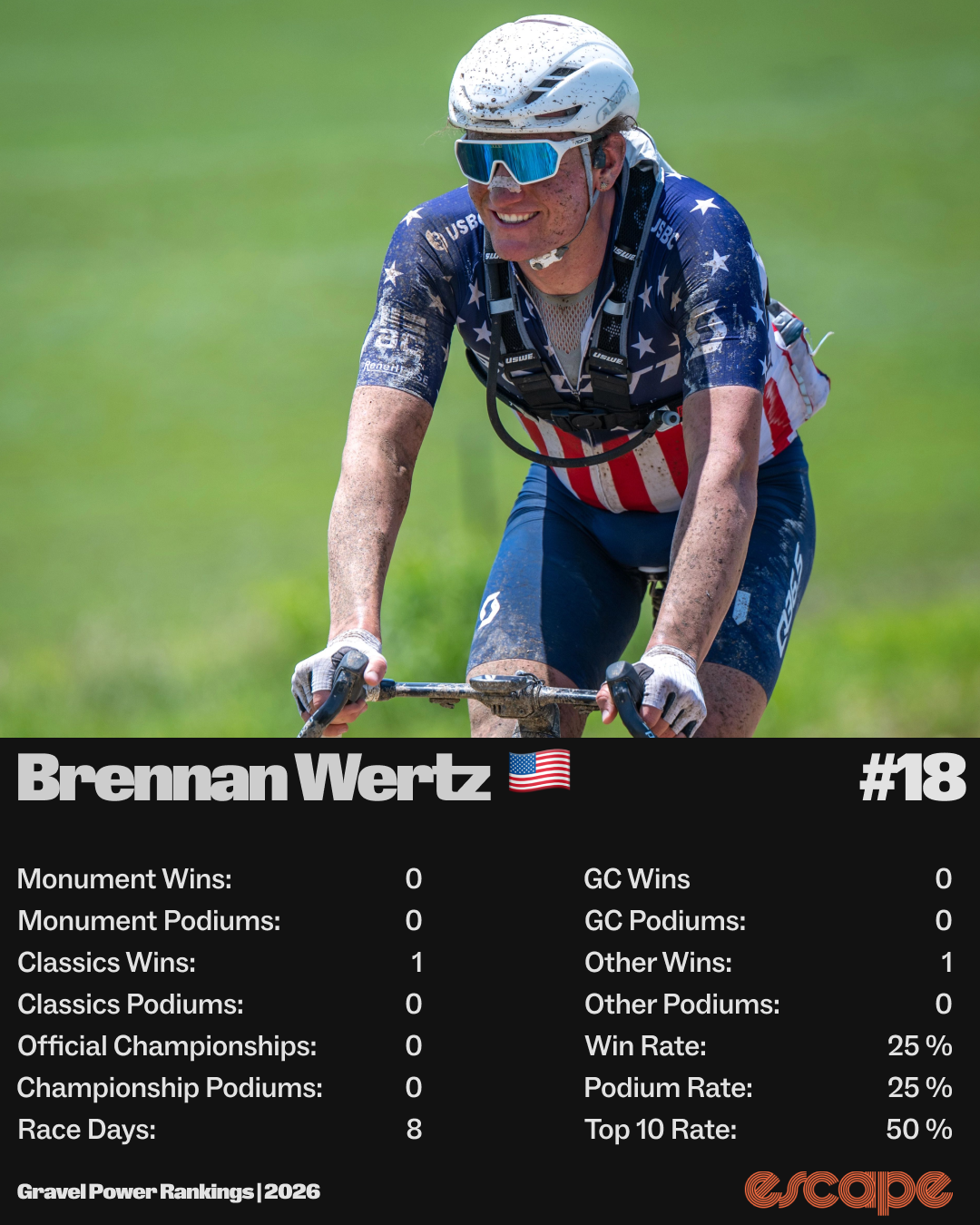 Photo: Life Time Grand Prix – Dan Hughes
For much of the season, Wertz raced in his Stars and Stripes US National Champion jersey which he won in 2024. While he could not defend his title at this year’s US nationals (he finished in 8th), he did manage to win one of gravel’s biggest classics, namely SBT GRVL. On the champagne gravel roads of Steamboat Springs, Colorado, he beat the likes of Stetina, Keegan Swenson, and Alexey Vermeulen with a powerful late attack.
He also won the Huffmaster Hopper and finished in the top 10 of Gravel Locos and Lost and Found. On a good day and on the right course, Wertz can bang heads with the best of them. On other days, if the course doesn’t suit him, he can end up out of the mix, as evidenced by results like 45th at Sea Otter or 49th at Unbound (where he had stomach issues). Overall, this nets him 18th place.
17. Mathijs Loman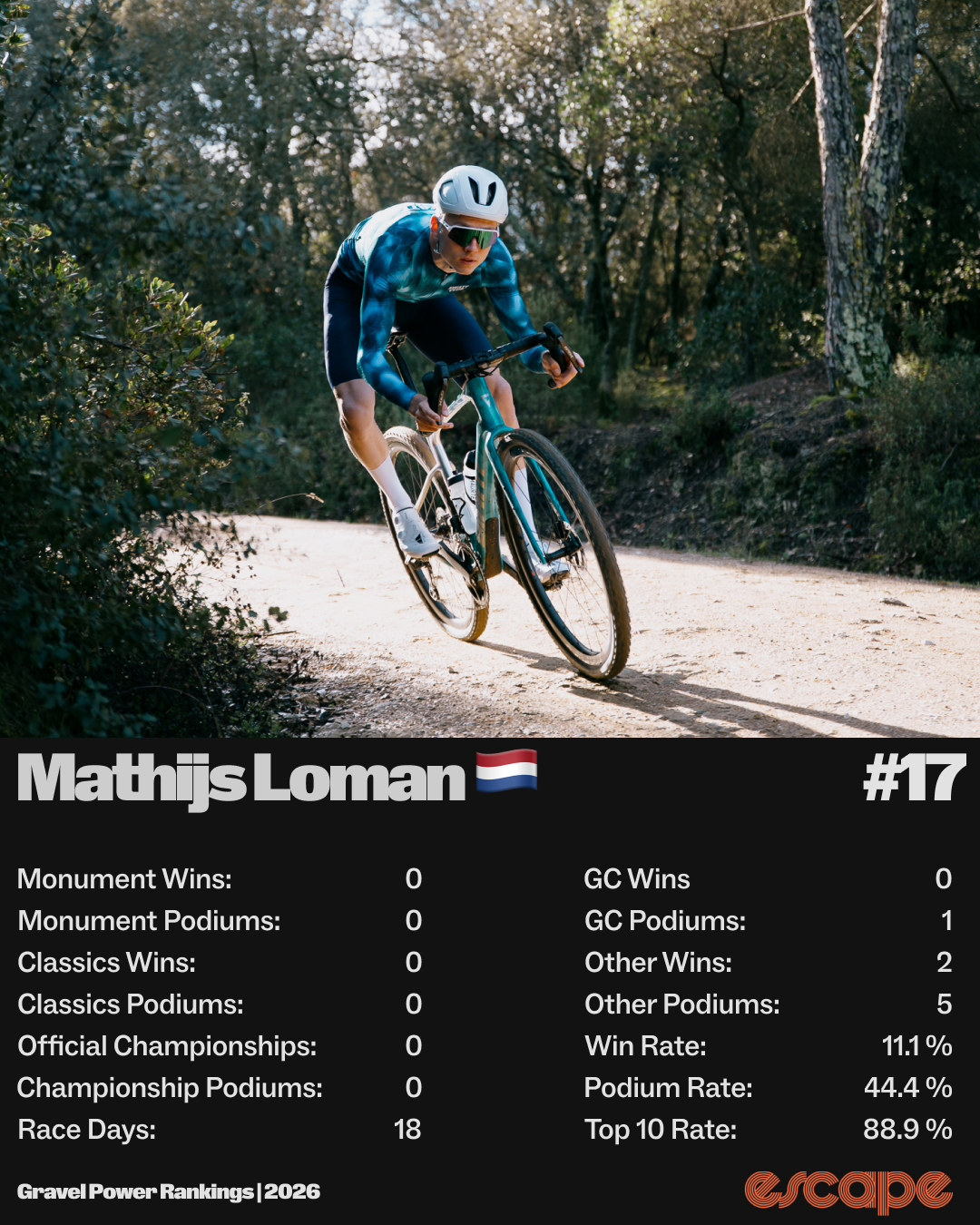 Photo: SWATT Club
With apologies to the perennial 17th place Dylan Johnson, 17th on this list is Mathijs Loman. He may not yet be a famous name in gravel, but he might be if the UCI Gravel World Series did a better job of covering the series. The 25-year-old Dutch Swatt Club racer is a veritable UCI gravel crusher. He won two races of the World Series, namely Eislek Gravel Luxembourg ahead of Vakoč and the Hegau Gravel Race ahead of Jonas Koch of Red Bull-Bora-Hansgrohe and Felix Stehli (who we’ll cover in a few minutes). Add to this four more podiums at UCI Gravel races, a fourth place in GC at Sahara Gravel, and a third place in the GC at Gravel, Grit ‘n Grind, and the picture of a talented young-ish (by gravel standards) racer emerges.
The reason he doesn’t rank even higher? In his limited outings on gravel’s biggest stages, he has fared only okay. He finished 26th at both Unbound and Traka 200. Maybe he’s not built for those longer distances or has yet to develop his engine. Or he simply didn’t have great days. Still, memorize his name.
16. Simen Nordahl Svendsen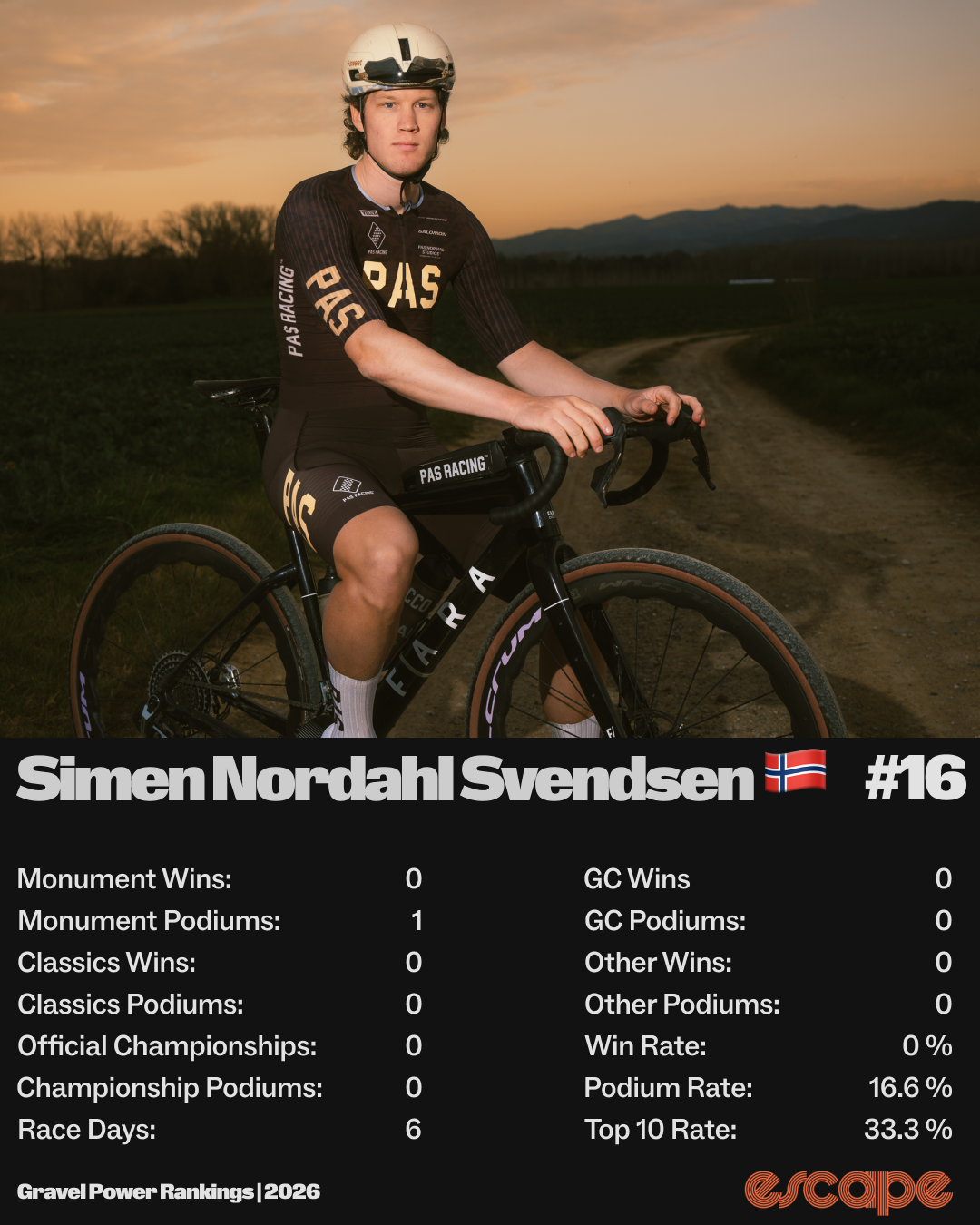 Photo: sonam.cc – PAS Racing
The 2024 Gravel Earth Series winner had a strange season that, among other things, included a US trip where he ended up not racing and other mishaps. Judging by the numbers above, you may wonder how a single podium at a Monument – his third place at The Traka 360, to be precise – could possibly justify this position. Indeed, that alone wouldn’t be enough. But his other results at top-level races show that Svendsen still has a pretty high level. After a disappointing 23rd place at Unbound and 13th at The Rift, he trended in the right direction and finished Lauf Gravel Worlds in 5th and Ranxo in 11th. As Svendsen will compete in the LTGP next season, we are about to find out if he can regain his momentum and string a successful season together.
15. Adne Koster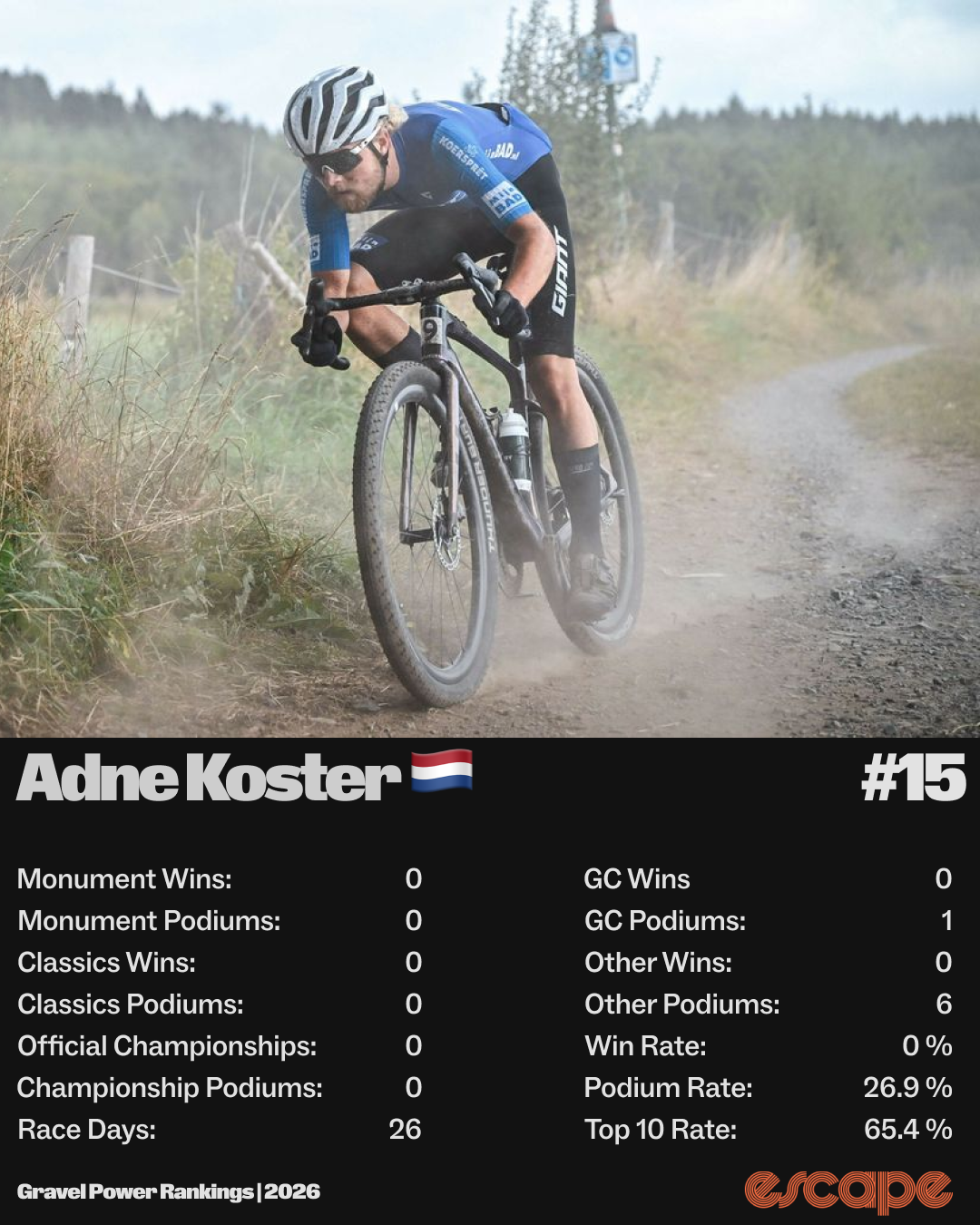 Photo: Sportograf
The 25-year-old Dutchman, who spends his winters racing speed skating marathons, isn’t a household name among gravel fans, but don’t be surprised if that changes next year. As the data above shows, Koster isn’t a serial winner. But he’s at the pointy end a lot, in all kinds of fields. He stood on podiums at various Belgium indie gravel races and at the UCI 66 Degrés Sud, where he finished 3rd behind Bardet and Drechou and ahead of guys like Vakoč, Würtz Schmidt, and Chad Haga. Critically, he also kept up with pretty elite competition in the bigger races. He finished fifth at The Traka 360, 11th at Unbound, and fifth at The Rift. Koster is one breakout result away from being on everybody’s map.
14. Romain Bardet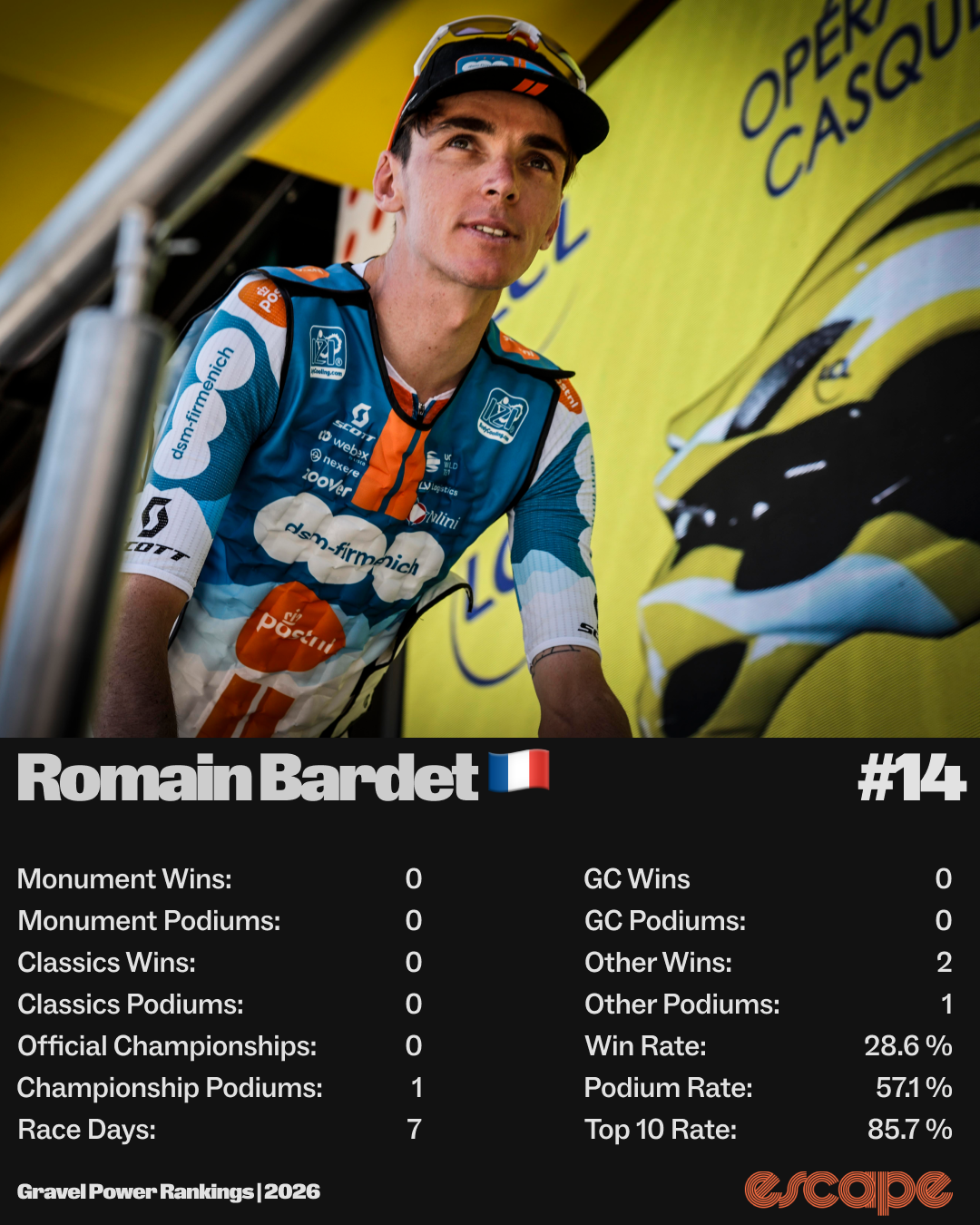 Photo: Cor Vos
Speaking of well-known names, Romain Bardet has more than 100x the followers of Adne Koster. I’m not sure if he qualifies as “French cycling royalty,” but if not, he’s close. He ended his WorldTour career in the summer at the Critérium du Dauphiné (the new name of which I do not intend to use, ever). Just two months later, he lined up at his first-ever gravel race. It didn’t take him long to get the hang of it.
After a 10th place at his first-ever gravel race in Sweden, he won his next two UCI GWS races and got second at Falling Leaves Lahti (GES). He also took second at the French national championships. In case Bardet stays around and keeps racing gravel for a while, he may well climb up these rankings quickly. He’s undoubtedly a quality rider and seems to have a knack for the bumpy stuff.
13. Felix Stehli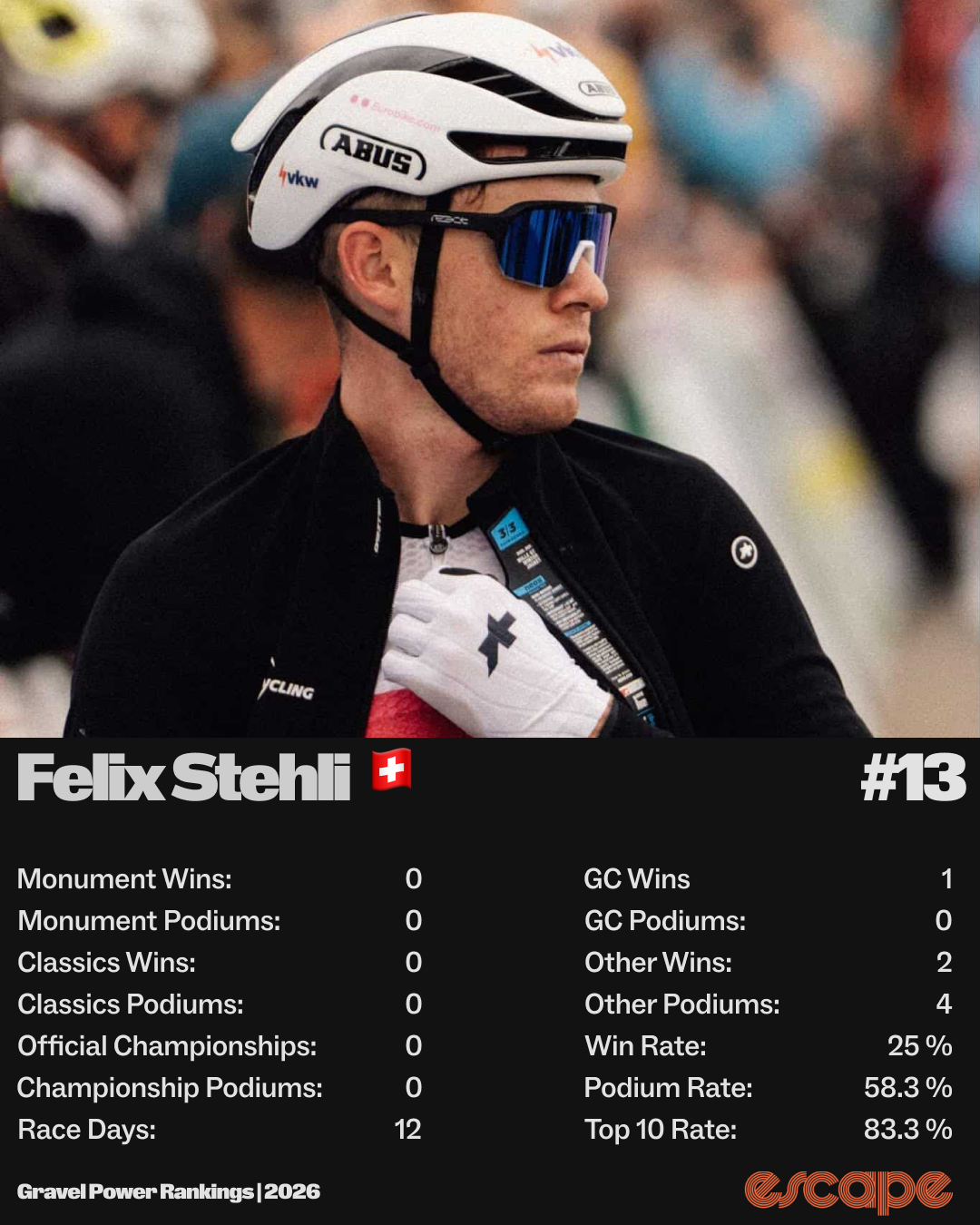 Photo: Team Honeycomb 226ers
The 25-year-old Swiss is another rider you potentially only know because you looked at next year’s LTGP roster. Felix Stehli is a multi-discipline rider who races everything from road to mountain bike. After two years at EF Education’s development team, he rode two seasons for the Austrian continental Team Vorarlberg, where he started to incorporate more gravel in his season schedule in 2024. While Stehli still raced a fair bit on the road this year, he built a strong resume on gravel as well. He won the South African UCI race The Ceder and both the GC and a stage at Gravel, Grit ‘n Grind. He also podiumed three European UCI races.
His standout result, which catapults him up this list, is his fifth place at the UCI Gravel World Championships, finishing just ahead of Tom Pidcock in the sprint for fourth. Otherwise, Stehli didn’t yet show himself on the biggest stages of gravel racing. But that’s about to change in 2026, as he joined the LTGP where he’ll be one of two riders on the Team Honeycomb 226ers outfit.
12. Wout Alleman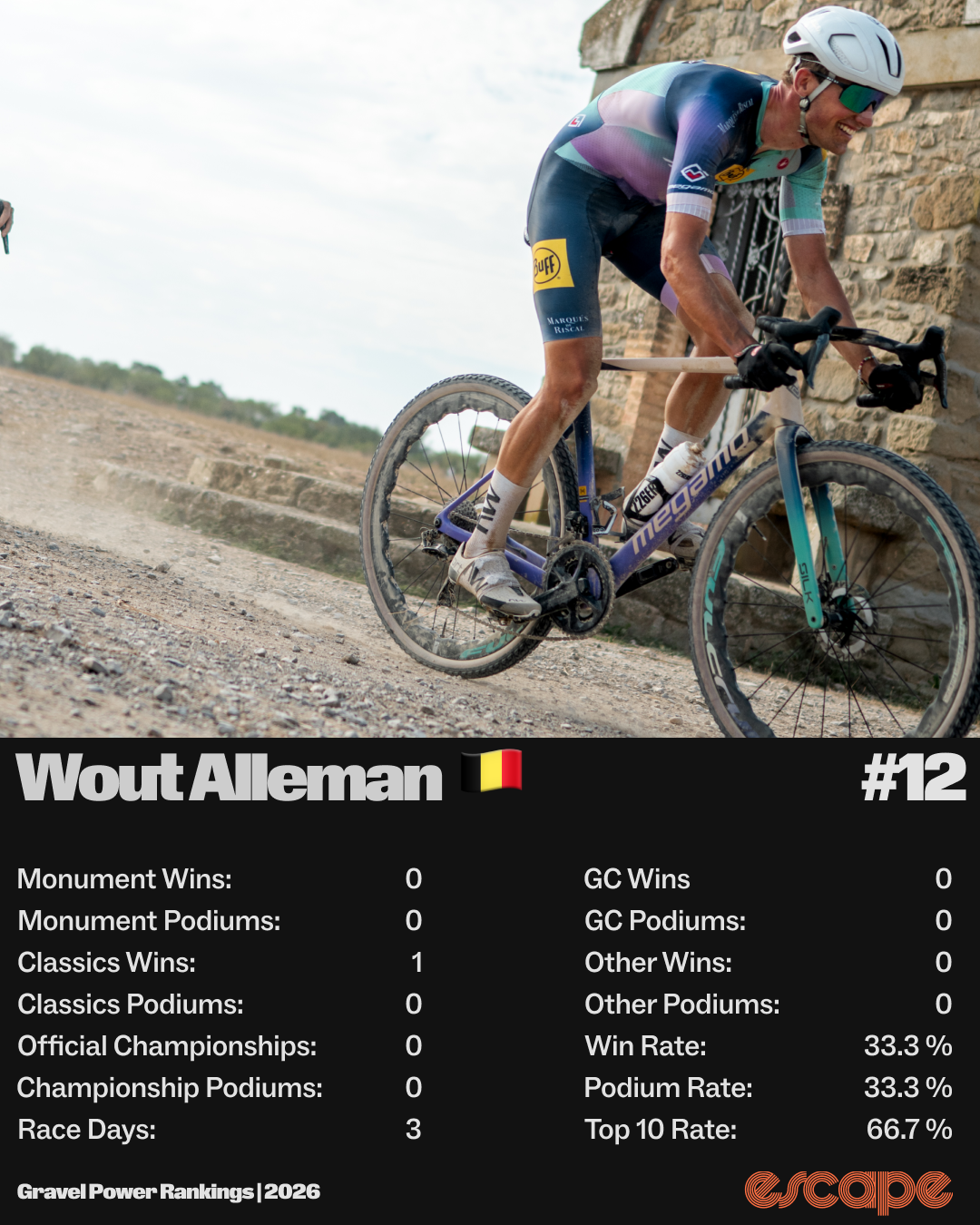 Photo: Gravel Earth Series – Ranxo – Roger Salanova
Wout Alleman is a mountain biker first and foremost. He’s ranked second in XCM in MTBdata’s World Ranking. Alas, we have to set his results on the MTB aside when it comes to the gravel power rankings. Around here, we only consider gravel (and Xtreme Gravel) results. Alleman didn’t race a whole lot of gravel this year. In fact, his PCS profile only lists three results on gravel – but they were all quality.
He won Ranxo, the Gravel Earth Series finale, where he beat Magnus Bak Klaris in the sprint and distanced a strong, international field that comprised folks like Vakoč, Jan Stöckli, and Frederik Raßmann. With that, he added a classics win to his palmares and scores in the momentum category. His other two results weren’t shabby either. He finished fifth at The Traka 200 and 17th at the UCI World Champs. If Alleman adds more gravel to his 2026 schedule, he could move up the rankings.
11. Brendan “Trekky” Johnston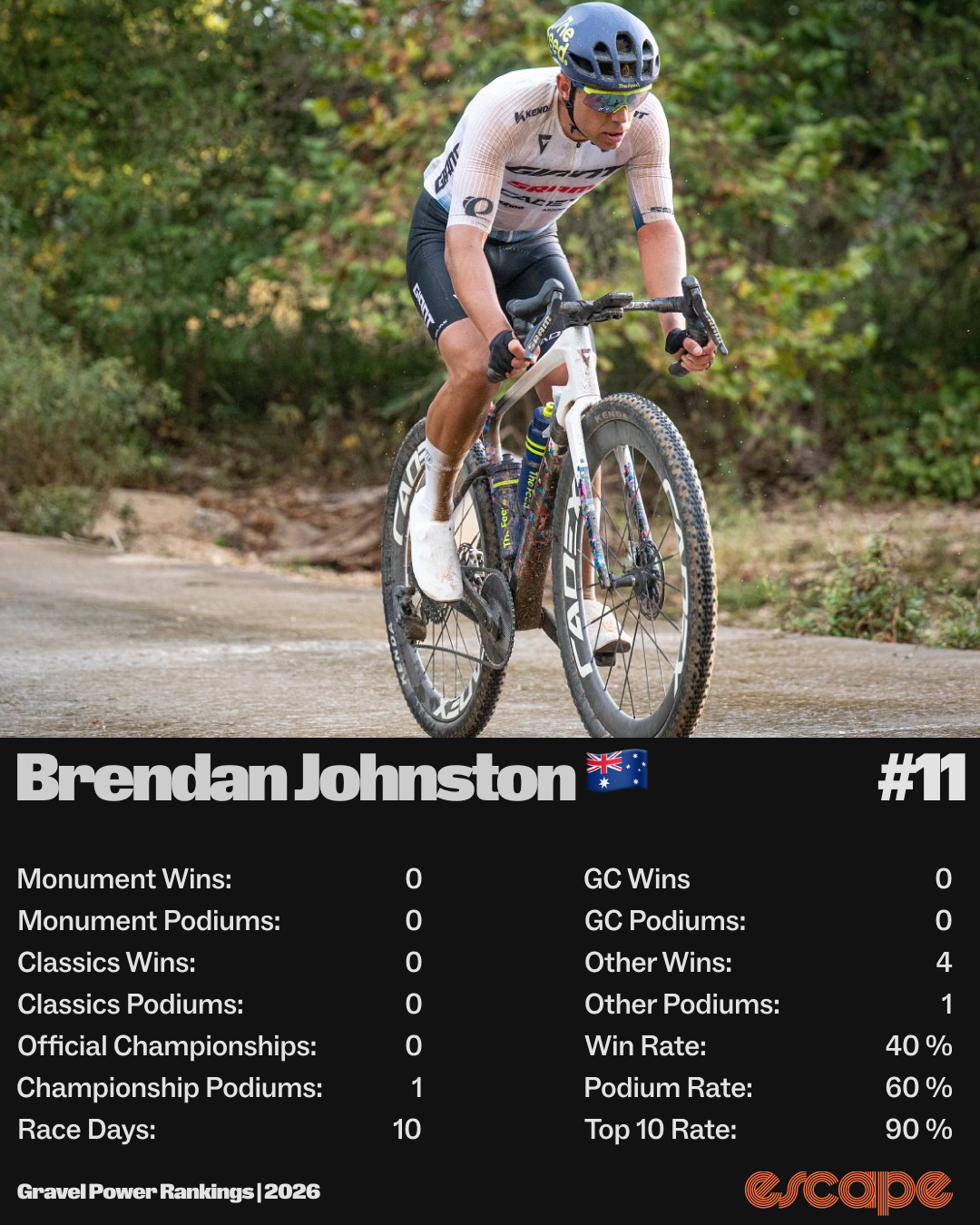 Photo: Life Time Grand Prix – Dan Hughes
Brendan Johnston, better known by his Trekky moniker, won a fair share of races. He earned three of his victories on his Australian home turf, where he won two UCI Gravel World Series races and RADL GRVL, against some proper Australian hitters. His fourth win was at Salty Lizard, an indie US race. These are all nice results, but they would not get him up here on their own.
For that, he also had to perform on some of gravel’s biggest international stages. And he did, most notably with a fifth place at Unbound, accompanied by another fifth at Sea Otter, third at Chequamegon, and an eighth place at Lauf Gravel Worlds. Even though half of his races were either Monuments, Classics, or an official championship race (Australian nationals, where he came in third and lost his jersey to Mark O’Brien) – and despite him not getting a boost from GC placings in stage races – he finished 90% of his races in the top 10. Factoring all that in, my algorithm spits out an 11th place in these rankings.
10. Torbjørn Andre Røed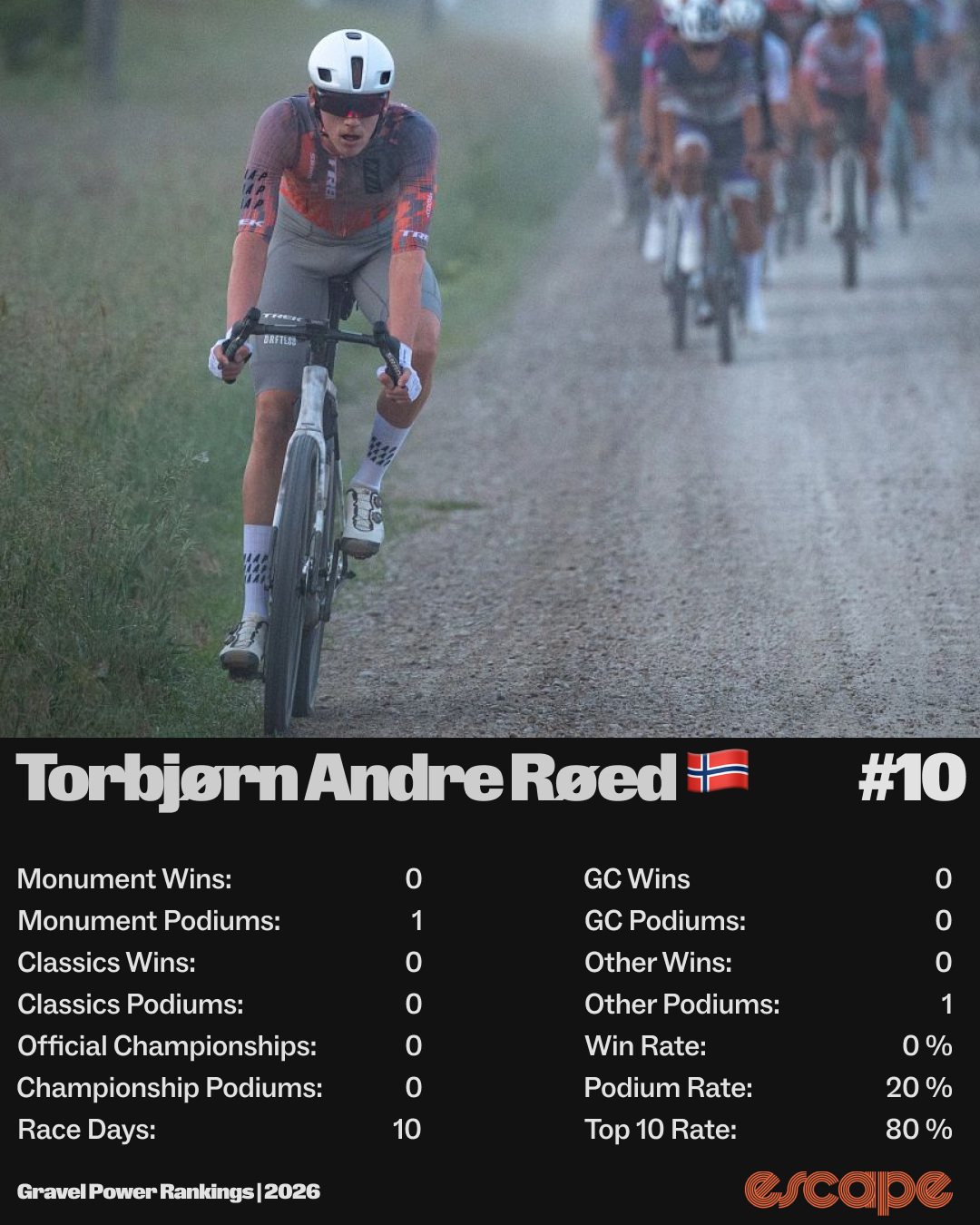 Photo: Life Time Grand Prix – Dan Hughes
Drumroll please, we’re entering the top 10. It’s started by Torbjørn Andre Røed, the Norwegian hitter who just finished his Life Time Grand Prix season in third overall, just ahead of Swenson. His case is built on consistency more than anything else. Røed isn’t a regular on the top step of the podium. But rarely is he to be found outside the top 10, even in the toughest of races. His standout result this year was his third place at Unbound, where he beat Mads Würtz Schmidt to the line.
He finished in fourth in both of the LTGP’s two Xtreme Gravel races, and he top-10ed all of The Traka 360, Lauf Gravel Worlds, SBT GRVL, and Big Sugar (two Monuments and two Classics). Moreover, he was second at Crusher in the Tushar and eighth at BWR Arizona. With that, 10th place in the Power Ranking seems fitting.
Before earning that spot, though, he had to survive the head-to-head comparison with Trekky, who had a very similar case. Røed wins that comparison 4:2 (he placed ahead of Trekky at Unbound, Lauf Gravel Worlds, Big Sugar, and Leadville, while Brandan scored at Chequamegon and Sea Otter). Congratulations on cracking the inaugural Gravel Power Rankings top 10!
9. Alexey Vermeulen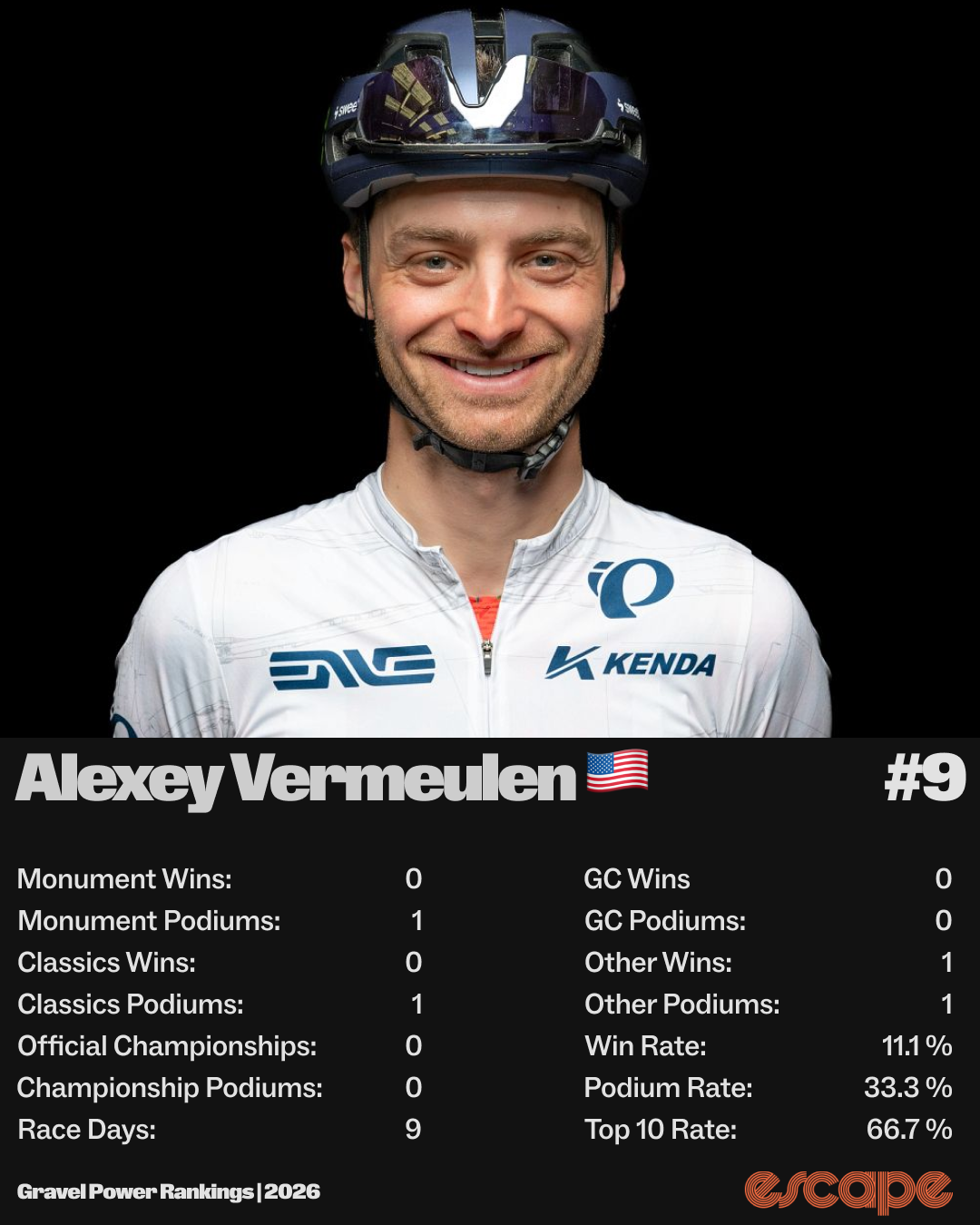 Photo: Life Time Grand Prix – Dan Hughes
Next in line is Alexey Vermeulen, a favorite of many gravel heads (and dog lovers). Given that Vermeulen finished the LTGP three spots behind Røed, you may be wondering how he is ranked ahead of him. The answer is simple. Consistency only gets you so far. To reach the highest heights of these power rankings, you have to win as well. And while Vermeulen did not win a lot, he did take an Xtreme Gravel race in Chequamegon. Yes, he won it on flat bars, so you might object to my considering the race here. It would be a fair criticism. But these are my power rankings, and I opted to include it.
Luckily, the pure gravel part of his resume is in line with his placing here as well. He podiumed at Sea Otter and BWR California, the latter counting as a Monument podium here, and he finished Rule of Three in second place. He also was fourth at SBT GRVL and the US nationals. All solid results.
Let’s once more look at the head-to-head data and compare Alexey vs Røed in 2025, just to be sure. In the six LTGP races, it’s a draw between the two. But as we disregard Little Sugar, a proper MTB race, this gives the edge to Røed at 3:2. With SBT GRVL, Alexey draws it even again at 3:3. At that point, Vermeulen’s Chequamegon win comes in and gives him the edge over Røed by a hair. That said, I wouldn’t fight you too hard if you had them in reverse order.
8. Petr Vakoč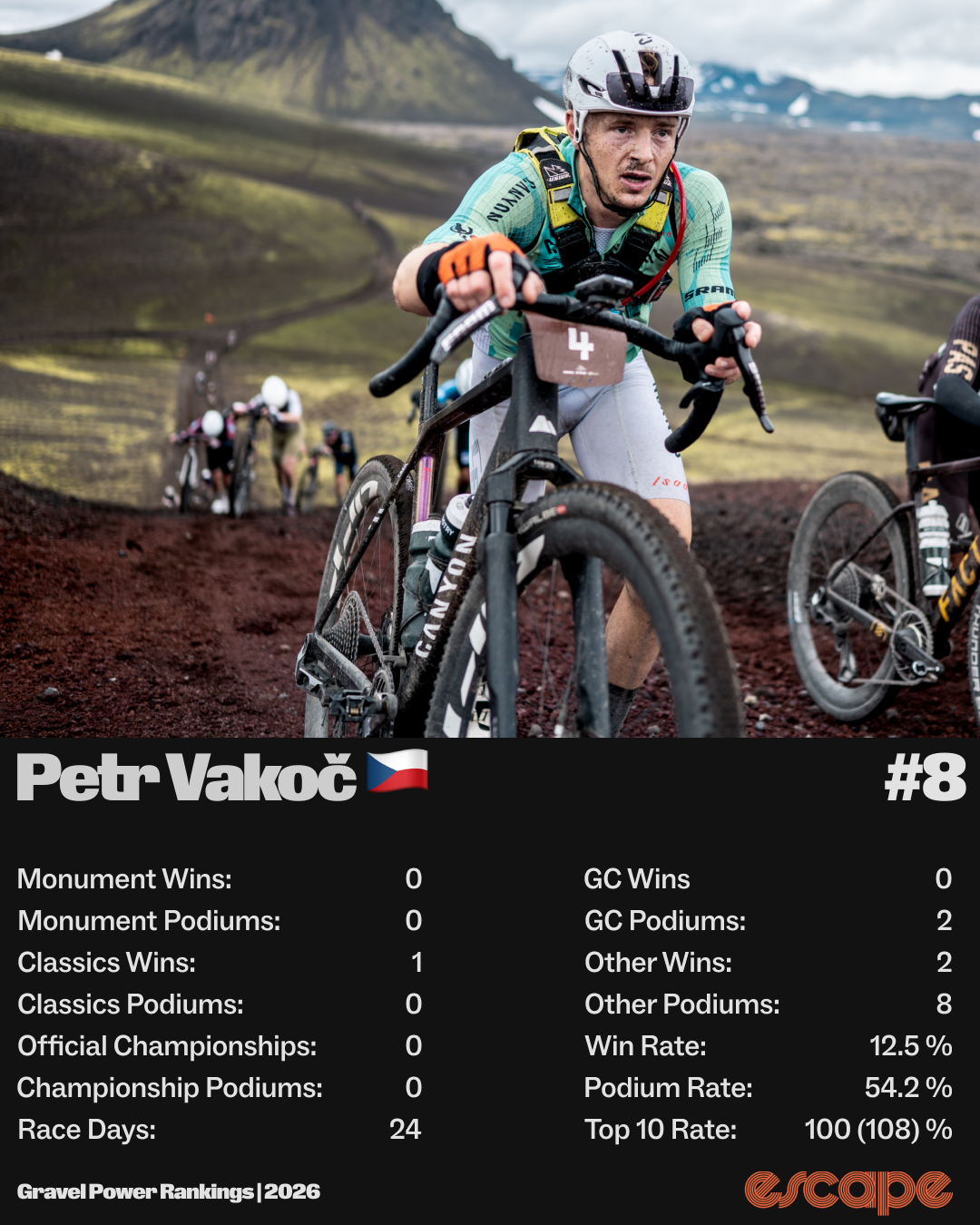 Photo: Gravel Earth Series – The Rift – Roger Salanova
Did I say consistency only gets you so far? Well, it gets you into the eighth spot if you do it the Petr Vakoč way. He is easily the Mr. Consistent in the global gravel circuit. Sure, he also has the occasional win, most notably The Gralloch, the only race in the UCI series that already has Classics status in my book. His other two victories are a stage win at Sahara Gravel and the LAWI Tour Classic, comparably minor wins (though, mind you, winning bike races is never easy).
To fully understand Vakoč’s placing here, we need to look at his other results. They firmly position him among the gravel world’s elite time and time again:
third at The Rift for a Gravel Monument podiumfourth at The Traka 200 (Monument) as well as at The Hills, Sea Otter Gravel, and Ranxo (all Classics) fifth at BWR California (another Monument)second at Santa Vall in GC and on stage 2second in GC at Sahara Gravel, plus three stage podiumsfour podiums in UCI GWS races (and three more top fives) 15th at Unbound
When Petr Vakoč lines up at a gravel race, it’s more likely than not that he’ll end up somewhere in the top five. Elite consistency plus some winning earn him eighth in these rankings.
7. Tobias Mørch Kongstad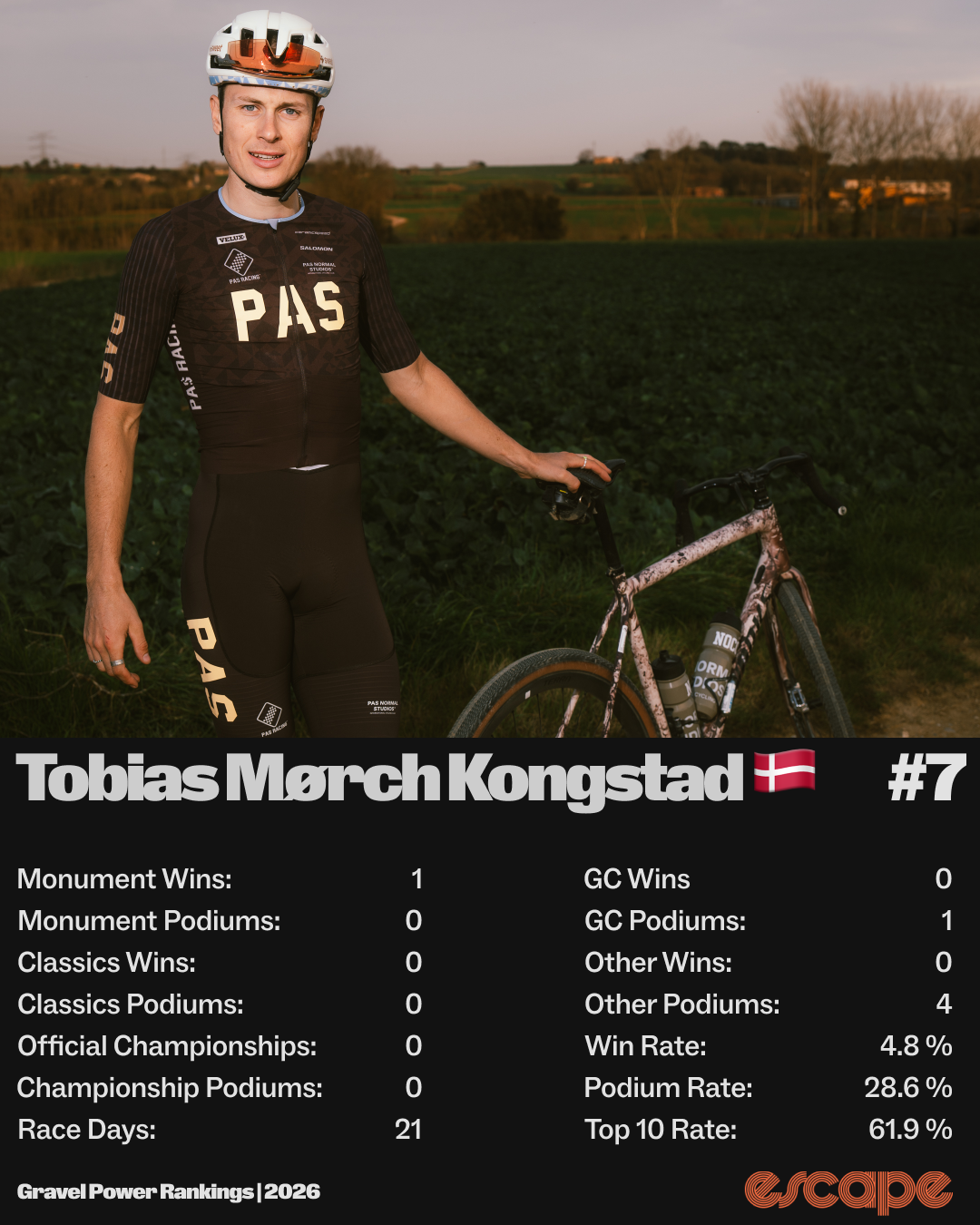 Photo: sonam.cc / PAS Racing
I changed my mind several times when it came to this spot. Kongstad has a Monument win to his name thanks to his long-distance solo to victory at The Traka 360. And he had other strong results, including 10th at Unbound, fourth at The Rift, three podiums at smaller Gravel Earth Series races (Megre, Gravel Weekend Latvia, Core4), and a second place at Dustman, the Thailand stop of the UCI GWS.
The question I had to answer was: how much does winning a Monument count vs. the handful more lower-tier wins that Simon Pellaud has to his name? To that end, I looked at the head-to-head data and figured in momentum. Kongstad had the upper hand at The Traka, Pellaud at Unbound and Big Sugar. Add to this that Kongstad’s’ curve trended down towards the end of the year, while Pellaud remained on his high level until the very end, and it leaves Kongstad in the seventh spot.
6. Simon Pellaud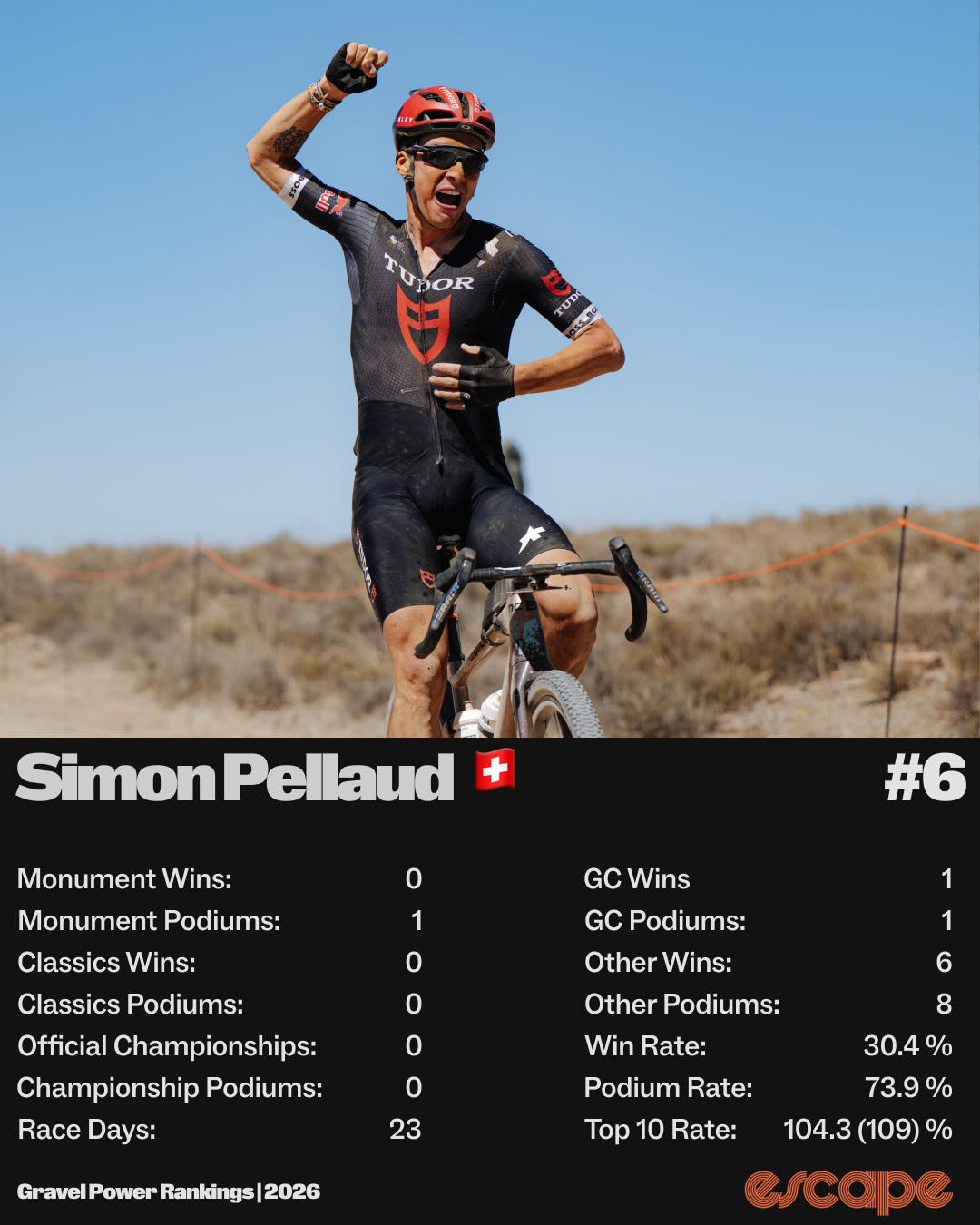 Photo: Paul Ganse/Gravel Burn
After this season, Simon Pellaud needs no introduction. The Swiss rider quickly developed from a relatively anonymous new LTGP entrant to a beloved figure in the gravel scene. His 2025 season, which he split between racing on the Chinese road circuit and gravel, netted him 2nd overall in the LTGP. His standout performance, which turned him into a globally recognized gravel pro, was his Unbound ride, where he broke away early with Cameron Jones and ended up in second after swapping turns with the Kiwi for 240 km.
There was more to his season than Unbound, though. He kicked off his gravel campaign in style by winning the GC plus four stages at the Columbian Transcordilleras 8-day stage race. He went on to win the Brazilian round of the UCI GWS. Later in the year, Pellaud also won the Canadian Gravel Earth Series race Festivus of Gravel and podiumed at Leadville, showing his chops as a Xtreme Gravel racer.
He further solidified his ranking here with top 10 finishes at Sea Otter Gravel, Big Sugar, and Chequamegon. If there were any doubts remaining, he erased them in the South African Karoo at Gravel Burn. There, in a fairly stacked field, he capped off his season with a stage win and a closely contested 2nd place in GC behind only Matt Beers.
Pellaud will be back in the LTGP on a new bike in a new setup. If focusing completely on gravel and having a year’s worth of experience under his belt can elevate his level further, Pellaud may be getting into the top five sooner rather than later.
5. Magnus Bak Klaris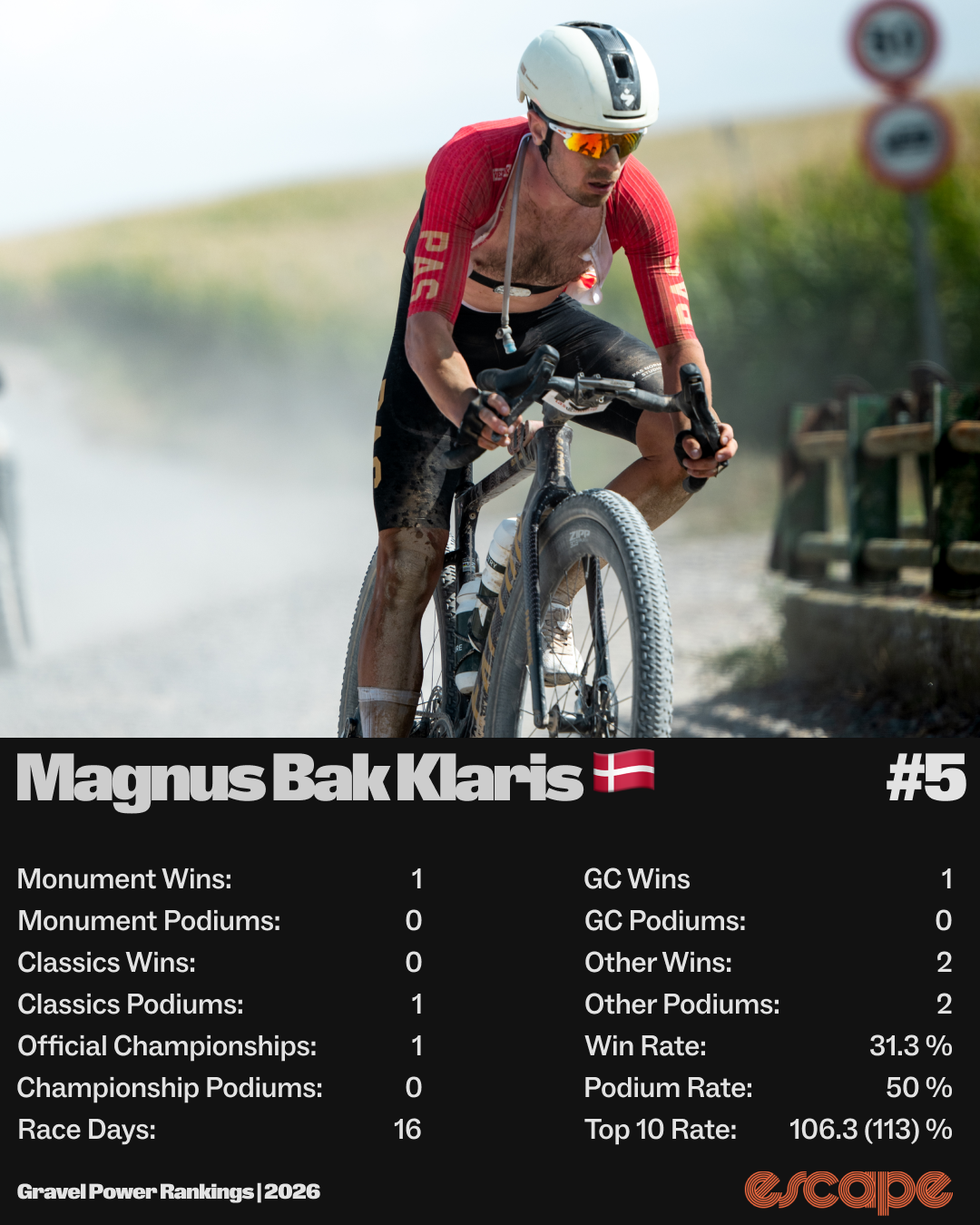 Photo: Gravel Earth Series – Ranxo – Roger Salanova
After adding a little bit of gravel to his schedule at the end of 2024, Bak Klaris’ true arrival to the gravel scene was Santa Vall at the beginning of the 2025 season. Still a relative unknown, he lined up at the European season opener and won both stages plus the GC. The field there included many of the names you’ve read so far. While Bak Klaris undoubtedly arrived with a bang, the early season is tricky. Many folks will not be at their top level yet. So Bak Klaris left us wondering if it was a fluke, the consequence of prioritizing an unusual event, or if indeed a new force had come to gravel.
We have since found out that the latter was true. After Santa Vall, Bak Klaris came in second at Turnhout and won Wörthersee Gravel (both UCI GWS), and he finished The Traka 200 in eighth. The following US trip was likely the low-point of his season, with two sixth places at Rule of Three and Gravel Locos and a 51st place at Unbound, apparently thanks to punctures, and a crash.
But Bak Klaris got over those setbacks and found his mojo again. In Iceland, he added his first Gravel Monument to his palmares by winning The Rift. He followed it up with another win at Megre (part of GES). He finally manifested his claim on the top five spot with his late-season run. First, he won the Danish National Championships, then he secured his GES overall title with his second place at Ranxo. And last but not least, he finished his year with a 10th place at the UCI World Champs (where his impressive performance made me call him the standard bearer of gravel).
4. Keegan Swenson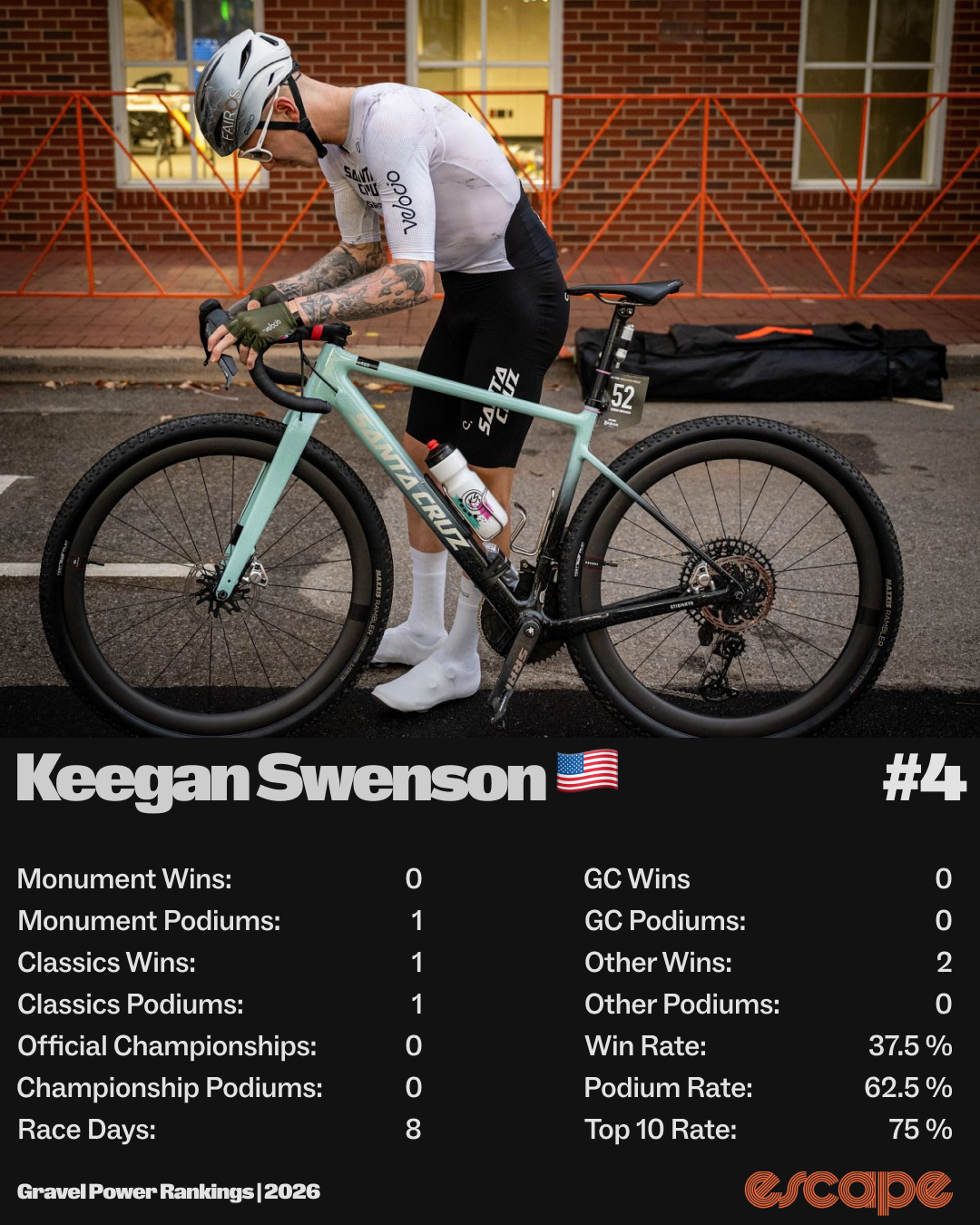 Photo: Life Time Grand Prix – Dan Hughes
Keegan Swenson is widely regarded as the best gravel racer in the world. And yet, he only ranks fourth in the power rankings?! Is my algorithm broken? Am I committing heresy? Well, hear me out.
Let’s start with the obvious: power rankings aren’t a GOAT (greatest of all time) ranking. They are intended to reflect the current state of affairs. As I explained in the intro, momentum matters here. Whenever I had to make a tough, close call, more recent performances mattered more than those longer ago. So while I considered all 2025 performances, I weighted those later in the year more heavily.
Let’s look at Swenson’s season first – specifically focusing on gravel. Swenson’s XCM World Championships title is an incredible achievement, but it’s out of scope for our purposes here. He still won quite a bit, including BWR Arizona, (the vomit-inducing) Sea Otter Gravel, and of course Leadville (as Swenson does). His remaining results were also stellar: seventh at Unbound (where we need to note that he’s likely being the most-marked rider of the day and doesn’t have options like soloing away to victory), and second at both SBT GRVL and Lauf Gravel Worlds.
With three wins total and two podium finishes in races of the highest level, it is undoubtedly a strong season, although not Swenson’s best-ever. By now we have entered the part of those rankings where margins are slim and getting it right becomes increasingly important. Hence, I debated myself a fair bit whether the fourth spot should go to Swenson or Cam Jones. Once more, I looked at head-to-head data.
Swenson was ahead of Jones at Sea Otter, Lauf Gravel Worlds, and Leadville, Jones had the upper hand at Unbound, Big Sugar, and Chequamegon (just as Swenson’s XCM title does not count here, Jones’ Little Sugar win doesn’t either). A tie doesn’t help us so I had to lean on two other factors. The momentum swung Jones’ way with his fifth place at Big Sugar, ahead of Swenson’s 11th place, a performance that also secured Jones’ overall victory of the LTGP. The case-closing last detail is that Swenson, unlike Jones, did not win a Gravel Monument (with apologies to Leadville, which officially is a MTB race). Meanwhile, Jones won the world’s biggest gravel race.
And so, Swenson ranks fourth. For now. I would not be surprised if he shot up the ranking again. Neither should you.
3. Cameron Jones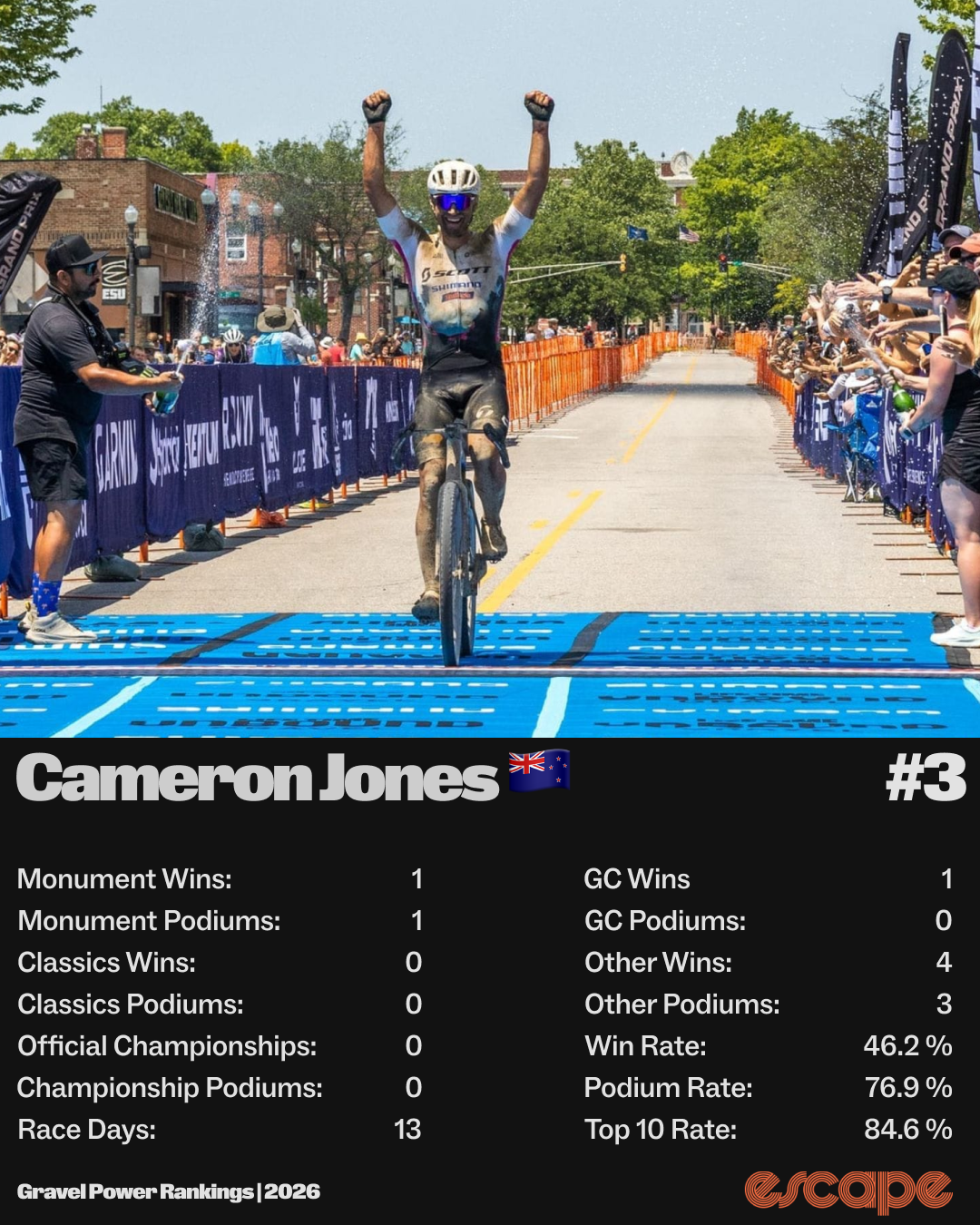 Photo: Josh Weinberg
The beloved Kiwi won the Life Time Grand Prix, Unbound, and a number of other races. Notably, he wasn’t originally admitted to the Grand Prix and had to earn his spot by winning a Wild Card. He did and never looked back since. Jones had a great season and has emerged as one of gravel’s strongest racers. Third place in the power rankings is absolute elite territory. And yet, you may be surprised that he isn’t higher up the list. After all, he got my MVP vote.
But unlike the Most Valuable Rider awards, these Power Rankings are all about performance. Other factors that influence the value of a rider, like popularity with fans or attractiveness for sponsors do not count here. So let’s look at Cam’s performances.
Besides winning Unbound, he also won the GC at the Oregon Trail, including two stage wins, and two minor gravel races in New Zealand. I repeat myself, but we do not count Little Sugar because that’s a mountain bike race. He added a Monument podium in the shape of his third place at Lauf Gravel Worlds, and he came in fifth at Big Sugar and eighth at Chequamegon.
That is a top-notch resume. And yet, two guys rank ahead of him. Let’s find out who and why.
2. Mads Würtz Schmidt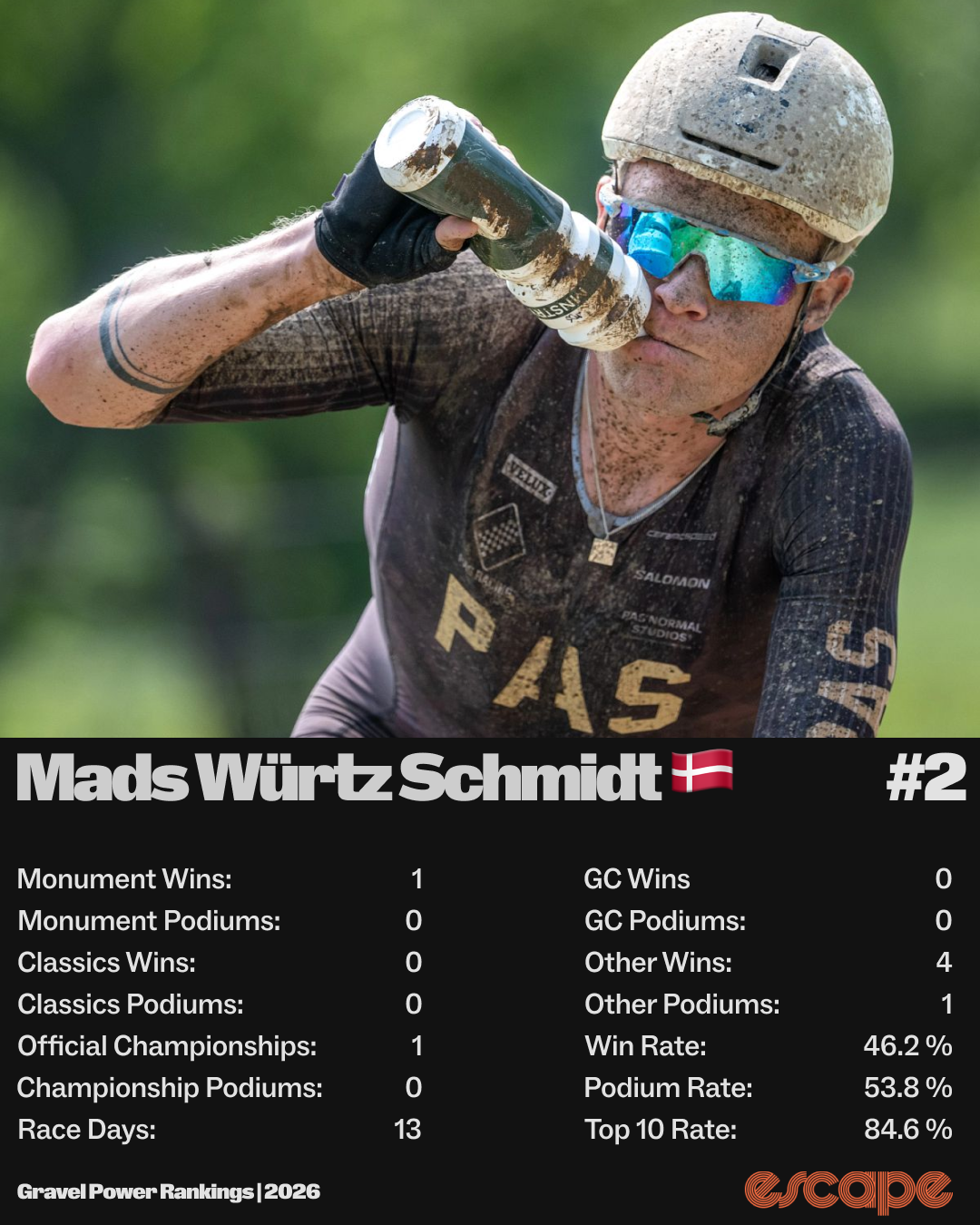 Photo: Life Time Grand Prix – Dan Hughes
If you only follow US gravel, you may not know Würtz Schmidt very well. In case you need an introduction: Until 2024, Würtz Schmidt raced for the WorldTour (and later ProTour) team formerly known as Israel-Premier Tech. When they didn’t renew his contract, after a season full of health mishaps, he joined PAS Racing for the 2025 season. I think in his mind, Würtz Schmidt came to take over gravel and get back into the WorldTour. He climbed up the ladder quickly. After not finishing Santa Vall stage 2 (in only his sixth ride on a gravel bike, ever) due to a knee issue that plagued him early in the season, he went into winning mode.
To warm up, Würtz Schmidt won two UCI GWS races. Then, he claimed his first Gravel Monument when he won The Traka 200 ahead of Matt Beers (the story of which he told me here). At Unbound, he just missed the podium with his fourth place, but that came on the back of a herculean effort. Deep in the race, Würtz Schmidt was in the group of all the favorites, which at that moment was the third group, behind the leading duo of Pellaud and Jones and then a chase group. Würtz Schmidt decided to take the race into his own hands and tried to bridge to the chase. While that moment wasn’t broadcast, you likely heard me talk about it (too often?) if you follow my work. Voss, the only rider who was able/willing to follow Würtz Schmidt, told me the story from his perspective: he was going way too hard in the wheel of Würtz Schmidt. Just when they finally made contact with the chase group, Voss was dropped for good. Würtz Schmidt, meanwhile, went on to battle for the podium with Røed.
After Unbound, Würtz Schmidt returned to Europe and won two more UCI GWS races before claiming the European Championships in Italy with an impressive 108 km solo. Alas, he punctured out of the UCI World Champs race. Who knows what could have been?
Now, the obvious difficulty is comparing Würtz Schmidt’s resume with the other riders in here. His calendar was vastly different from theirs. As a result, we have very little opportunity for head-to-head comparisons. In fact, the only race where all riders in the top four faced off is Unbound. There, Würtz Schmidt finished behind Jones and ahead of Swenson and Beers.
The only other head-to-head data point we have is Würtz Schmidt vs Beers at The Traka 200. So it’s 2:0 for Würtz Schmidt between the two. Of course, the rankings are not that simple. But the head-to-head data at least gives us an inkling of where Würtz Schmidt needs to rank. If we then factor in the quality of his results, his win rate*, and the quality of racer he is, he ends up in second by the slimmest of margins in both directions.
* A technical note: as mentioned in the intro, most gravel races don’t report DNFs to PCS. The UCI World Champs are a notable exception. I counted it as a race day for Würtz Schmidt, even though he DNFed. Maybe I should not have; just be aware that it lowers his win and other rates in comparison to others.
1. Matthew Beers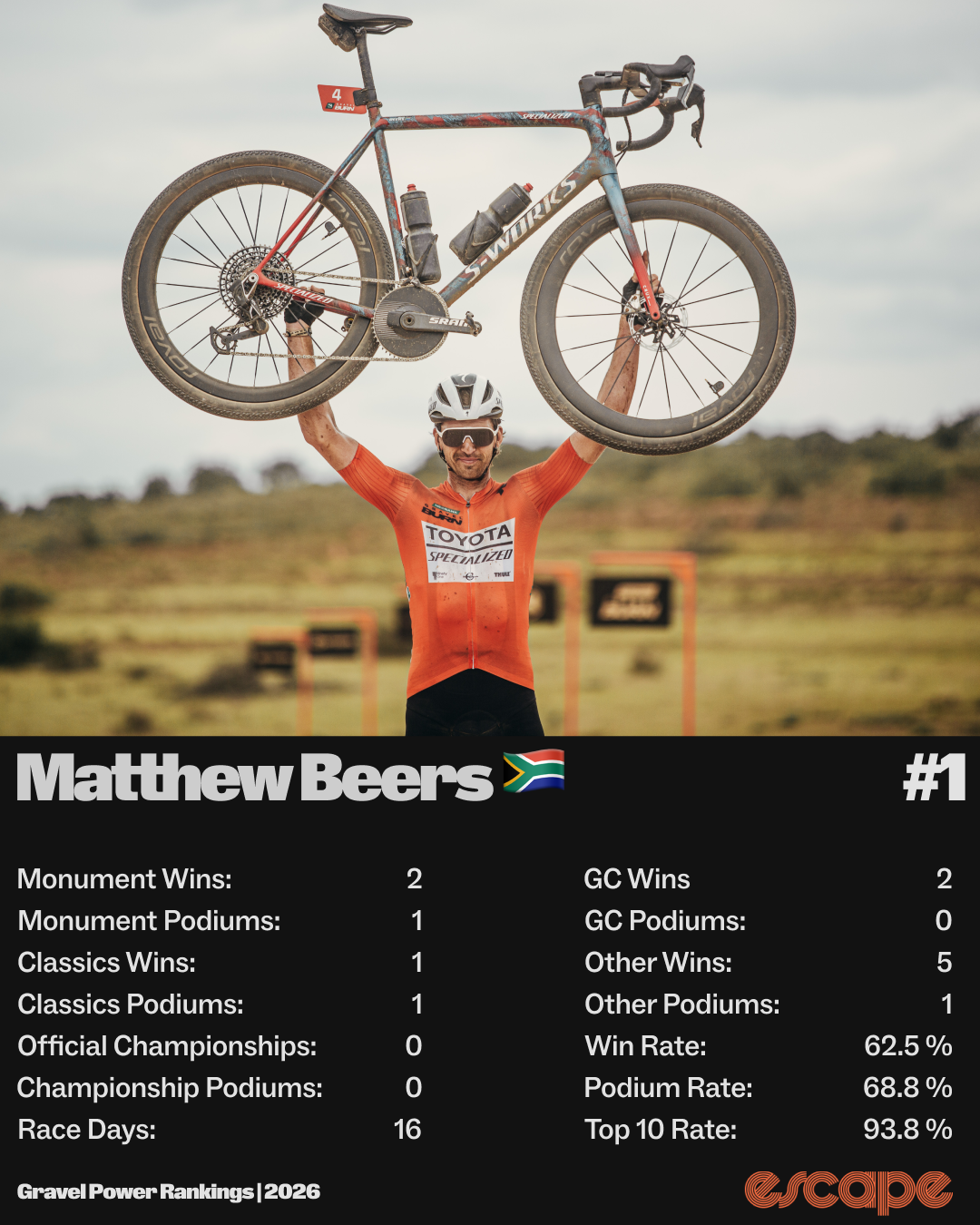 Photo: James Cameron Heron/Gravel Burn
Heading into the 2026 gravel season, Matt Beers sits atop the gravel power rankings. If you look at his PCS profile (which only shows pure gravel races and doesn’t include the MTB/Xtreme Gravel races of the LTGP that also factor in here), it will appear as if he didn’t finish worse than second in any race except Unbound and two Gravel Burn stages.
Matt is the only rider who won two gravel Monuments in 2025, namely BWR California and Lauf Gravel Worlds. He also podiumed in another one (The Traka 200) and won a Gravel Classic, Big Sugar. Critically, Matt also crushed it in stage racing. He swept Rebecca’s Private Idaho and won Gravel Burn, against a stacked field, including three stage wins (presumably he could have won the final stage as well but allowed his Specialized teammate Travis Stedman to take it).
I think it’s hard to argue against the fact that Matt Beers had the best overall season in gravel racing. The only rider who, based on head-to-head data, would have an argument to rank ahead of Beers is Mads Würtz Schmidt. But the amount of prestige wins Matt collected in 2025 outweighs this minor flaw in his application for the top spot.
In case you’re wondering about the other head-to-heads: Beers and Jones are tied at 3:3 (Beers was ahead at Lauf Gravel Worlds, Big Sugar, and Sea Otter; Jones at Unbound, Chequamegon, and Leadville).
Between Beers and Swenson, it’s actually Swenson 4 : Beers 2. (Beers had the upper hand at Lauf Gravel Worlds and Big Sugar; Swenson at Sea Otter, Chequamegon, Leadville, and Unbound). I still give Beers the edge based on the number and quality of his wins on gravel. Plus, the late-season momentum is clearly on his side.
Also, Beers claims a 480 watt FTP. So there’s that.
Did we do a good job with this story?
👍Yep
👎Nope