
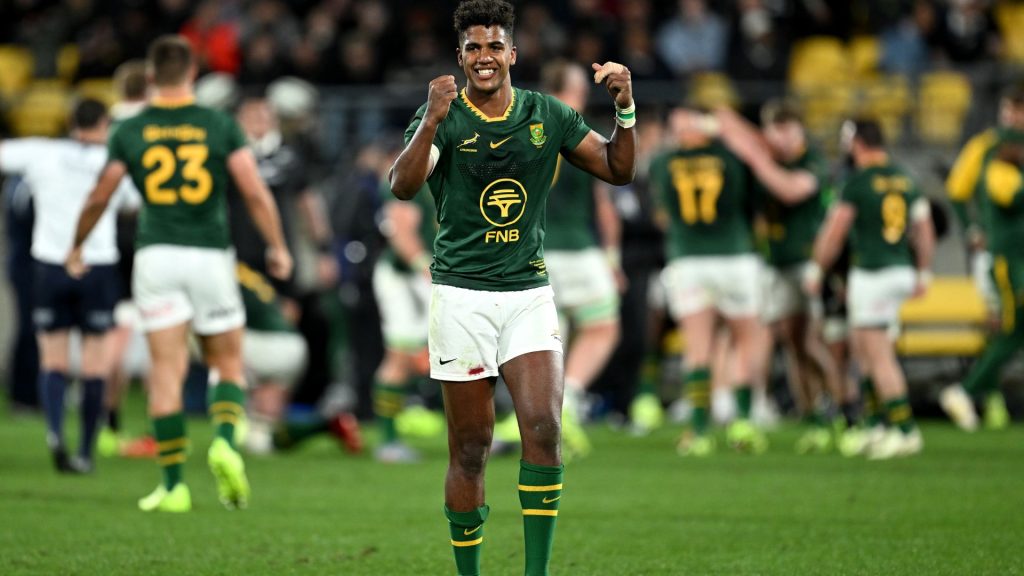
OPINION: Rassie Erasmus’ Springboks pushed the boundaries in 2025 but could take their game plan and development strategy to the next level in 2026.
EYES ON THE (BIG) PRIZE
From the start of the World Cup cycle, Erasmus has said that the global tournament in 2027 – and the opportunity to win a third-consecutive title – remains the top priority.
Over the past two seasons, Erasmus and the coaches have encouraged the team to play a more attacking game in line with the current laws, and perhaps in preparation for some of the World Cup matches staged on the faster Australian pitches.
In terms of development, there’s been a big push to experiment with new players and combinations, with 50 players used in 2024 and again in 2025.
Erasmus has highlighted the need for balance between youth and experience at a World Cup, and has suggested that the Boks need to develop more of the former before they depart for Australia in 2027.
And over the past two seasons, he’s given the likes of Sacha Feinberg-Mngomezulu, Canan Moodie, Ethan Hooker, Morné van den Berg, Elrigh Louw, Ruan Nortje, Boan Venter and Jan-Hendrik Wessels more responsibility in the big games.
Other youngsters and less established players could add to their modest Test cap tallies in 2026.
Zac Porthen has been identified as a swing prop in the mould of Thomas du Toit and Trevor Nyakane, while Erasmus considers BJ Dixon a like-for-like replacement for utility forward Pieter-Steph du Toit.
Another Stormer in Paul de Villiers, who has been on fire in the early rounds of the United Rugby Championship and Champions Cup, should get a look in – at least for the home games against Scotland and Wales in July, and possibly the one-off against Australia in September.
Cameron Hanekom and Sebastian de Klerk should be in the mix if they fire for the Bulls at the back-end of the club season, while Asenathi Ntlabakanye, Renzo du Plessis and Ruan Venter (all Lions) also bear watching.
Erasmus invited the Junior Bok trio of Batho Hlekani, Haashim Pead and Cheswill Jooste to train with the senior squad this past season, and it will be interesting to see if any of these players feature for the Boks in 2026 – or if Erasmus keeps them in mind for the cycle beyond 2027.
The story continues below…
 GREATEST SHORT-TERM GOAL
During a recent press conference, Erasmus played down the significance of the inaugural Nations Championship – given that the Boks have prioritised the Greatest Rivalry series in the short term and the 2027 World Cup down the line.
The last time the All Blacks toured South Africa for a three-Test series in 1996, Sean Fitzpatrick’s charges won the rubber 2-1.
While it remains New Zealand’s only series victory in the Republic, the All Blacks have enjoyed many success against the Boks in the professional era.
It’s only in the past eight years where the Boks have pulled things back, and only in the past three where they’ve dominated the rivalry – winning five of the last seven Tests.
The Boks will head into next season’s four-Test series as favourites, given the first three games will be staged on South African soil, and the fourth at a neutral venue overseas.
Current form suggests the Boks should win at least two of the three games in South Africa.
And in a series spanning four gruelling weeks, the Boks – thanks to their outstanding depth – are better place than the All Blacks to maintain their physical effort.
Is it too much to hope for four-successive victories? Perhaps.
But Erasmus and company should be aiming for at least three out of four.
If the All Blacks manage to win two, they will consider their mission to South Africa a success, given the Boks’ position in the world rankings as well as the challenge of playing consecutive Tests in the Republic.
The story continues below…
KINGS IN THE NORTH
While the Boks are unlikely to chase the Nations Championship title, they should target marquee fixtures against northern-hemisphere opponents who may be World Cup contenders in two years’ time.
It’s a pity that the clash against England – who won 11 Tests in a row in 2025, and may add to that tally in the coming Six Nations – will be staged at the beginning of July rather than at the end.
As a result, the Boks will have to hit the ground running in the first Test of the season.
South Africa’s preceding match against the Barbarians should provide some of the players with a chance to shake off the rust, but this contest – as seen in the corresponding fixture staged in June 2025 – is unlikely to simulate Test match intensity.
The Boks should be desperate to prove a point against an England side that could – if one considers the recent World Cup draw – advance to the final in 2027.
The Boks may also end up playing England if both teams advance to the Nations Cup decider in November 2026, which is a strong possibility.
The back-end of the Nations Championship should test the quality as well as the depth of the Boks.
Apart from the race to qualify for the Nations Championship final at the end of November, the fixtures in Italy, Paris, Dublin – and possibly the decider itself, which will be staged in London – will simulate the pressure and intensity of a four-game World Cup playoff structure that is set to be introduced in 2027.
And in that respect, Erasmus and company will view the November block of the Nations Championship as a good opportunity to make a World Cup statement, or at the very least, assess their ability to cope with the four-playoff challenge.
IMPROVING THE PIPELINE
Erasmus is building a team to peak at the 2027 World Cup, but there’s evidence to suggest the Boks will be even stronger in 2031.
SA Rugby recently extended Erasmus’ contract for another four years, and the Bok boss will have the chance to strengthen and improve the national structures in the coming seasons.
What’s more, the development programmes and initiatives implemented by Erasmus himself some 10 years ago are starting to bear fruit.
Younger franchise players, Junior Boks and some of the nation’s best schoolboys should push for Test selection in the next World Cup cycle.
The likes of Junior Bok coach Kevin Foote and SA Rugby general manager of high performance Dave Wessels have been tasked with fixing the pipeline between junior and senior rugby, and will look to build on the success of 2025.
The Junior Boks won the World Rugby U20 Championship this past June, and will look to defend their title when they travel to Georgia in 2026.
At franchise level, the Stormers have started to get things right in terms of their development and results.
If they progress to the playoffs of the Champions Cup and URC in the first half of 2026 – and their younger players are exposed to that level of pressure and intensity – it will only boost the national side in the long run.
Over the past season or so, South African rugby has lacked a consistent club effort – and this would be my biggest wish for the 2026 calendar year.
While the Bulls, Sharks and Lions all have their individual problems, they shouldn’t be struggling in the URC or even across the European competitions to such an alarming degree.
The Bulls can still qualify for the URC playoffs this season, but it will take something special to secure home advantage ahead of the quarterfinals.
The Sharks face a fight to qualify for the URC knockouts, and more importantly, the next instalment of the Champions Cup.
It would come as a surprise if the Lions made the final eight for the first time in history, given their issues on and off the field.
The Johannesburg-based franchise has to make changes across the board if they are to become realistic playoff contenders in future seasons.
