
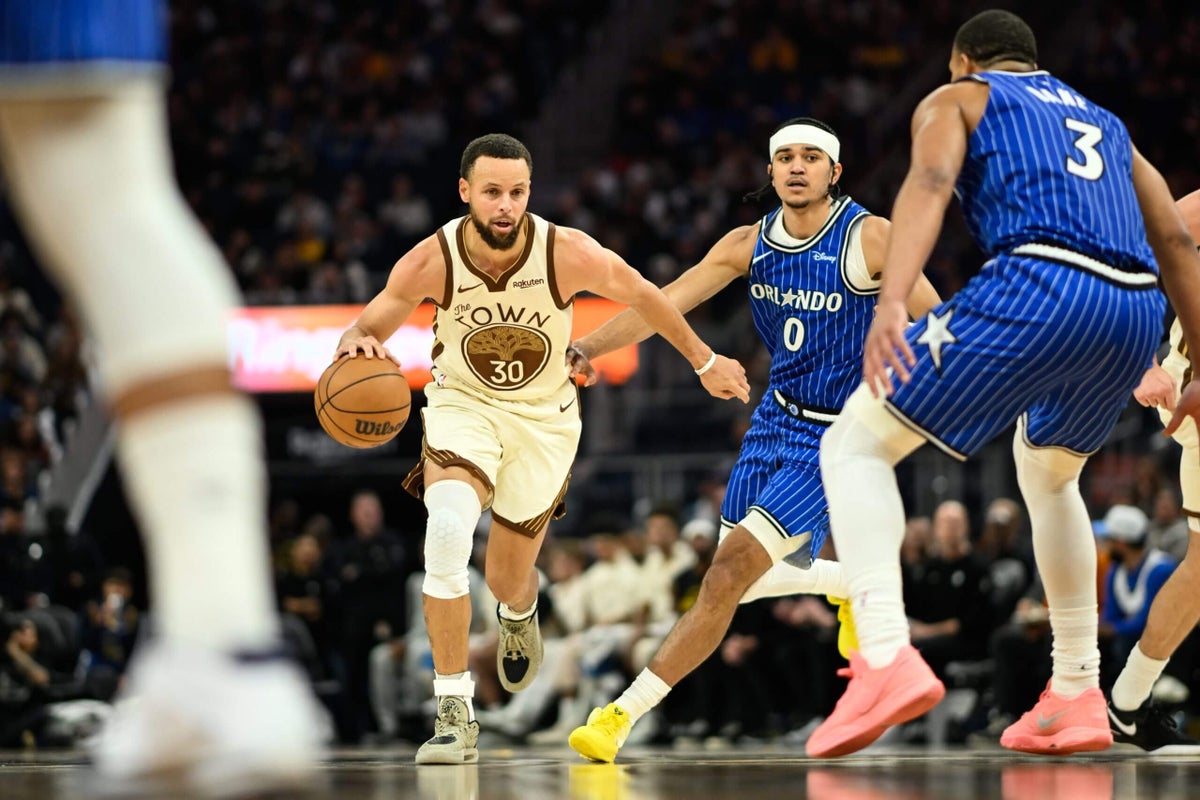
Other than his fellow league standard-bearer, LeBron James, nobody has been at the center of as many big NBA moments over the last 15 years as Golden State Warriors superstar Steph Curry. It’s strange, then, that so little connects Curry and the biggest day on the league’s regular-season calendar.
In 11 career Christmas games, the greatest shooter of all time is a combined 24-for-75 from beyond the arc. Had it not been for Curry’s 38-point performance during a loss to James’ Los Angeles Lakers last season, the percentage would be even worse. The Warriors’ success, propelled by Curry’s exploits, has made them a staple on the day the NBA has tried to own. It has just rarely been Curry’s best day.
Even if Curry picks up from where he left off last Christmas, one wonders how much it will register in the greater NBA conversation. With Curry and the Warriors facing former teammate Klay Thompson and the Dallas Mavericks, the league is fixated on them. This time, though, it’s not because of the greatness that has defined the team for most of the last decade and a half. It’s because the Warriors look like a team that is stuck in mediocrity, with no clear path back to anything approaching their former standard.
At 15-15, they have looked old and inconsistent.
That realization is part of what makes the annual Christmas day line of demarcation so interesting this season. It won’t be the last time Curry and his teammates play on the NBA’s big day — Curry will be a draw until he retires — but it very likely will mark the last time they do so in a season where a championship started as a realistic internal goal. That aspiration’s likelihood is already fading.
The Warriors are almost midway through the season and still can’t settle on a rotation. Golden State’s emotional leader, Draymond Green, left the bench for a stretch during Monday’s win over the Orlando Magic after a heated exchange with coach Steve Kerr. The Warriors have struggled to win games or even find a baseline consistency. They’ve struggled to develop younger players to supplement Curry’s greatness.
At the start of the season, the Warriors felt that Curry, Green, Jimmy Butler and Al Horford were lined up contractually to take two more swings at getting the organization one more title before Curry retired. As this season has played out, that idea seems far-fetched at best.
All four veterans have dealt with injuries as the missed games have piled up. At 37, Curry is still playing at an incredibly high level. But his nine games missed because of injury, coupled with a handful of other games where he just didn’t shoot well, are a reminder that he can’t be counted on to do everything, every night.
Butler has been more aggressive offensively in recent games, and his track record shows that he can reach a higher level in postseason games. It remains to be seen whether or not Butler, at 36, can hit that same level often enough in the regular season. After all, the Warriors aren’t a lock to be in the final 16, allowing Playoff Jimmy to appear.
Many of the Warriors’ first 30 games have felt similar. They’re close, but they have struggled to find the extra gear necessary to pull away from their opponent. They have a hard time finding an offensive rhythm behind Curry, as evidenced by their 19th-ranked offense. A play or two at the end usually marks the difference between winning and losing. To those paying attention, it has felt like a few years worth of Groundhog Days.
The addition of Butler was supposed to alleviate many of those issues. For a while following his arrival last February, it actually did. The Warriors finished 23-8 after acquiring Butler and were hoping to build on that momentum entering this season, their first full one with Butler playing alongside Curry and Green. Instead, the trio hasn’t found the chemistry needed, and the frustration surrounding the rest of the roster seems to grow every day.
Former first-round picks Moses Moody, Brandin Podziemski and Jonathan Kuminga have all shown flashes of promise, but the young group has not strung together consistent performances. Horford was supposed to provide stability and length to the Warriors after years of going against them, but his lingering sciatica has kept him mostly off the floor. He has looked like a player at the end of a great career in the few appearances he has made. The Warriors have dropped a few games they felt they should have won against undermanned teams playing without their biggest stars. They hope that their net rating, which at 2.2 ranks ninth in the league according to NBA.com, is more indicative of their true level than their record. They have the burden of proof on that count.
Aside from age and inconsistency, the Warriors’ biggest problem is the salary cap. As The Athletic’s cap expert Danny Leroux points out, they cannot have a total payroll that exceeds the second apron this season, which makes any proposed deal tough to complete. The Warriors can aggregate salaries together in a deal, but they can’t add more than they send out.
Warriors owner Joe Lacob has proven that he is willing to pay the premium price to give his team the best chance to win. He’s competitive and confident after presiding over the Curry reign that has produced four NBA titles. But no matter how badly Lacob, general manager Mike Dunleavy and the rest of the team want to turn things around, another reality looms.
Those hoping for a solution on Jan. 15 could be disappointed. That’s when Kuminga, a “two timelines” holdover who re-signed with the Warriors after protracted negotiations in restricted free agency in the offseason, is eligible to be traded. After a strong start to the season, he has disappeared from Kerr’s rotation again. Even if Dunleavy and the front office can make the cap cooperate, Kuminga’s value has likely never been lower.
The Warriors could hold out on the pipe dream of acquiring Giannis Antetokounmpo and pairing him with Curry, but that would require including Green or Butler in any version of that trade. Why would Milwaukee, who would likely be in rebuilding mode after dealing Antetokounmpo, sign off on acquiring either veteran player when there are likely better offers out there?
With Curry in the fold, the Warriors owe it to him to try everything they can to re-work the roster in advance of the Feb. 5 trade deadline. But Dunleavy is a basketball executive, not a magician. What he really needs to find is one more present under the tree in the form of a dynamic scorer that can take the pressure off Curry. He needs to find this season’s version of the Butler trade.
The Warriors don’t appear to have the pieces to make that deal happen. The only other option is to run the majority of the same group back next season and hope that the next star — one nobody is currently talking about — grows tired of their current situation and asks for a trade.
If that doesn’t happen, this will be the last time the Warriors celebrate Christmas with a surrounding context worthy of Curry’s individual excellence. Given the way they have started the season, many would argue that time has already passed.
They are probably right.