
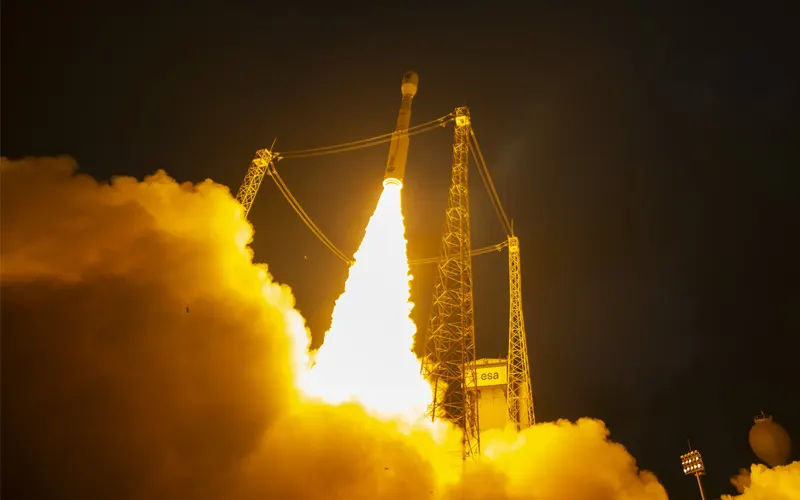
 Credit: ESA / S. Corvaja
The Taiwan Space Agency (TASA) has awarded Italian rocket builder Avio a launch contract for its FORMOSAT-8C and 8D, and FORMOSAT-9A and 9B Earth observation satellites.
On 19 December, Avio announced that it had signed two launch contracts with undisclosed customers, with a combined value of over €100 million. While the company left it up to the customers to make the announcement themselves, it did share that one of the customers was European and the other non-European.
Two days prior to Avio’s announcement, TASA published a tender award notice that revealed that Avio had been tapped to launch four satellites for its FORMOSAT Earth observation constellation. While the exact contract award amount is not disclosed, the notice does include a maximum budget for the project of NTD 2,556,750,000 (approximately €69 million).
FORMOSAT-8 will be a constellation of six high-resolution optical Earth observation satellites. The first was launched aboard a SpaceX Falcon 9 rocket in November. The next, FORMOSAT-8B is, according to TASA, slated for launch in December 2026. The agency has not yet published targeted launch dates for the other four.
The FORMOSAT-9 constellation will be made up of two synthetic aperture radar (SAR) satellites, which are expected to be launched in 2028 and 2030, respectively.
All four satellites will be launched aboard Vega C rockets from the Guiana Space Centre in French Guiana. The rocket returned to flight in December 2024 following a two-year grounding after a December 2022 failure. In 2025, the rocket completed three successful missions, deploying payloads for the European Space Agency, the French space agency CNES, and the Korea Aerospace Research Institute.
During an 18 December media briefing following the 342nd ESA Council meeting, acting Director of Space Transportation Toni Tolker-Nielsen explained that between three and four Vega C flights would be completed in 2026. According to Tolker-Nielsen, this launch cadence target is “more a question of payloads than availability of rockets.”
Keep European Spaceflight Independent
Your donation will help European Spaceflight to continue digging into the stories others miss. Every euro keeps our reporting alive.