
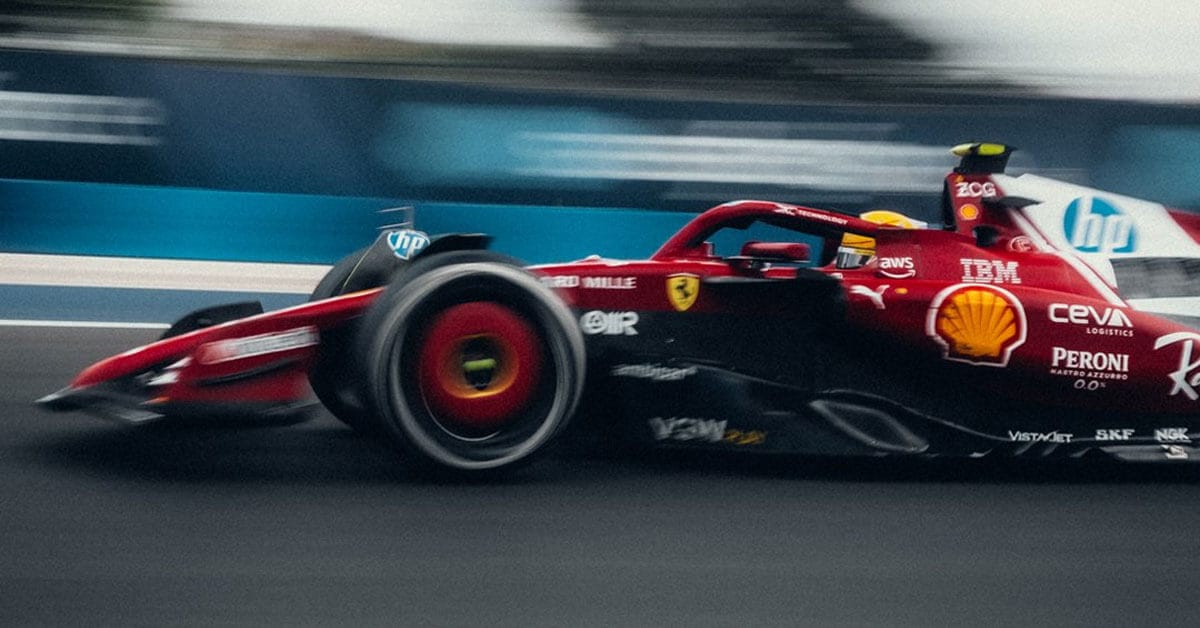
New technical directives ahead of the 2026 Formula 1 season are beginning to reshape the competitive landscape. Scuderia Ferrari is exploring a different fuel solution compared to other engine manufacturers, while Mercedes has reportedly made a mistake involving so-called “sensitive documentation,” adding further tension to an already complex regulatory transition.
As the new regulations begin to impact the pinnacle of single-seater racing, teams are finding themselves navigating borderline solutions and unexpected technical problems. Ferrari, however, has managed to avoid some of the most delicate challenges linked to the 2026 framework, thanks in part to a fuel choice that differs from the one selected by most other power unit suppliers.
The road leading to the 2026 World Championship is proving to be anything but straightforward. Even before the cars take to the track, the paddock is already filled with tension, suspicion, and technical difficulties tied to a regulation set that still offers very few certainties. Between aggressive interpretations, grey areas in the rules, and structural issues yet to be fully resolved, the clear feeling is that the real battle has already begun far from the kerbs and racing lines.
Within this complex scenario, one of the most debated topics concerns the so-called piston solutions adopted by Mercedes and Red Bull. These represent advanced interpretations of the regulations, approaches that would allow teams to push beyond the theoretical limits established by the FIA. It is a familiar script in Formula 1, where those who arrive first often do so by operating right at the edge of legality, forcing the governing body to follow up with clarifications and technical directives.
Once again, however, the spark was ignited behind the scenes. An information leak has brought to light a situation far more delicate than initially expected, revealing how fragile the current balance really is as teams prepare for the new era.
Behind the scenes of a fragile balance
According to reports from Motores, an engineer who previously worked at Mercedes and has since moved to Cadillac was mistakenly left included in internal mailing lists from Brackley. These were not routine communications, but highly sensitive documents containing critical technical information such as component weights, chassis architectures, materials used, and production processes.
This continuous flow of confidential data allegedly reached even a personal email address, without the internal control systems identifying the issue in time. The seriousness of the incident reportedly forced Mercedes to intervene directly, with Toto Wolff said to have travelled to the United States to manage the situation personally and prevent it from escalating into a public controversy.
An internal resolution was reportedly reached, but the episode has clearly left lasting consequences. In an environment where competitive advantage can hinge on the smallest detail, such an error inevitably raises concerns about data security and the protection of intellectual property.
Another critical area concerns electronics. With the introduction of the new TAG700 control unit, designed to support the 2026 power units, several manufacturers have encountered communication problems and data loss. These issues have been attributed to interference generated by the electrical side of the engine.
Audi, Mercedes, and Red Bull have already reported significant anomalies, prompting the FIA to step in and separate the functions. The TAG700 will continue to manage traditional systems, while a new dedicated unit will be responsible exclusively for controlling the electric section. This is widely seen as a provisional but necessary solution in order to manage reliability during this transitional phase.
When caution becomes a strength
Amid this uncertain and technically demanding landscape, Ferrari stands out as one of the teams that has managed to avoid some of the most dangerous pitfalls. The key factor has been its approach to fuel development. While many teams opted for synthetic fuel solutions, Ferrari chose to focus on biofuels derived from organic waste.
This decision has allowed the team from Maranello to reduce ignition-related issues and stabilize combustion more quickly. As a result, Ferrari has avoided several complications that are currently slowing down other engine manufacturers. In a phase where every detail can influence the direction of development, this represents a valuable advantage.
Aston Martin, although not involved in the data leak incidents, is instead dealing with problems related to lubricants. This is far from a minor issue, especially with the first collective tests in Barcelona scheduled behind closed doors at the end of January. Reliability and consistency will be crucial during these early test sessions, making any unresolved issue potentially costly.
It is therefore clear that the new regulations have opened up a particularly delicate phase for Formula 1. Between borderline technical solutions, unstable electronics, and experimental fuels, the sense is that what has emerged so far represents only a fraction of what is actually happening away from the spotlight.
In this initial chaos, Ferrari can at least afford a small smile. By taking a more cautious and alternative approach in certain key areas, the Scuderia has managed to sidestep some of the traps that could weigh heavily on the 2026 season. Whether this early advantage can be translated into long-term competitiveness remains to be seen, but for now, Maranello appears to have made the right calls at a critical moment.
Dec 26, 2025David Carter
Let other Scuderia Fans know about us


