
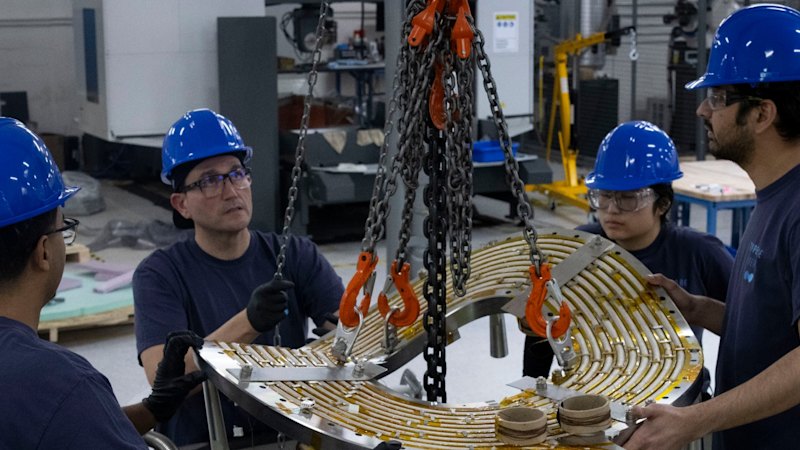
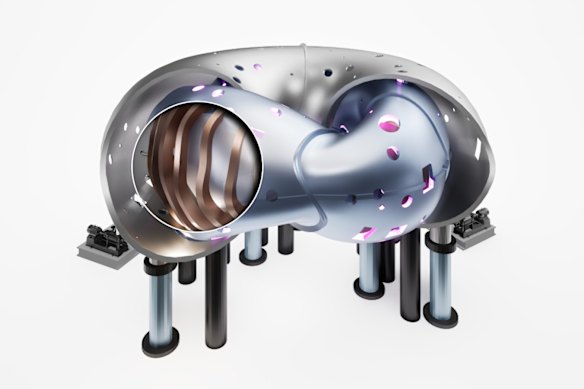
The stellarator design, which Type One says will produce clean energy within a decade.Credit: Type One Energy
Nuclear fusion differs. Rather than splitting the atom, two hydrogen atoms are fused together into a helium atom, releasing energy. Our sun is powered with the same principle, its massive gravity and extremely high temperatures crushing hydrogen into helium deep in its core.
Fusion reactions release much more energy than fission. There are no greenhouse gases. To quote the International Atomic Energy Agency: “It could provide virtually limitless clean, safe and affordable energy to meet the world’s demand.”
Achieving nuclear fusion itself is a solved problem. In 2018, 12-year-old Jackson Oswalt did it on a home-made reactor in his bedroom.
The real challenge can be boiled down to a simple statement, from emeritus professor John Howard, who oversaw the Australian National University’s experimental fusion reactor for many years: “You are keeping a star inside a magnetic bottle.”
This is as difficult as it sounds. The fusion reaction must be sustained, steady and reliable to provide baseload power.
Loading
Fusion scientists start with plasma – a super-hot swirling gas of atoms that have been stripped of their electrons. The plasma is sensitive to magnetic fields, so huge magnets are used to contain it and send it swirling through the reactor chamber.
Type One is proposing to build stellarators, which look like twisted hollow donuts wrapped in coils of superconducting magnets. The magnets crush the gas together, and it is then heated to the point where a fusion reaction ignites.
The technical challenges are enormous. Stellarators need to survive temperatures exceeding a hundred million degrees kelvin, while keeping the superconducting magnets that surround the chamber below zero.
It can work. The German W7-X stellarator set a record this year for the longest controlled fusion reaction. All that is needed now, says Baynes-Reid, is to scale up the German model to grid-size. One Energy proposes repurposing old shuttered coal plants, which already have grid connections.
Loading
“The fundamental science and technology has been proven. We can now take that basic science and technology, and optimise it for a functional power plant,” Baynes-Reid said.
Other scientists are less optimistic. The W7-X set a record by running for a grand total of 47 seconds.
“I hate being a naysayer. Huge progress has been made. But there’s a few fairly deft tech challenges yet to be solved,” said Howard.
Two stand out. First, for fusion to work, engineers need to prove up tritium breeding.
Fusion reactors run by fusing two special types of hydrogen, deuterium and tritium. Deuterium can be easily extracted from water, but tritium is rare – and radioactive.
A commercial fusion reactor needs to make its own tritium as a byproduct of the reaction, which can then be reused as fuel. This technology is theoretically possible, but scientists are yet to prove it works.
Second, neutrons created as part of the reaction can degrade the components of the reaction chamber. Can you quickly and economically swap them out, while still providing a reliable power supply?
“Their prospectus is fairly optimistic. I’d love to say it was grounded in demonstrated achievements, but that’s not quite the case yet,” said Howard. “Would I put my money into it, if I had any? Probably not.”
Then there’s the timescale problem. Type One believes it could have a working plant up in Tennessee by 2034, replacing the coal plants scheduled to reach the end of their working life over the next decade.
Australia has committed to cutting emissions by between 62 and 70 per cent of 2005 levels by 2035 – a dramatic increase in the pace of emissions reduction, likely requiring 95 per cent of all electricity generation to be renewable within a decade.
ITER, the world’s largest and most powerful experimental fusion reactor, conceived in 1985, has been under construction since 2013 and is projected to cost $US66 billion.
It is designed to reach breakeven, and will test out tritium breeding. But it won’t achieve first plasma until 2034 at the earliest, and won’t be connected to the grid.
“I am a believer. But there is the problem at hand. We’re cooking ourselves alive, and setting up the conditions for crazy rainfall and flooding and sea-level rises. First things first, deal with that with the tech that is available and proven,” said Dr Nathan Garland, a fusion researcher at Griffith University.
“I’m a believer in this, but on the timescales I may not be as aggressive as private industry.”
The Examine newsletter explains and analyses science with a rigorous focus on the evidence. Sign up to get it each week.