
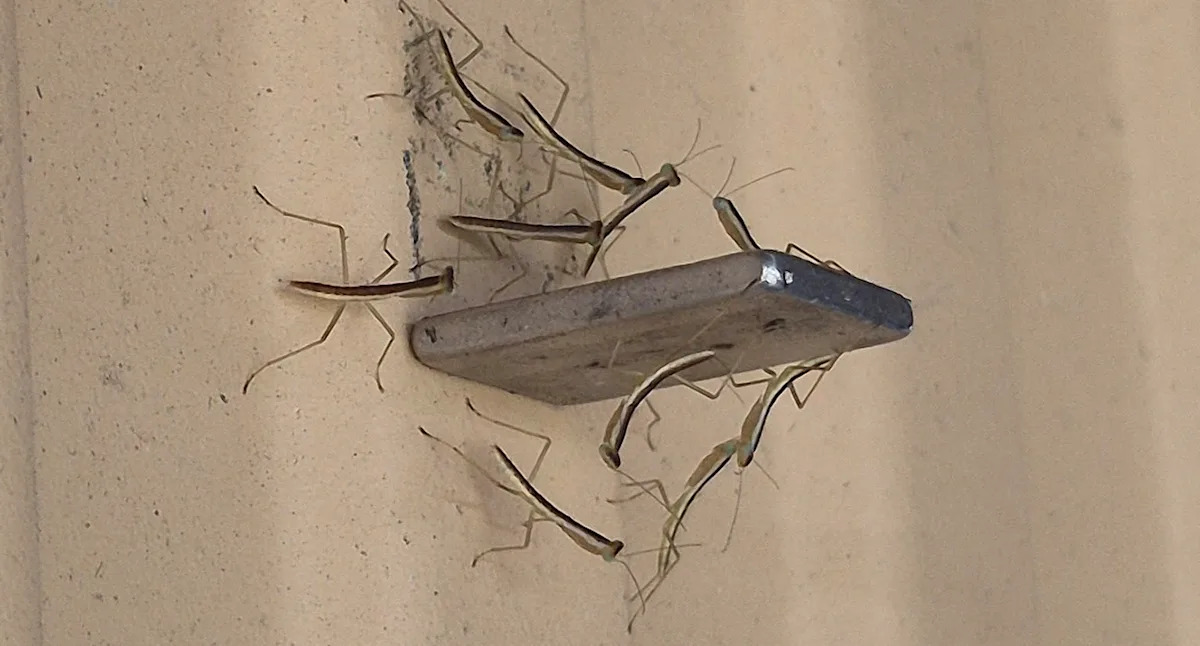
The discovery of insects “worshipping” a magnet has sparked a surge of interest on social media. A photo snapped in the suburbs of Darwin shows 10 newly hatched praying mantises surrounding what had been part of a broken magnetic stubby holder.
“Why are these creatures worshipping this magnet on the side of my house?” Kaya Rubin wrote as he shared a picture to the Northern Territory’s field naturalists page.
Dozens of amazed people responded with one saying, “Seriously, are they attracted to the magnetic field? WTF”.
“They’re drawn to it,” another joked.
Kaya told Yahoo News he noticed the praying mantises next to his front door and took a photo.
“It was mid-morning, sunny and hot outside,” he said, before adding that they’ve all since left.
It’s not the first time the internet has erupted after Aussies have found evidence of animals worshipping an idol.
In 2023, a man momentarily thought he’d created a magpie god after the birds began surrounding his homemade scarecrow.
At the time, the insects had only recently hatched from a protective egg case, known as an ootheca, which was attached to the wall nearby.
Related: Beer bottle-loving Aussie bowerbird caught flying 4km to fulfil obsession
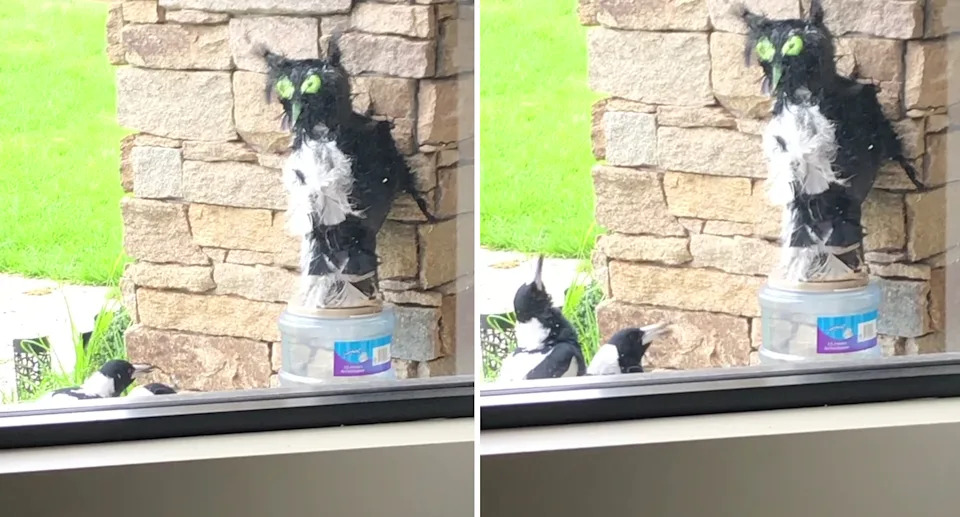
A Sydney man believed he’d created a “magpie god” after the birds surrounded his home-made creation. Source: @givlivs_x
Expert reveals what drove the insects’ response to magnet
There is some evidence to suggest insects, including mosquitoes, can be impacted by very large magnets that resemble the Earth’s magnetic field.
But, there is no proof that smaller magnets will have any impact on praying mantises, with an expert from the Queensland Museum, revealing to Yahoo that the reason for their crowding is much simpler.
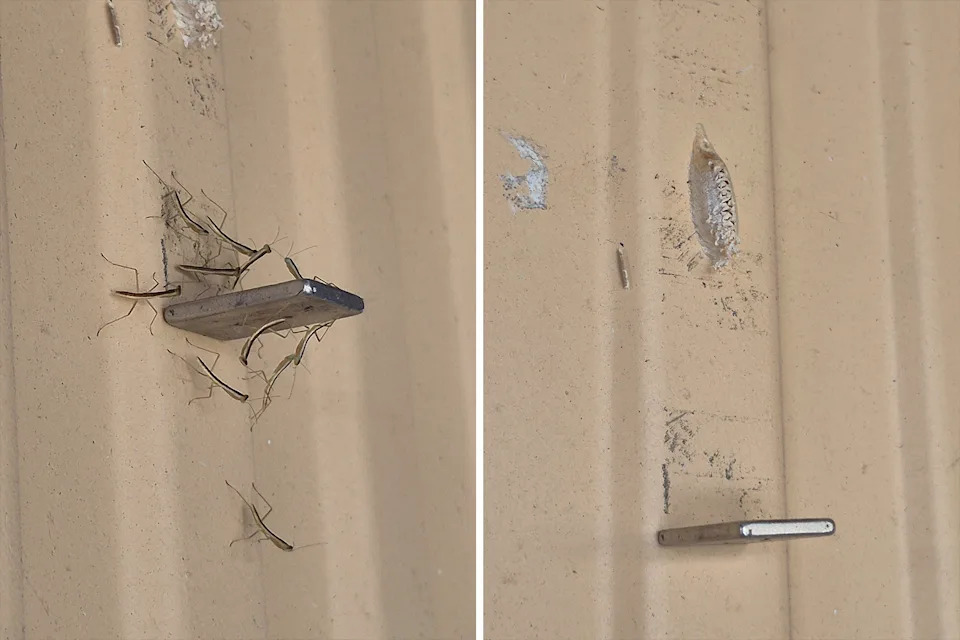
A second picture (right) taken after the insects had left shows their egg sac. Source: Kaya Rubin
Nicole Gunter, a scientist and curator of entomology, said the praying mantis nymphs would have clustered around the closest structure for protection.
“Their instinct upon hatching is to disperse away from the ootheca as they are vulnerable to predation by their siblings and other predators, and they should quickly disperse to a more suitable place to seek shelter and wait for their first meal,” she said.
Matthew Connors, an expert in praying mantises working at James Cook University, agreed that the insects were likely simply seeking shelter from predators and the elements.
“The wall where the ootheca was is quite exposed, and so they’ve likely just gone to the nearest thing that’s not a flat surface, which in this case is the magnet, because it gives them some protection from two sides,” he explained.
“Lots of different animals can sense magnetic fields, and there’s a lot that we don’t know about insects in general, so the magnet could be influencing them in some way.
“As it stands, I don’t think there’s any evidence for it here, unfortunately.”
Connors noted there’s still a lot to learn about the Northern Territory’s praying mantises, with many simply referred to by locals as garden mantises.
He identified the insects in the picture as being from the order Orthodera, which don’t yet have a common name as a group.
There are estimated to be around a dozen similar species within the family, of which only a couple have scientific names.
Love Australia’s weird and wonderful environment? 🐊🦘😳 Get our new newsletter showcasing the week’s best stories.
