
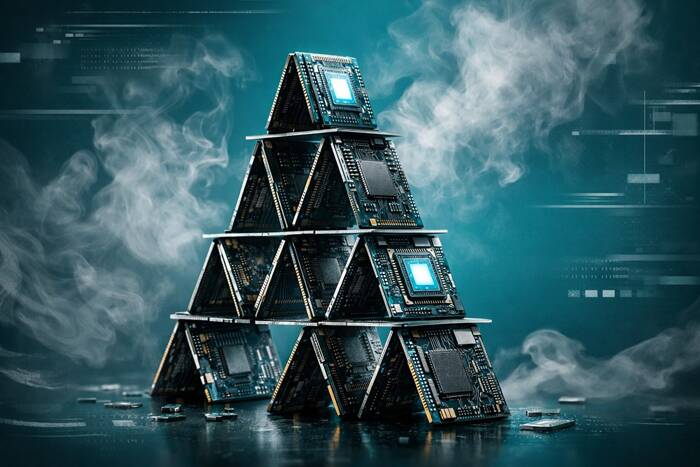
OpenAI, valued at $500 billion, expects $13 billion in revenue and a $5 billion loss in 2025. It may burn more than $140 billion before it turns profitable — more than Amazon, Tesla, and Uber’s cumulative early losses combined.
Meanwhile, enterprise adoption is far slower than the hype suggests. An MIT study found 95% of companies see zero return on their generative-AI investments despite spending $30–40 billion. Bain estimates that AI will need $2 trillion in annual revenue by 2030 just to justify current infrastructure spending — more than the combined revenues of America’s largest tech firms in 2024.
That gap between vision and actual income is the classic hallmark of a bubble.
Big Tech’s Hedge: They’ll Benefit Either Way
Despite the headline spending numbers, the giants aren’t taking as much risk as it appears.Microsoft outsources heavy lifting to OpenAI. Amazon supports any model customers want. Meta is giving away its model for free. As Harvard’s Andy Wu argues, this tells you what Big Tech really believes: core AI models might not be great standalone businesses.
The majors can afford misfires. Nvidia’s valuation has surged, but its earnings expanded even faster. The S&P tech sector trades at 30× forward earnings — high, but nowhere near dot-com extremes. Apple, once criticized for being slow on AI, now looks smart for not overspending.
Market Concentration Has Hit Rare Levels
By late 2025, five companies made up 30% of the S&P 500 and 20% of the MSCI World — the highest concentration in 50 years. U.S. equities trade far richer than global peers, with the S&P at 23× forward earnings versus 14× for the FTSE.Only Alphabet and Nvidia beat the market this year. Oracle, despite rising 14%, plunged 42% from its September high after missing revenue and lifting its AI capex forecast to $50 billion. It wiped out $80 billion in market value overnight.
AI has driven 75% of S&P returns, 80% of earnings growth, and 90% of capex growth since late 2022. The numbers reveal a market increasingly dependent on a handful of companies betting heavily on AI infrastructure.
Goldman Sachs Warns: Five Danger Signals
Goldman Sachs notes that $19 trillion in market cap is running ahead of economic impact. The bank cites five danger signals reminiscent of the 1990s: peaking investment, falling profits, rising debt, Fed cuts, and widening credit spreads.The conclusion: AI may be transformative, but investors may have already overpaid for that transformation.
What Could Actually Pop the Bubble