
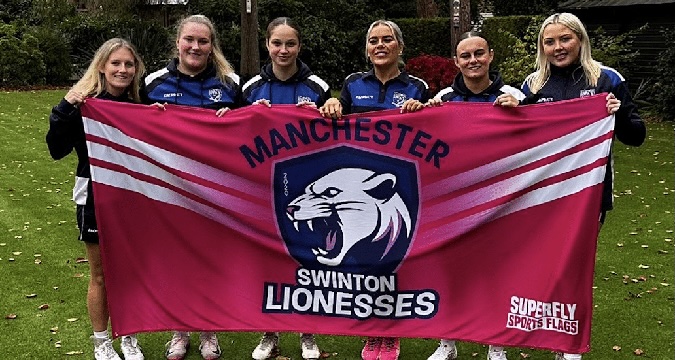
Swinton’s women’s team will be sporting a new name in 2026, having been rebranded as Manchester Swinton Lionesses, and they hope to reach a whole new audience as well as carrying their existing fans with them on the journey.
“ONE Club, One Vision”. It’s a philosophy Swinton Lions have often spoken about over the last year, and one they will still be embracing to the full, even though their women’s team will now play under a new name and wear a new badge on their chest.
Having challenged all the way in a highly competitive Championship last season – only narrowly missing out on a play-off spot on points difference over Salford – and won the Challenge Shield as Swinton Lionesses, 2026 will see the Manchester Swinton Lionesses look to go one step further and challenge for a spot in Super League.
Any rebrand always comes with as many worries as it does potential benefits, but for women’s chairman Jason Harborow, it was worth the risks, and he is hopeful that the whole club can reap the benefits.
“When I got involved with the club about 14 months ago we realised we hadn’t really maximised what we could do with our women’s side, so we set about, not professionalising, but making the team a little bit more focused and providing what we needed to give them the best chance to be successful,” said Harborow, who admitted the club took inspiration from York, who renamed their men’s and women’s teams as the Knights and the Valkyrie respectively and have enjoyed great success on both fronts since.
“So when we came towards the end of last season, there were a couple of things that we looked at. One of the things was how we can become a Super League team. We’re really committed to trying to do that, but it was a case of asking how do we attract players? How do we attract more fans? How can we become more commercially attractive to investors?
“We had a focus group at the end of last season with the players, and while they are all proud of the heritage of the club and are very committed to it, they just felt, as role models, they should have their own identity.
“So we started to look at what that could look like, and through that process, one question that kept coming up was ‘Why don’t we broaden our appeal and adopt the name Manchester?’ Over the course of, say, two months, that gained some momentum, and we took the idea to the board.
“We debated for a long time at board level on whether doing this and rebranding just one of the teams was the right thing to do because we have driven the “One Club, One Vision” idea since it was introduced last year. But you don’t have to play the same kits and the same name to have the same values within the organisation.
“We discussed it, and we’re absolutely confident that, actually, by allowing the young women to have their own identity, which they fully deserve, we’ve made the right decision.
“We still have all the same social media, we still play in the same stadium, and our home kit remains exactly the same, just with a different badge, while each team will have its own unique away shirt.
“We will still do our kit launches and everything like that together, alongside our new wheelchair team, so we’re still one club.
“We were a little worried about what the fan base would say, but so far we’ve had very little pushback from the Swinton fans and a lot of applause from other clubs.
“We look at York, and we take a lot of inspiration from what they have done with their women’s team over the last five or six years. They didn’t just build a great team under Lindsay Anfield and win two Super League titles, they were able to grow pathway programs, they were able to develop their own identity, and they were able to attract a crowd on standalone match days.
“They’re not in a traditional hotbed of rugby either, and we’ve learned from that, taken the best of what they’ve done, added some other things we’ve seen in other places, and we’ve created some of our own magic.”
But this change wasn’t done on a whim, or decided, as so many things are now, on AI-generated algorithms – it was based on what mattered to a key set of individuals – the players.
Everyone who runs out onto the pitch is proud to do so, but this major change gives those players a new sense of identity, while also remaining part of the larger club ethos.
“I started playing at Thatto Heath, and then I was captain at Widnes for a bit, before signing for Warrington, where I spent about six years,” Lionesses captain Sammi Simpson added.
“But I have never played for a team like this. Those other clubs all had male and female teams, but the females never really had their own identity.
“Even when I started at Swinton Lionesses we still had a male lion with a big mane on our shirts. Everyone knows a lioness doesn’t have a big mane, but that’s what we were playing in. But now we have our own logo, designed just for us, and that gives us our own identity within the “One Club, One Vision” idea.”
Finding a healthy equilibrium that worked for everyone was something Harborow was keen to do, and he believes the club has been successful in that.
“We’ve managed to find that nice balance for everyone,” added Harborow.
“When you look at the new Lionesses badge, we’ve still maintained a lot of the elements of the club badge. The shield remains the same, the year on there has changed from 1866 – the men’s team first year – to 2020, when the women’s team was formed. The way the lion and lioness sit in the badge is identical; it’s just one is a male, the other a female. And then we’ve added the Manchester element to the Lionesses badge.
“But for me, this is about the athletes, if they’re pleased, happy and excited, and they get the opportunity to play under a bigger banner to a bigger city population and be more successful, which is what we’re about, then it’s a good thing.”
Adding Manchester to their name instantly gave the club a wider reach and opened them up to a much wider population. With plans to take the game on the road and play home games at multiple venues across the city of Manchester, there will be more eyes than ever before on Simpson and her team-mates.
Some might think that would pile the pressure on the players, but for Simpson, it’s something they will all take in their stride.
“Now that we’ve got Manchester in our name, we just want to be the team in that city that people are talking about,” added the 28-year-old.
“There are other smaller rugby clubs in Manchester, but we want to be the biggest, most popular and well-known team around.
“Knowing that that is something we want to achieve is just going to make us play even better and make us perform the best we can in every game.
“When we came up from League One ahead of last season, I don’t think many people expected us to do much in the Championship because we’d never played there before. We came up as a bit of an unknown, but we proved everyone wrong. That pressure didn’t crumble us, so I don’t think having a bigger audience will either.”
The ultimate proof of whether the rebrand has been a success will be if crowds for the women’s game and the merchandise sales of the team’s individual apparel continue to rise, but Harborow has already seen some early benefits to the move after signing Australian Tamika Bull.
Several clubs in Super League have gone overseas to bring Australian talent in, but it is almost unheard of for a Championship side to do the same, and while Bull may not have played in the NRLW, she does have lots of experience that could prove vital to the Lionesses.
Having come up through the Newcastle Knights pathways, she most recently represented the club in the Harvey Norman NSW Women’s Premiership and has representative honours with NSW Country, Gems Country, All Stars and the Indigenous Women’s Academy. She has also represented Australia at Tag Rugby.
“I love Swinton, but even talking to girls from Wigan they sometimes don’t even know where Swinton is, so talking to a girl in Australia- there’s no chance she’ll have heard of the place,” added Harborow.
“So being able to talk to Tamika about Manchester really helped in bringing her over, and selling her the dream.”
Captaining the first Manchester Swinton Lionesses side will be an historic moment for Simpson – but it’s not the only legacy she has been involved with while at the club.
Due to her heritage through her paternal grandmother, Simpson was part of the first ever Scotland side that made their international debut against Wales in August.
After narrowly losing that game 18-12 to a late Bethan Dainton try, they regrouped and faced Jamaica in November – running out 38-12 winners.
Simpson wasn’t involved in that second match, but she has been named in the squad for their next outing – when they will play their biggest game yet against the USA Hawks as part of a weekend of action when rugby league returns to Las Vegas in March.
“Being part of the Scotland set up, and representing my family roots, is something that I’m really proud of,” added Simpson, who joined the Lionesses ahead of the 2025 season and has recently signed a new deal to remain at the club for another 12 months.
“Wales are a well-established team that have qualified for the World Cup and to play as well as we did against them, only losing it in the last couple of minutes, was amazing. There was no feeling quite like it.
“I don’t really know what level America are at, but if we can compete as well as we did against Wales, we should give them a really good game, and I honestly think we can beat them.
“Scotland have never had a female rugby league team before, and now we’re taking a team over to the USA for the first time – what a history-making thing to be part of.
“It’s such a fantastic opportunity to be a part of, and it will give us all the experience of a lifetime.
“As well as being involved with the new Manchester Swinton Lionesses, playing in Vegas is going to be up there with one of the biggest highlights of my career.
“My rugby memories are just getting better and better, and I am so grateful to be playing this sport.”
First published in Rugby League World magazine, Issue 516 (January 2026)