
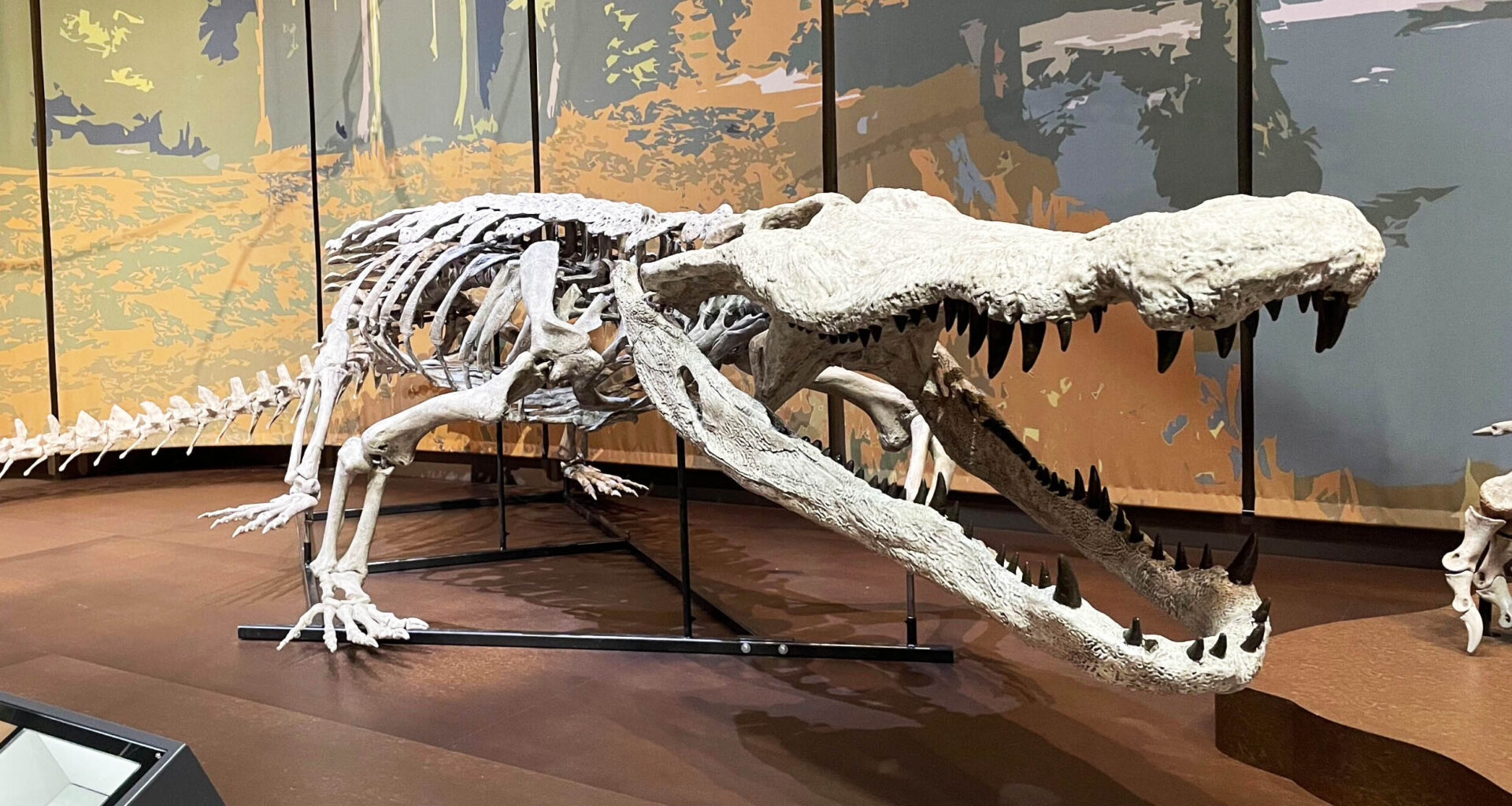
Reconstructing an ancient animal like Deinosuchus is rarely about a single, dramatic fossil. Most of the time, information comes from the slow accumulation of fragments, careful comparisons, and a willingness to revise ideas when new evidence appears.
Decades of fieldwork across North America has steadily transformed scientists’ understanding of the size, behavior, and evolutionary relationships of extinct giant crocodilians and their early relatives.

That long process now stands on display in physical form, offering a clearer view of an animal that once dominated Cretaceous waterways.
Deinosuchus as a river predator
Deinosuchus schwimmeri lived along rivers and coastal wetlands of eastern North America between 83 million and 76 million years ago.
Fossils recovered from multiple states show a massive, semi-aquatic predator that exceeded 32 feet in length. This places it among the largest crocodilians ever known.
Bite marks on dinosaur bones reveal active predation rather than scavenging, indicating control over water access points where large animals gathered.
Research summarized in a comprehensive systematic review confirms that Deinosuchus belonged to the alligatoroid lineage – not the crocodile lineage that dominates many modern tropical regions.
Skeletal traits such as heavy armor plates and robust jaws link Deinosuchus more closely to early relatives of modern alligators, even though overall body size far exceeded that of any living species .
Naming the species
For many years, scientists debated how many different species of Deinosuchus existed across North America.
Earlier studies suggested a single, widespread species, but expanded fossil sampling revealed consistent anatomical differences between eastern and western populations.
As a result, researchers formally named Deinosuchus schwimmeri in 2020 to represent eastern material previously grouped under older names.
The decision reflected detailed comparisons of skull openings, jaw proportions, and armor structure, rather than isolated features.
The “terror croc” was also named in honor of Dr. David Schwimmer, a world-renowned expert on North American crocodilians and a geology professor at Columbus State University.
Building the Deinosuchus skeleton
Creating a full-scale Deinosuchus skeleton required more than just assembling bones in dramatic poses.
High-resolution scans of fossil material allowed paleontologists to test articulation, posture, and armor placement with anatomical accuracy.
The resulting replica reflects how the animal balanced immense mass while remaining effective in water-based ambush hunting.
Dr. Schwimmer emphasized that scientific replicas contribute to research as much as to public education.
“These replicas are more than just creating a ‘scare factor.’ Understanding dinosaurs’ predatory habits helps us decode some of nature’s greatest survival strategies,” said Dr. Schwimmer.
“By studying these ancient apex predators, we are essentially looking back in time to see exactly how life adapted and dominated a changing world.”
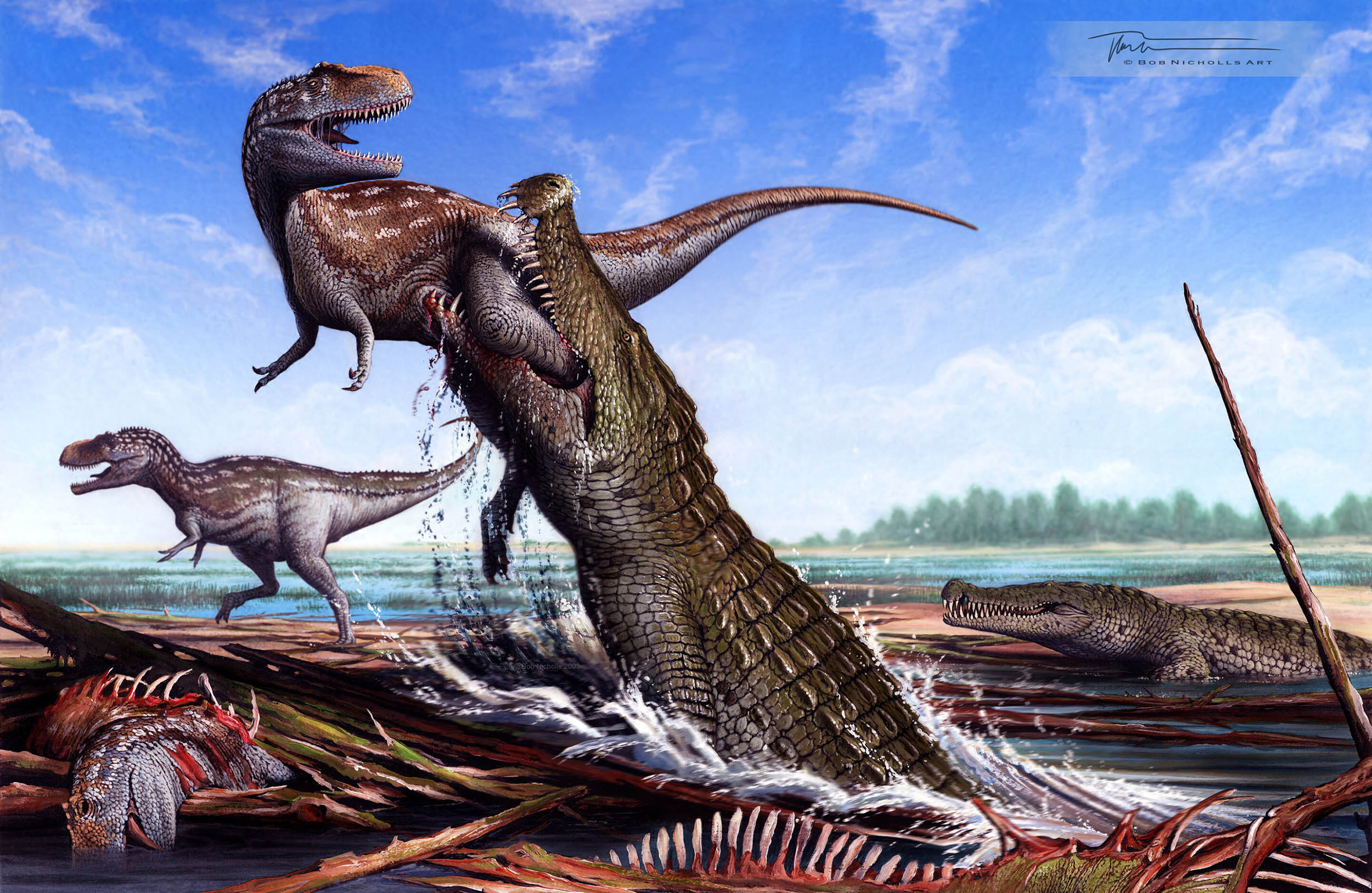 “Reaper in Paradise,” an artist’s rendering showing Deinosuchus schwimmeri emerging from the water and preying on an Appalachiosaurus. Credit: Bob Nicholls. Click image to enlarge.Learning through fossils
The mounted skeleton, now installed at the Tellus Science Museum in Cartersville, represents the only cast of Deinosuchus schwimmeri available to the public.
“Tellus is currently the only museum to have a cast of Deinosuchus schwimmeri, so this is an experience our visitors can’t get anywhere else,” said curatorial coordinator Rebecca Melsheimer.
“The scale of the dinosaurs and other creatures that lived during [the Late Cretaceous epoch] is hard to capture in words or pictures. We can tell you that Deinosuchus is 30 feet (9.1 meters) long, but seeing it is far more impactful.”
For students visiting from across Georgia and nearby states, the display connects regional geology with global evolutionary history.
“Each year, we have thousands of students visit us from across Georgia and neighboring states,” said Hannah Eisla, the museum’s director of education.
“Many of these students come on school field trips specifically to learn more about the region they call home and how it has changed over time.”
“The addition of Deinosuchus schwimmeri allows us to provide a more detailed picture of this area’s ecosystem in the Cretaceous Period.”
The story of crocodilian evolution
The systematic review of Deinosuchus reshaped ideas about early crocodilian evolution by showing that massive body size evolved early within alligatoroids, not as a late offshoot.
Fossils from both sides of the ancient inland seaway reveal how geography influenced anatomy while maintaining a shared predatory blueprint.
For Dr. Schwimmer, the replica represents closure and continuation at once. “Bones and fossils tell us only part of the story,” he said.
“Fully assembled, life size replicas become a blueprint for better understanding the dynamic animals that creatures like Deinosuchus really were.”
Standing before the completed skeleton, visitors encounter not a monster from legend – but a carefully reconstructed predator shaped by environment, evolution, and decades of scientific revision.
This article contains information from a press release by the Columbus State University.
—–
Like what you read? Subscribe to our newsletter for engaging articles, exclusive content, and the latest updates.
Check us out on EarthSnap, a free app brought to you by Eric Ralls and Earth.com.
—–