

Growth is then expected to accelerate gently, averaging a solid but not spectacular 2.1 per cent over the four years to 2028-29. That’s slightly better than what was forecast in the state budget last June.
Stronger conditions in the construction sector, underpinned by buoyant house prices, should help boost the state’s growth. New investment in data centres and renewable energy projects will also contribute. However, a recent uptick in inflation has cast a shadow over the economic outlook.
Inflation and interest rates
At the beginning of 2025 it appeared inflation was under control after a damaging spike during 2023 and 2024 which triggered a sharp rise in interest rates. To the relief of millions of home borrowers, the Reserve Bank cut rates in February, May and August.
But since then, price pressures have re-emerged. In October, the inflation rate hit 3.8 per cent – the highest in over a year and well above the Reserve Bank’s target band of 2-3 per cent.
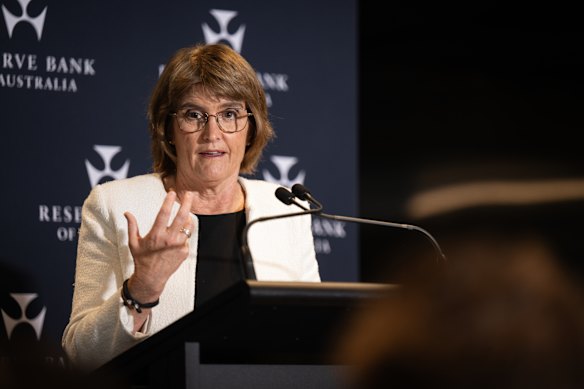
RBA governor Michele Bullock warned in December that inflation risks have tilted “to the upside”.Credit: Louie Douvis
In December, Reserve Bank governor Michele Bullock warned that inflation risks had tilted “to the upside”; she even canvassed the “possibility of a rate rise” to keep inflation in check.
A swag of private sector forecasters now expect higher interest rates in 2026. National Australia Bank has forecast the Reserve Bank to hike rates by 0.25 of a percentage point in both February and May.
That would be a financial blow to the state’s many highly indebted borrowers, especially in Sydney. It would also take a toll on consumer and business confidence.
Household income growth in NSW has been subdued for some time, and the state budget review warned that higher interest rates would “weigh on” consumer spending. Some key sectors of the NSW economy, such as housing construction, would be hampered if borrowing costs start to increase again.
Mookhey says the state government’s focus is on “making life in NSW more affordable”.
But achieving that will be far more difficult if inflationary pressures linger and interest rates rise.
Jobs and unemployment
The NSW unemployment rate has hovered about 4 per cent for most of 2025 – a little higher than the previous two years but still low by historical standards.
The government forecasts the NSW jobless rate will climb to 4.5 per cent by the middle of this year before easing back to 4.25 per cent in 2026-27. However, demand for employment could prove weaker than expected if households and businesses are hit by multiple interest rate increases in 2026.
Regional unemployment rates already vary widely, especially across Greater Sydney. In parts of the city’s west and south-west the jobless rate has been well above 5 per cent for most of 2025, according to modelled estimates by the Bureau of Statistics. Unemployment rates have been less than half that level in the city’s eastern suburbs and Sutherland district.
State finances
The NSW government will spend a record $129 billion on its core activities this financial year, about $1.4 billion more than anticipated in June.
The state’s finances were hit hard by the disruptions of the COVID-19 pandemic and are still recovering.
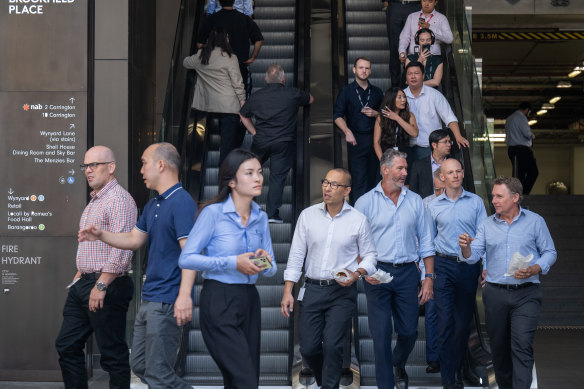
An economic rebound forecast for NSW could be hampered by inflation and higher interest rates.Credit: Louie Douvis
Last month’s budget review forecast a deficit of $3.1 billion for 2025-26, making it the seventh straight budget in the red. But that forecast was an improvement on the $3.4 billion deficit predicted in June and is shaping to be the best budget result since 2019-20.
The government has forecast a return surplus in 2027-28, but the budget papers warn uncertainty about the state’s financial outlook “remains elevated”.
NSW government debt has risen steadily since the pandemic, driven in large part by borrowings for infrastructure construction. Gross state debt is forecast to reach a record $177 billion by next June and climb to $198 billion by mid-2029.
Even so, NSW’s gross debt as a share of economic output – now about 20 per cent – will be the second lowest among the states and territories over the next four years. Western Australia has the lowest share at just over 5 per cent.
Start the day with a summary of the day’s most important and interesting stories, analysis and insights. Sign up for our Morning Edition newsletter.