
Karishma Vaswani
January 1, 2026 — 2:00amSave
You have reached your maximum number of saved items.
Remove items from your saved list to add more.
Save this article for later
Add articles to your saved list and come back to them anytime.
Got it
This is the season when columnists turn to prophecy, and then congratulate themselves a year later for getting some of it right.
I’m afraid I’m about to join the club.
As I predicted at the end of last year, Asia in 2025 revolved around three main forces: the blossoming bromance between US President Donald Trump and China’s Xi Jinping, rising pressure on Taiwan, and a newly emboldened Kim Jong Un drawing closer to both Moscow and Beijing.
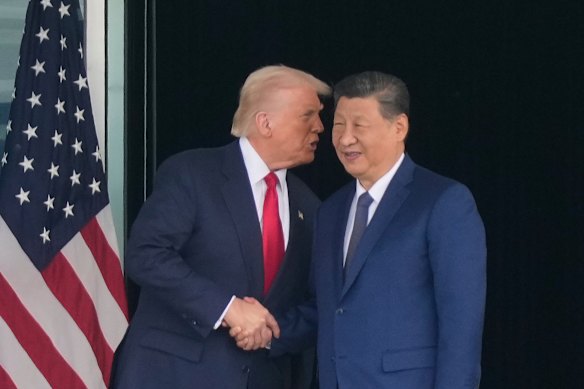 It’s not going to last: US President Donald Trump with Chinese President Xi Jinping.AP
These dynamics will only get more obvious in 2026. The region is heading into an increasingly precarious year, with deepening tensions that will have a cascading effect on all of us.
The Trump-Xi bromance could go sour
On the surface, Trump and Xi appear to have found a new warmth — but it’s fragile. Xi was the winner of the trade war in 2025, which means Trump is going into this next year on the back foot. That won’t be lost on Washington, no matter how loud the bluster. While the rapprochement has been welcomed by markets, a lot could go wrong. The leaders will have the opportunity to meet as many as four times in 2026, providing multiple occasions for relations to head south.
And even if they don’t, they’ll likely remain tense, according to a 2026 forecast for United States-China relations from the Berlin-based Mercator Institute for China Studies. Almost three-quarters of respondents, comprising China experts and observers, see relations deteriorating across the board, from military and trade ties to technology. That’s despite Trump’s most recent decision to allow Nvidia to sell advanced chips to China, watering down years of national security safeguards. Washington says Nvidia’s top products will still be restricted, but the move gives Beijing access to semiconductors at least a generation ahead of its best technology.
Another front to watch: China-Japan relations
Tokyo has become more vocal about the link between its own security and stability in the Taiwan Strait, a position Beijing views as provocative. The Chinese leader will see how much he can push Trump on Taiwan, the self-governed democratic island Beijing claims as its own. That will make Taipei more vulnerable.
Taiwan will feel the heat even more
Taiwan’s President Lai Ching-te has his work cut out. He’ll need to navigate a politically gridlocked legislature while trying to pass a $US40 billion ($60 billion) supplementary defence budget aimed at modernising the military and strengthening deterrence to defend against the rising threat from China. The island has already pledged to lift defence spending to 5 per cent of gross domestic product by 2030, up from over 3 per cent. But more money alone may not be enough.
Related Article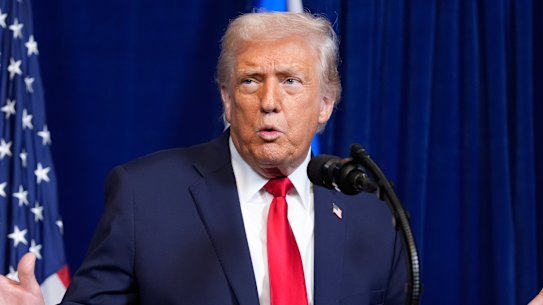
US intelligence sources believe that Xi wants the People’s Liberation Army to be capable of an invasion by 2027. However, many military strategists suggest a full-scale invasion then is unlikely, as China’s economy grapples with a slowdown and the People’s Liberation Army reels from corruption probes and purges. They point to quarantine or blockade scenarios instead.
Beijing, which has vowed to take control of Taiwan through peaceful means but has refused to rule out doing so by using force, has ramped up military and political pressure in recent years to assert its claims. The People’s Liberation Army conducted a second day of live-fire military drills to Taiwan’s north on Tuesday, while China’s gray-zone tactics — warplanes crossing the median line, naval patrols circling the island, cyber and information warfare — are now near-daily events. These will almost certainly continue in 2026.
Kim Jong Un is getting more confident
North Korea is among the most serious risks on Asia’s security landscape. A 2025 briefing from the US Defense Intelligence Agency notes that Pyongyang has now developed an intercontinental ballistic missile capable of reaching the US mainland.
Related Article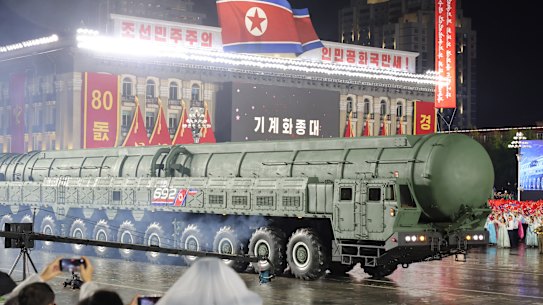
Kim has repeatedly rejected denuclearisation negotiations since the most recent talks in 2019 with Trump broke down. The North Korean leader views nuclear weapons as a guarantor of his security and has no intention of renouncing them. He’s also being emboldened by his deepening ties with Russia and steady support from China, which is changing the calculus on the peninsula.
South Korean officials have hinted at the chance of a summit with the North in 2026, something unimaginable over a year ago. This gives Kim the leverage he’s been looking for to potentially get sanctions relief, or extract tacit approval from the US that denuclearisation has been a failure and that he can go ahead and continue with his nuclear weapons program. Expect more missile launches, diplomatic theatre and other attempts to hijack the geopolitical agenda.
Asia in 2026 is not on the brink of war. But the region will be more volatile than it has been in recent memory. Buckle up.
Karishma Vaswani is a Bloomberg Opinion columnist covering Asia politics with a special focus on China. Previously, she was the BBC’s lead Asia presenter and worked for the BBC across Asia and South Asia for two decades.
Bloomberg
Save
You have reached your maximum number of saved items.
Remove items from your saved list to add more.
Most Viewed in BusinessFrom our partners