
Hallie Gu and Ilena Peng
January 1, 2026 — 7:30am
Save
You have reached your maximum number of saved items.
Remove items from your saved list to add more.
Save this article for later
Add articles to your saved list and come back to them anytime.
Got it
China has placed quotas on beef imports as it seeks to protect domestic farmers and producers, dealing a blow to Australia and other major shippers including Brazil and Argentina.
Shipments exceeding the limits will be subject to a 55 per cent duty, after authorities determined that rising imports had harmed China’s own industry. The series of quotas will be in effect from January 1, the Ministry of Commerce said on Wednesday.
The trade measures, which follow an investigation launched in December 2024, are likely to restrict flows of beef into the world’s top importer, and could hurt producers and cattle farmers elsewhere. China brought in 2.6 million tonnes of beef in November this year, customs data shows.
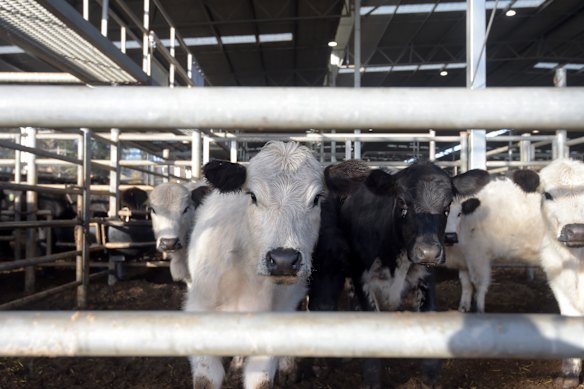 The new Chinese import quotas are a blow to Australian beef exporters.Bloomberg
The Australian Meat Industry Council said it was “extremely disappointed” and warned the measures could slash its beef exports to China by about a third from recent levels, hitting trade worth more than $1 billion.
“This decision will have a severe impact on trade flows to China over the duration of the measures’ enforcement,” said chief executive officer Tim Ryan. “Imports of Australian beef are not a cause of damage to the domestic beef industry in China.”
The move may be good news for consumers outside of China, however, boosting supplies and potentially easing prices that have surged to record highs amid strong demand and limited supply.
‘This decision will have a severe impact on trade flows to China over the duration of the measures’ enforcement.’
Tim Ryan, Australian Meat Industry Council chief executive officer
The United States, the world’s largest market for the red meat, has struggled to match shrinking herds with resilient consumption. President Donald Trump has moved to cut tariffs on beef, along with other pricey grocery items, to appease voters increasingly disgruntled over high living costs.
The total quotas for all beef imports are set to rise incrementally each year, from 2.69 million tonnes in 2026 to 2.74 million tonnes in 2027, and 2.8 million tonnes in 2028.
Brazil is also among the hardest-hit countries, as China accounts for nearly half of its beef exports.
Related Article
The South American nation could lose up to $US3 billion ($4.5 billion) in revenue in 2026 as a result of the new policy, the country’s Association of Refrigerated Meat Packers said. It could also discourage ranchers from expanding production, just as they had been about to start the years-long process of rebuilding herds.
Brazil has been allocated just over 1 million tonnes a year, less than the 1.7 million tonnes the country shipped in 2025, according to the Brazilian Association of Meat Exporting Industries and the Brazilian Confederation of Agriculture and Livestock.
“Adjustments will be required throughout the entire chain, from production to exports, in order to avoid broader impacts,” the industry groups said.
Brazil Agriculture Minister Carlos Favaro said the country was entering discussions with China this month to discuss what counted towards the quota, and to see if countries that didn’t fully use their quotas could transfer those quantities to Brazil.
Suppliers may try to front-load shipments earlier in the year to avoid reaching the new thresholds, according to Altin Kalo, the chief economist at Steiner Consulting Group. “It will also provide buyers in other countries more leverage; no longer can suppliers rely on China to absorb ever-increasing supplies,” he said.
Related Article
The impact on the US will less severe, at least for now. Quotas for the US are set at 164,000 tonnes in 2026, rising to 168,000 tonnes in 2027 and 171,000 tonnes in 2028. That’s well above current trade flows as shipments have constricted after China earlier this year did not renew export registrations for US beef plants.
The market is hard to replace, while the absence of Chinese buyers reduces competition and lowers the value of sales to other Asian markets, says Joe Schuele, the US Meat Export Federation’s senior vice president of communications.
“Our main priority is to get the market fully reopened,” Schuele said. “Once we are back into the market, the safeguard is certainly a concern, but we don’t see an immediate impact on export volumes.”
China’s beef imports have surged in recent years, along with rising incomes, but domestic production has also climbed as the government urged farmers to raise more cattle at home. Plentiful supply is now straining the local industry as consumers cut back, leaving freezers full. Wholesale beef prices fell to the lowest since 2019 earlier this year.
The measures could also broadly protect the Chinese pork industry, which had declined as consumers were “eating too much foreign beef and not enough domestic pork”, said Brian Earnest, the lead animal protein economist at CoBank ACB.
Bloomberg
Save
You have reached your maximum number of saved items.
Remove items from your saved list to add more.
Most Viewed in BusinessFrom our partners