
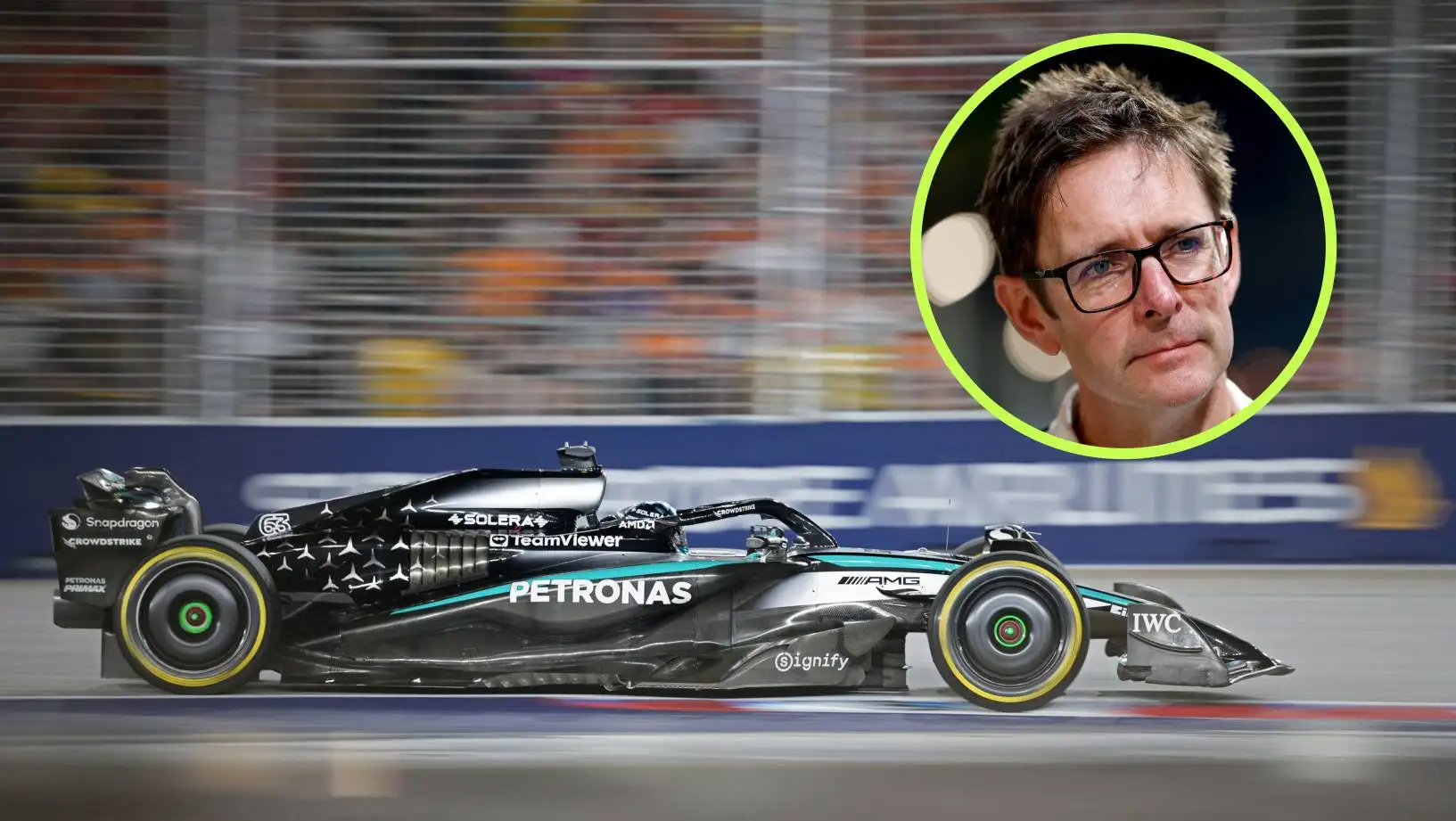
A combination of factors, including a later-removed suspension update, led Mercedes into a tricky European leg of the F1 2025 season.
Introducing a suspension update to the W16 at Imola, the expected performance improvement didn’t arrive, and, after a tricky run of races, Mercedes put the update “in the bin” after the Hungarian Grand Prix.
Andrew Shovlin explains rear suspension upgrade logic
Want more PlanetF1.com coverage? Add us as a preferred source on Google to your favourites list for news you can trust.
Over the first six races of the F1 2025 season, the Mercedes W16 proved competitive and versatile in the hands of George Russell and Kimi Antonelli, with regular strong points finishes and occasional podium finishes.
But, during the second quarter of the season after F1 returned to Europe, this form ebbed away, with the team becoming aware that some element of its upgrade route had brought the car down an incorrect development path.
This was pinpointed as being down to the rear suspension upgrade introduced at Imola, and, following a reversion back to the pre-Imola specification, the removal of the newer specification yielded immediate results as Russell returned to the podium.
The path to finding the problem hadn’t been entirely straightforward. Mercedes had taken a 1-3 finish in Montreal in June, muddying the waters somewhat as the Brackley-based squad attempted to figure out what it was that was sapping the confidence of the drivers.
Looking back over the F1 2025 season as a whole, Mercedes’ head of trackside engineering, Andrew Shovlin, explained the logic behind the rear suspension upgrade as the team explored ways to improve the performance of the W16.
“With the last couple of years, we were struggling to get the car to turn effectively in the slow corners,” he told select media, including PlanetF1.com, at the Abu Dhabi Grand Prix.
“I think some of our issues with rear tyre temperatures were actually coming from the fact that the drivers were having to use the throttle to help that.
“There was then quite a useful seam of development we got into on allowing the front wing to bend, and that then helped you in the low speed, and you have a stable rear in the high-speed, which was quite good.
“But the FIA, obviously, brought in regulations this year that have limited that quite significantly. It took us a bit of time to readapt after those rules came in in Barcelona.
“To be honest, when you’re not the quickest car, you look at who is, and you look at what’s on their car.
“We could look at the McLaren rear suspension, and you could see what they were trying to do with the anti-lift on that, and to try and maximise the extent to which you can hold the rear low into a corner.
“One of the challenges with these cars is that you end up with a really narrow window for rear downforce. You get a very narrow window for rear downforce, so you have to run the thing stiff.
“When you get a circuit with a range of very low, very fast corners, somewhere, you’ve got to compromise it. The other problem is, as you slow them down, you don’t get a natural balance shift that we used to in the previous regs, because the car doesn’t move a lot.
“So you don’t get this sort of benefit where it won’t just pick up front downforce as the rear lifts.
“The big change that we introduced for Imola, which we went back on, was obviously an attempt to go even further down that route.
“But we then introduced other characteristics that were quite bad. We lost a bit of stiffness in the suspension that was more penalising than we had expected it to be, and that caused us to then backtrack and more or less go back to where we were at the start of the year.
“So that was one of the major issues with it. I think, in a way, it was good that we did that as an update, because if we had baked it into the launch car… had we seen what we wanted to do earlier, we could have possibly launched with that.
“If you launch with something, it’s a far harder challenge to unpick it. Then, if you introduce it mid-season and you suddenly see that the car is not handling the same way and the results aren’t coming in the same way, it’s quite easy to spot that you need to revert.
“But we were able to make some improvements for launch, but, in a way, it was a blessing that we hadn’t introduced the Imola suspension for winter testing.”
Another element that was confusing Mercedes’ attempts to figure out where it had gone wrong was that, at the Spanish Grand Prix, the FIA had introduced more stringent flexibility tests for the front wings.
This led to several teams having to make their front wings less flexible in order to meet the new requirements, and, as Shovlin explained, this had a fundamental effect on the balance of the cars.
“I think it affected everyone. The issue that we had was just you end up with too much front-end in the high-speed,” he said.
“These regulations don’t organically create a nice balance around the lap. You sort of had to try and force that, and all teams are going down the route of bending the front wing.
“The FIA then limited it, and then you’re left with a reduction in your tools to do it.
“Now, you can try and achieve that mechanically as well by effectively softening the rear axle as the car goes faster, or softening it in roll, which then gives you an understeer balance.
“But your tools are quite limited, and it also takes a bit of time. Even the drivers are adapting to that different balance. The engineers are working out how to set up around it, and in and around the same time, we had the updated suspension coming on and off the car.
“We had that wing, we were also getting reasonably adventurous with setups on just exploring how extreme we could go, and the combination of the three just led to quite a confusing European season.”
More on Mercedes in F1
Who is Bradley Lord? Meet Toto Wolff’s trusted Mercedes lieutenant
The eye-opening record Mercedes aims to reset as major female driver claim made
Aside from a spell in mid-2024, Mercedes never looked as though its car was the outright quickest at any point during the four years of the ground-effect regulations, and Shovlin admitted that the team had started the regulation cycle somewhat on the back foot.
“There was quite a lot to really reposition, I think, coming into these regs,” he said.
“We wouldn’t say we underestimated the challenge of getting a nice sort of through-corner balance, where you have stability on the way in, power to turn the car at the apex, and then good rear-end on traction.
“But we clearly didn’t put enough effort into making sure that we kept the goodness of the 2020/’21 cars, and brought it in on these.
“You look at it now, and we’re all doing this more or less the same speed through all the corners. I think the difference is in how well-suited your balance is to the circuit, one of the things that’s just setting the teams apart right now.”
Read Next: Christian Horner ‘went through fire for me’ as Verstappen opens up on Red Bull sack